



pPB_Cdc42-TomKat-sensor-CAAX
(Plasmid
#172473)
-
PurposePiggybac vector for mammalian expression of TomKat (tdTomato-tdKatushka) FRET sensor for Cdc42 activity anchored to the membrane with the polybasic and CAAX motif from Kras.
-
Depositing Lab
-
Depositing OrganizationUniversity of California, Davis
Located in the United States of America -
Citations
-
Sequence Information


Ordering
| Item | Catalog # | Description | Quantity | Price (USD) | |
|---|---|---|---|---|---|
| Plasmid | 172473 | Standard format: Plasmid sent in bacteria as agar stab | 1 | $94 | |
| DNA | 172473-D50 | 50 μg of DNA in Tris buffer | $495 | ||
| DNA | 172473-D100 | 100 μg of DNA in Tris buffer | $585 | ||
Backbone
-
Vector backbonepPB
- Backbone size w/o insert (bp) 6785
- Total vector size (bp) 10943
-
Vector typeMammalian Expression ; Piggybac transposon
-
Selectable markersBlasticidin
Growth in Bacteria
-
Bacterial Resistance(s)Ampicillin, 100 μg/mL
-
Growth Temperature30°C
-
Growth Strain(s)NEB Stable
-
Copy numberUnknown
Gene/Insert
-
Gene/Insert nametdKatushka2-PBD(Pak1)-EVlinker-Cdc42-tdTomato-CAAX
-
Alt nameCdc42 TomKat sensor
-
SpeciesSynthetic
-
Insert Size (bp)4158
- Promoter CAG
-
Tags
/ Fusion Proteins
- polybasic and CAAX motif from Kras (C terminal on insert)
- tdTomato
- tdKatushka2
Cloning Information
- Cloning method Gibson Cloning
- 5′ sequencing primer cttctggcgtgtgaccg
- 3′ sequencing primer CCTCACATTGCCAAAAGACG
- (Common Sequencing Primers)
Resource Information
-
A portion of this plasmid was derived from a plasmid made byThis sensor is a modified version of a sensor originally developed by Michiyuki Matsuda's lab.
Terms and Licenses
-
Academic/Nonprofit Terms
-
Industry Terms
- Not Available to Industry
Trademarks:
- Zeocin® is an InvivoGen trademark.
Depositor Comments
This sensor is based on the design of the Matsuda lab (https://www.ncbi.nlm.nih.gov/pubmed/21976697) but modified to use tdTomato as the FRET donor and tdKatushka as the FRET acceptor. The tdKatushka2 was originally cloned by Michael Davidson's lab (Addgene plasmid #56049).
DNA (Catalog # 172473-D50)
Purpose
Ready-to-use, high-purity DNA prep. DNA aliquots are suitable for use in mammalian cell transfections and other molecular biology applications.
Delivery
- Amount 50 μg
- Concentration 1 μg/μL
- Pricing $495 USD
- Storage 4 ℃ (short-term) or -20 ℃ (long-term)
Terms and Licenses
-
Academic/Nonprofit Terms
-
Industry Terms
- Not Available to Industry
Quality Control
Every DNA prep is verified by next-generation sequencing, confirming plasmid identity, sequence integrity, and absence of DNA contaminants. Concentration is confirmed to be within ±2.5% of the stated concentration.
Our production process has been validated to consistently yield endotoxin levels below 1.0 EU/μg. Individual lots are not tested for endotoxin.
DNA (Catalog # 172473-D100)
Purpose
Ready-to-use, high-purity DNA prep. DNA aliquots are suitable for use in mammalian cell transfections and other molecular biology applications.
Delivery
- Amount 100 μg
- Concentration 1 μg/μL
- Pricing $585 USD
- Storage 4 ℃ (short-term) or -20 ℃ (long-term)
Terms and Licenses
-
Academic/Nonprofit Terms
-
Industry Terms
- Not Available to Industry
Quality Control
Every DNA prep is verified by next-generation sequencing, confirming plasmid identity, sequence integrity, and absence of DNA contaminants. Concentration is confirmed to be within ±2.5% of the stated concentration.
Our production process has been validated to consistently yield endotoxin levels below 1.0 EU/μg. Individual lots are not tested for endotoxin.
These plasmids were created by your colleagues. Please acknowledge the Principal Investigator, cite the article in which the plasmids were described, and include Addgene in the Materials and Methods of your future publications.
-
For your Materials & Methods section:
pPB_Cdc42-TomKat-sensor-CAAX was a gift from Sean R Collins (Addgene plasmid # 172473 ; http://n2t.net/addgene:172473 ; RRID:Addgene_172473) -
For your References section:
Optogenetic control of receptors reveals distinct roles for actin- and Cdc42-dependent negative signals in chemotactic signal processing. Bell GRR, Rincon E, Akdogan E, Collins SR. Nat Commun. 2021 Nov 16;12(1):6148. doi: 10.1038/s41467-021-26371-z. 10.1038/s41467-021-26371-z PubMed 34785668
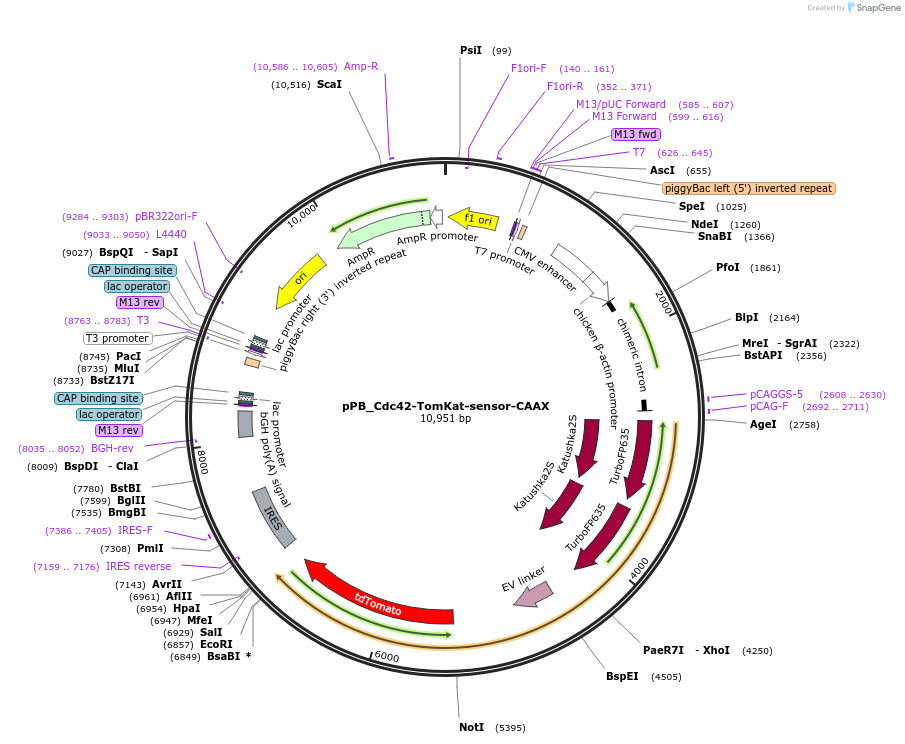
Map uploaded by the depositor.
