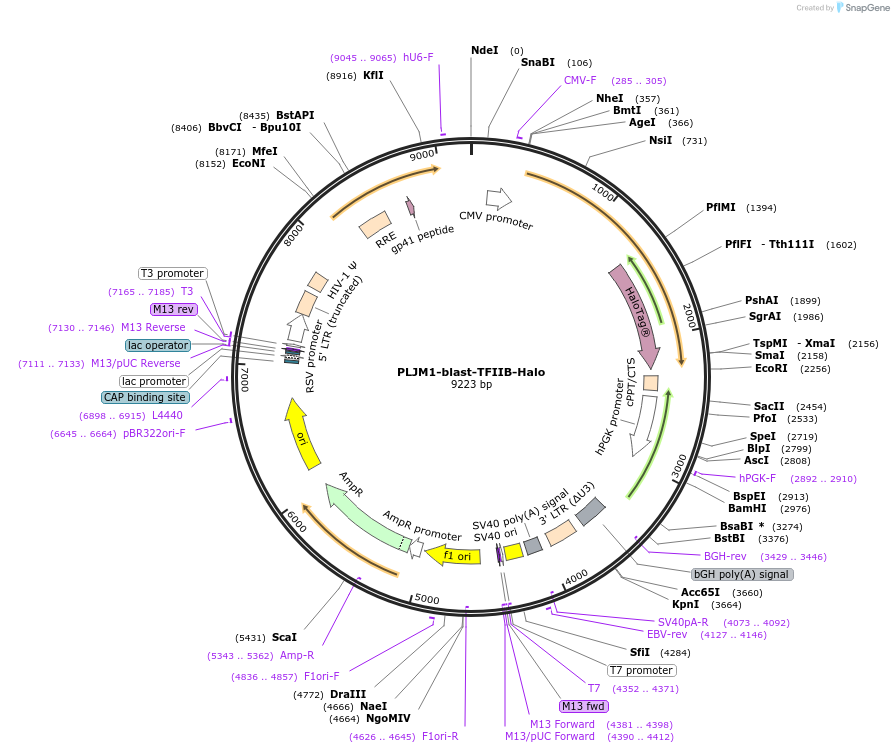
PLJM1-blast-TFIIB-Halo
(Plasmid
#213924)
-
PurposeLentivector for expression of TFIIB followed by flexible linker and C-terminal HaloTag
-
Depositing Lab
-
Depositing OrganizationUniversity of California, Berkeley
Located in the United States of America -
Sequence Information
Ordering
This material is available to academics and nonprofits only.
| Item | Catalog # | Description | Quantity | Price (USD) | |
|---|---|---|---|---|---|
| Plasmid | 213924 | Standard format: Plasmid sent in bacteria as agar stab | 1 | $94 | |
Backbone
-
Vector backbonepLJM1 modified to remove GFP and replace puromycin resistance with blasticidin resistance
-
Backbone manufacturerAddgene #19319 without GFP and with blasticidin resistance replacing puromycin resistance
-
Vector typeMammalian Expression, Lentiviral
-
Selectable markersBlasticidin
Growth in Bacteria
-
Bacterial Resistance(s)Ampicillin, 100 μg/mL
-
Growth Temperature30°C
-
Growth Strain(s)NEB Stable
-
Copy numberHigh Copy
Gene/Insert
-
Gene/Insert nameTFIIB-Halo
-
Alt nameGTF2B-Halo
-
SpeciesH. sapiens (human)
-
Insert Size (bp)1866
-
MutationCoding region changed for resistance to Dharmacon Accell and OnTarget GTF2B siRNA pools
-
Entrez GeneGTF2B (a.k.a. TF2B, TFIIB)
- Promoter CMV/hPGK
Cloning Information
- Cloning method Ligation Independent Cloning
- 5′ sequencing primer CGCAAATGGGCGGTAGGCGTG
- 3′ sequencing primer ggatctctgctgtccctgtaataaacc
- (Common Sequencing Primers)
Resource Information
Terms and Licenses
-
Academic/Nonprofit Terms
-
Industry Terms
- Not Available to Industry
Trademarks:
- Zeocin® is an InvivoGen trademark.
Depositor Comments
Please visit https://doi.org/10.1101/2024.01.16.575933 for bioRxiv preprint.
How to cite this plasmid
( Back to top)
These plasmids were created by your colleagues. Please acknowledge the Principal Investigator, cite the article in which the plasmids were described, and include Addgene in the Materials and Methods of your future publications.
-
For your Materials & Methods section:
PLJM1-blast-TFIIB-Halo was a gift from Britt Glaunsinger (Addgene plasmid # 213924 ; http://n2t.net/addgene:213924 ; RRID:Addgene_213924) -
For your References section:
Cleavage of the RNA polymerase II general transcription factor TFIIB tunes transcription during stress. Gulyas L, Lari A, Shah SB, Glaunsinger BA. Genes Dev. 2026 May 13. doi: 10.1101/gad.353187.125. 10.1101/gad.353187.125 PubMed 42128667