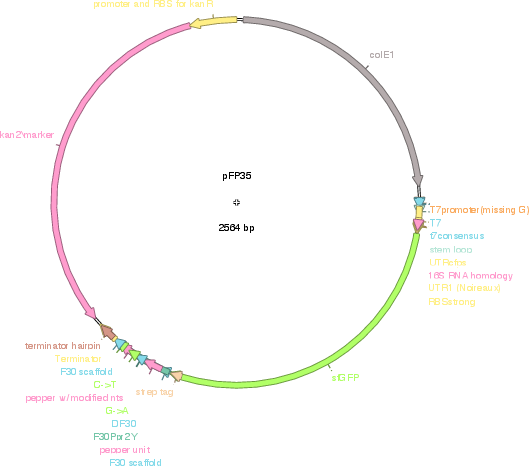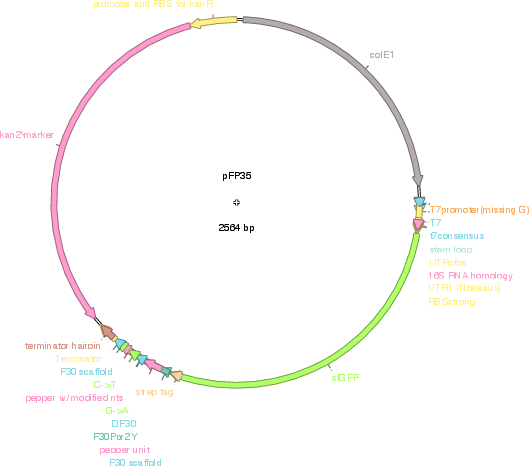



pFP35
(Plasmid
#247210)
-
PurposeExpresses superfolder GFP (sfGFP) and a Pepper RNA aptamer (DF30ppr) from a T7 promoter. Suitable for cell-free expression.
-
Depositing Lab
-
Depositing OrganizationNational Institute of Standards and Technology
Located in the United States of America -
Sequence Information

Ordering
| Item | Catalog # | Description | Quantity | Price (USD) | |
|---|---|---|---|---|---|
| Plasmid | 247210 | Standard format: Plasmid sent in bacteria as agar stab | 1 | $94 | |
Backbone
-
Vector backbonepJL1
- Total vector size (bp) 2564
-
Modifications to backboneThe Dimeric Pepper RNA aptamer (with F30 scaffold) was inserted into pJL1 downstream of the sfGFP gene.
-
Vector typeBacterial Expression, Synthetic Biology ; E. coli-based cell-free expression.
Growth in Bacteria
-
Bacterial Resistance(s)Kanamycin, 50 μg/mL
-
Growth Temperature37°C
-
Growth Strain(s)DH5alpha
-
Growth instructionsE. coli DH5alpha and DH10B are suitable for growth.
-
Copy numberHigh Copy
Gene/Insert 1
-
Gene/Insert namesuperfolder GFP
-
Alt namesfGFP
-
Alt namesfGFP-strepTag
-
Insert Size (bp)723
- Promoter T7
-
Tag
/ Fusion Protein
- Streptavidin tag (C terminal on insert)
Cloning Information for Gene/Insert 1
- Cloning method Unknown
- 5′ sequencing primer gtttcgccacctctgacttg
- (Common Sequencing Primers)
Gene/Insert 2
-
Gene/Insert nameDimeric Pepper RNA aptamer (with F30 scaffold)
-
Alt nameDF30ppr
-
Insert Size (bp)140
-
MutationTwo mutations were made to the second Pepper unit (G9A and C42T)
- Promoter T7
Cloning Information for Gene/Insert 2
- Cloning method Gibson Cloning
- 5′ sequencing primer GCTGCCGGATAATCATTATCTG
- (Common Sequencing Primers)
Resource Information
Terms and Licenses
-
Academic/Nonprofit Terms
-
Industry Terms
- Not Available to Industry
Trademarks:
- Zeocin® is an InvivoGen trademark.
Depositor Comments
The Pepper RNA aptamer was originally developed by Chen et al. (https://doi.org/10.1038/s41587-019-0249-1) and grafted onto an F30 scaffold by Mumbleau et al. (https://doi.org/10.1021/acssynbio.4c00009) To insert the aptamer into pJL1, we purchased the Pepper aptamer sequence from Integrated DNA Technologies (IDT) as part of a gBlock with two point mutations in one of the Pepper units to increase the likelihood of successful synthesis.
These plasmids were created by your colleagues. Please acknowledge the Principal Investigator, cite the article in which the plasmids were described, and include Addgene in the Materials and Methods of your future publications.
-
For your Materials & Methods section:
pFP35 was a gift from Elizabeth Strychalski (Addgene plasmid # 247210 ; http://n2t.net/addgene:247210 ; RRID:Addgene_247210) -
For your References section:
Characterizing Cell-Free Transcription and Translation Dynamics with Nucleic Acid-Based Assays. Piorino F, Sundberg C, Strychalski EA, Romantseva E. ACS Synth Biol. 2026 Jan 16;15(1):243-261. doi: 10.1021/acssynbio.5c00677. Epub 2025 Dec 24. 10.1021/acssynbio.5c00677 PubMed 41444210
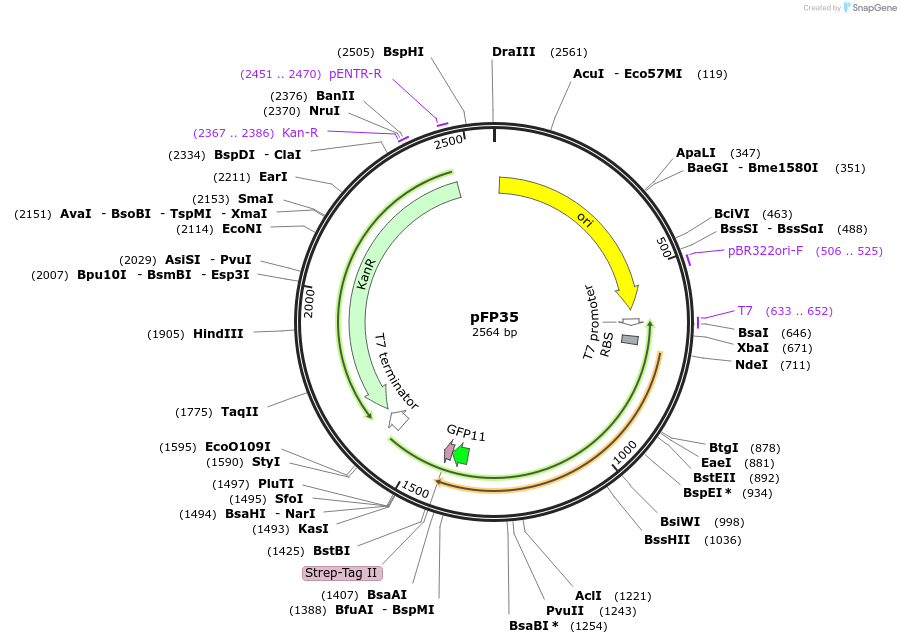
Map uploaded by the depositor.