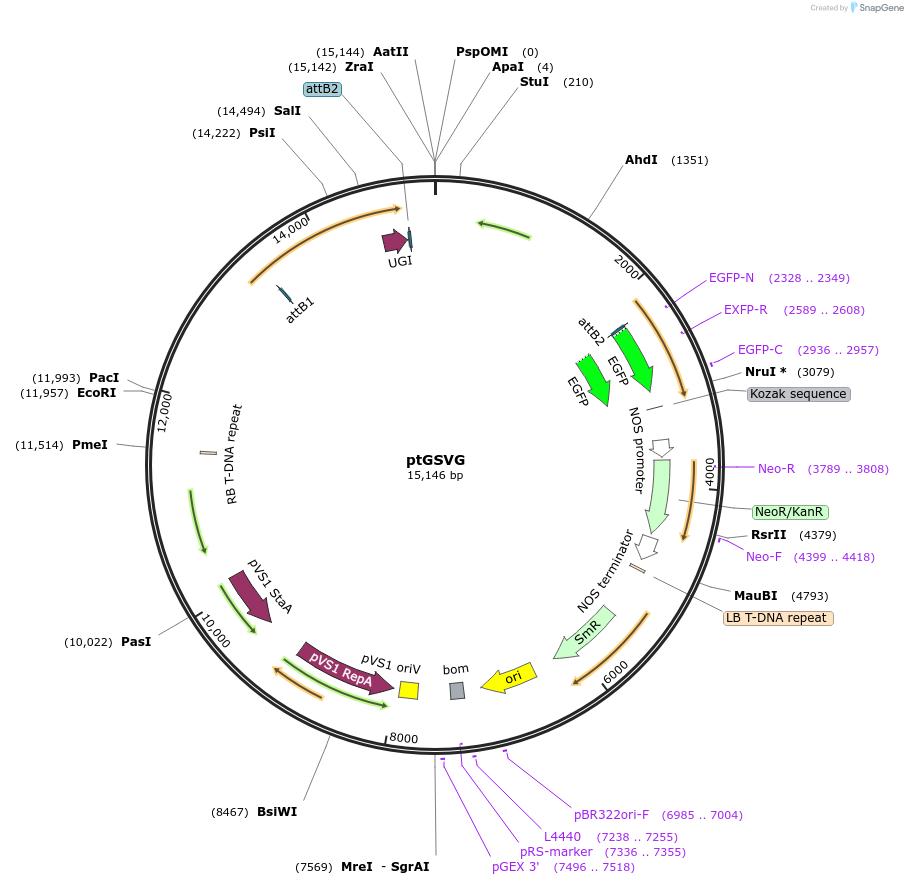
ptGSVG
(Plasmid
#248056)
-
PurposePlant organelle-genome-specific random C-to-T mutagenesis
-
Depositing Lab
-
Depositing OrganizationThe University of Tokyo
Located in Japan -
Sequence Information
Ordering
This material is available to academics and nonprofits only.
| Item | Catalog # | Description | Quantity | Price (USD) | |
|---|---|---|---|---|---|
| Plasmid | 248056 | Standard format: Plasmid sent in bacteria as agar stab | 1 | $94 | |
Backbone
-
Vector backbonepK7WG2
- Backbone size w/o insert (bp) 8151
-
Vector typePlant Expression
-
Selectable markersNeomycin (select with G418) ; Oleosin1-GFP
Growth in Bacteria
-
Bacterial Resistance(s)Spectinomycin, 50 μg/mL
-
Growth Temperature37°C
-
Growth Strain(s)DH5alpha
-
Copy numberHigh Copy
Gene/Insert
-
Gene/Insert nameArabidopsis thaliana RPS5A promoter
-
Alt namePlastid presequence of A. thaliana RecA1; A. thaliana WHY2; cytidine deaminase domain of B. cenocepacia deaminase toxin
-
Alt nameuracil glycosylase inhibitor of Bacillus phage AR9; CaMV 35S terminator; Oleosin1-GFP fusion
-
SpeciesA. thaliana (mustard weed), Synthetic
-
Insert Size (bp)6999
-
Mutation4 amino acid changes (S1326G, G1348S, A1398V, S1418G) in cytidine deaminase domain, lowers deaminase activity
Cloning Information
- Cloning method Gateway Cloning
Resource Information
Terms and Licenses
-
Academic/Nonprofit Terms
-
Industry Terms
- Not Available to Industry
Trademarks:
- Zeocin® is an InvivoGen trademark.
Depositor Comments
Please visit https://doi.org/10.1101/2025.11.01.685978 for bioRxiv preprint.
How to cite this plasmid
( Back to top)
These plasmids were created by your colleagues. Please acknowledge the Principal Investigator, cite the article in which the plasmids were described, and include Addgene in the Materials and Methods of your future publications.
-
For your Materials & Methods section:
ptGSVG was a gift from Shin-ichi Arimura (Addgene plasmid # 248056 ; http://n2t.net/addgene:248056 ; RRID:Addgene_248056) -
For your References section:
Chloroplast- and mitochondrion-specific random C-to-T mutagenesis for forward genetics of organelle genomes. Kosaka N, Harada Y, Nakazato I, Okuno M, Itoh T, Tsutsumi N, Arimura SI. Plant J. 2026 Jun;126(5):e70990. doi: 10.1111/tpj.70990. 10.1111/tpj.70990 PubMed 42290098