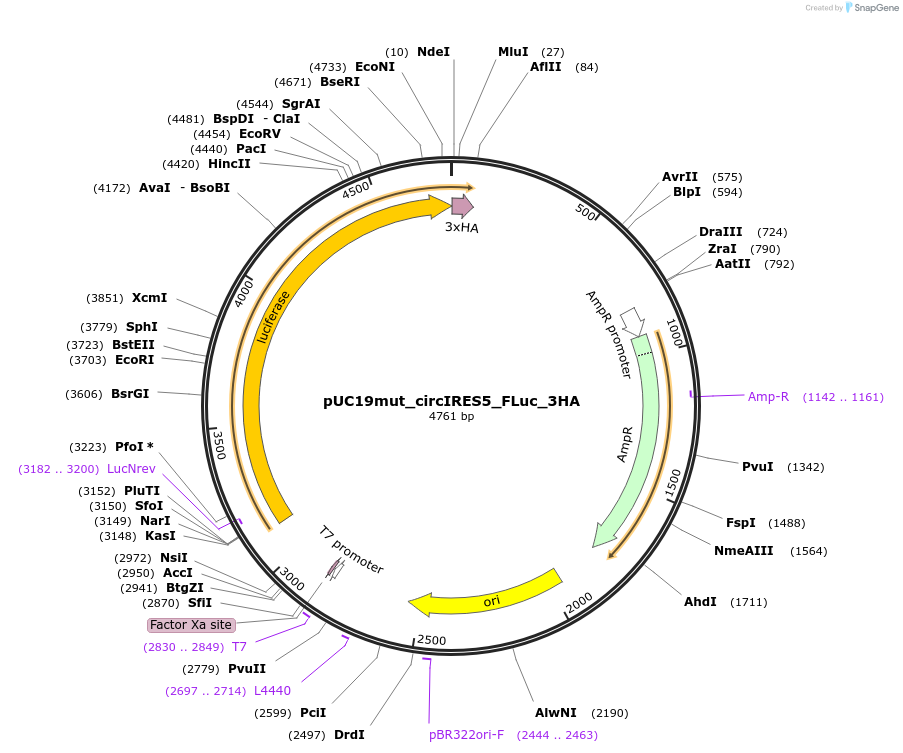
pUC19mut_circIRES5_FLuc_3HA
(Plasmid
#249688)
-
PurposeThis plasmid is designed to evaluate the translation efficiency of IRES5, an internal ribosome entry site derived from the Turnip crinkle virus (TCV).
-
Depositing Lab
-
Depositing OrganizationUniversitaet Regensburg
Located in Germany -
Sequence Information
Ordering
| Item | Catalog # | Description | Quantity | Price (USD) | |
|---|---|---|---|---|---|
| Plasmid | 249688 | Standard format: Plasmid sent in bacteria as agar stab | 1 | $94 | |
Backbone
-
Vector backbonepUC19mut
-
Backbone manufacturerSelfmade
- Backbone size w/o insert (bp) 4642
-
Vector typeBacterial Expression, Synthetic Biology
Growth in Bacteria
-
Bacterial Resistance(s)Ampicillin, 100 μg/mL
-
Growth Temperature37°C
-
Growth Strain(s)NEB Stable
-
Copy numberHigh Copy
Gene/Insert
-
Gene/Insert nameIRES of Turnip crinkle virus
-
Alt nameIRES5
-
SpeciesTurnip crinkle virus/ Betacarmovirus brassicae
-
Insert Size (bp)119
- Promoter T7 Promoter
-
Tag
/ Fusion Protein
- 3xHA (C terminal on insert)
Cloning Information
- Cloning method Golden Gate
Terms and Licenses
-
Academic/Nonprofit Terms
-
Industry Terms
- Not Available to Industry
Trademarks:
- Zeocin® is an InvivoGen trademark.
Depositor Comments
This plasmid is designed to evaluate the translation efficiency of IRES5, an internal ribosome entry site derived from the Turnip crinkle virus (TCV). The IRES is located upstream of the open reading frame for the p9 movement protein and is characterized by A-rich regions, a feature that appears to be well-conserved among IRESs in the Carmovirus genus, indicating their functional importance (May et al., 2017). The firefly luciferase (Fluc) reporter gene is positioned downstream of the IRES to enable quantitative analysis of translation efficiency through luciferase assays. A C-terminal 3xHA tag allows for the detection of Fluc expression via western blotting. This construct is primarily intended for comparative luciferase assays to assess the relative efficiency of different IRES elements in driving translation. Firefly luciferase downstream of IRES to asses translation efficiency.
These plasmids were created by your colleagues. Please acknowledge the Principal Investigator, cite the article in which the plasmids were described, and include Addgene in the Materials and Methods of your future publications.
-
For your Materials & Methods section:
pUC19mut_circIRES5_FLuc_3HA was a gift from Timo Schlemmer (Addgene plasmid # 249688 ; http://n2t.net/addgene:249688 ; RRID:Addgene_249688) -
For your References section:
A Luciferase-Based Assay for Assessing Cap-Independent Translation in Wheat Germ Extract. Cortot M, Stehlik T, Koch A, Schlemmer T. Bio Protoc. 2026 Aug 20;16(16):e5791. doi: 10.21769/BioProtoc.5791. eCollection 2026 Aug 20. 10.21769/BioProtoc.5791 PubMed 42656794