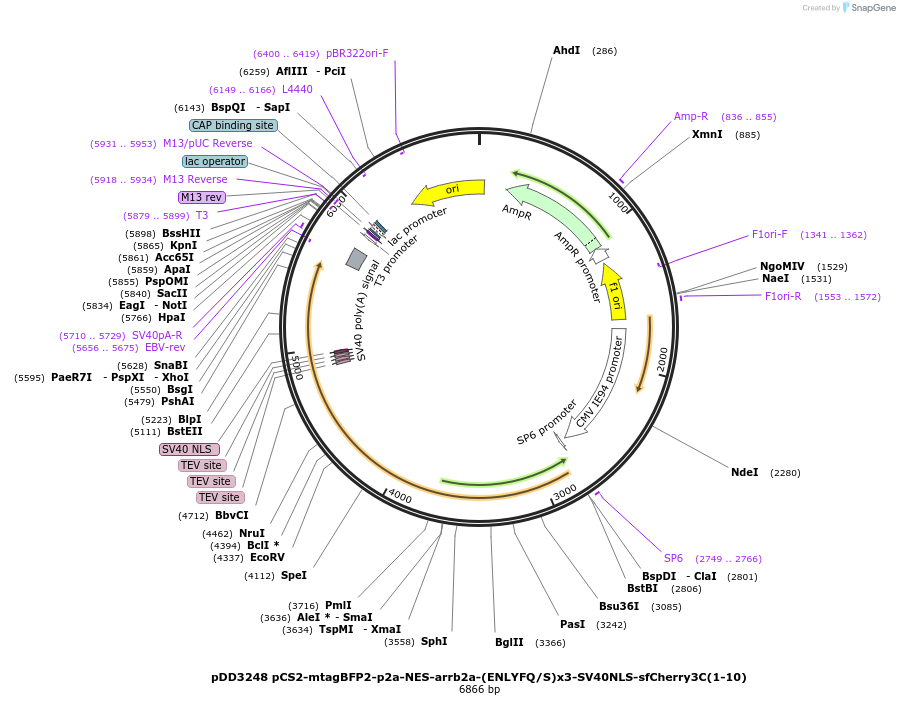
pDD3248 pCS2-mtagBFP2-p2a-NES-arrb2a-(ENLYFQ/S)x3-SV40NLS-sfCherry3C(1-10)
(Plasmid
#251770)
-
PurposeBlue fluorescent protein-tagged TEVp substrate (three-peat motif) for fluorescent protein reconstitution assay
-
Depositing Lab
-
Depositing OrganizationUniversity of Texas at Dallas
Located in United States of America -
Publication
-
Sequence Information
Ordering
This material is available to academics and nonprofits only.
| Item | Catalog # | Description | Quantity | Price (USD) | |
|---|---|---|---|---|---|
| Plasmid | 251770 | Standard format: Plasmid sent in bacteria as agar stab | 1 | $94 | |
Backbone
-
Vector backbonepCS2
-
Vector typeMammalian Expression
Growth in Bacteria
-
Bacterial Resistance(s)Ampicillin, 100 μg/mL
-
Growth Temperature37°C
-
Growth Strain(s)DH5alpha
-
Copy numberHigh Copy
Gene/Insert
-
Gene/Insert namearrestin, beta 2a
-
Alt namemTagBFP2-p2a-zebrafish arrestin, beta 2a fused to sfCherry3C large fragment
-
SpeciesD. rerio (zebrafish)
-
Entrez Genearrb2a (a.k.a. fc14e09, zeh0294, zgc:66353, hm:zeh0294, wu:fc14e09)
- Promoter CMV IE94
-
Tags
/ Fusion Proteins
- mTagBFP2-p2a-NES (N terminal on insert)
- NLS (SV40), sfCherry3C large fragment (C terminal on insert)
Cloning Information
- Cloning method Gibson Cloning
- 5′ sequencing primer TGCAggatcccatcgattc
- 3′ sequencing primer tacgactcactatagttctagaGGctcgag
- (Common Sequencing Primers)
Resource Information
Terms and Licenses
-
Academic/Nonprofit Terms
-
Industry Terms
- Not Available to Industry
Trademarks:
- Zeocin® is an InvivoGen trademark.
How to cite this plasmid
( Back to top)
These plasmids were created by your colleagues. Please acknowledge the Principal Investigator, cite the article in which the plasmids were described, and include Addgene in the Materials and Methods of your future publications.
-
For your Materials & Methods section:
pDD3248 pCS2-mtagBFP2-p2a-NES-arrb2a-(ENLYFQ/S)x3-SV40NLS-sfCherry3C(1-10) was a gift from Dave Dingal (Addgene plasmid # 251770 ; http://n2t.net/addgene:251770 ; RRID:Addgene_251770) -
For your References section:
Identification and engineering of highly functional potyviral proteases in cells using co-evolutionary models. Lim Suan MB, Ziegler C, Syed Z, Yedavalli AS, Nagineni J, Raposo R, Tunikipati A, Kaur J, Morcos F, Dingal DP. Nat Commun 17, 3257 (2026). 10.1038/s41467-026-69961-5