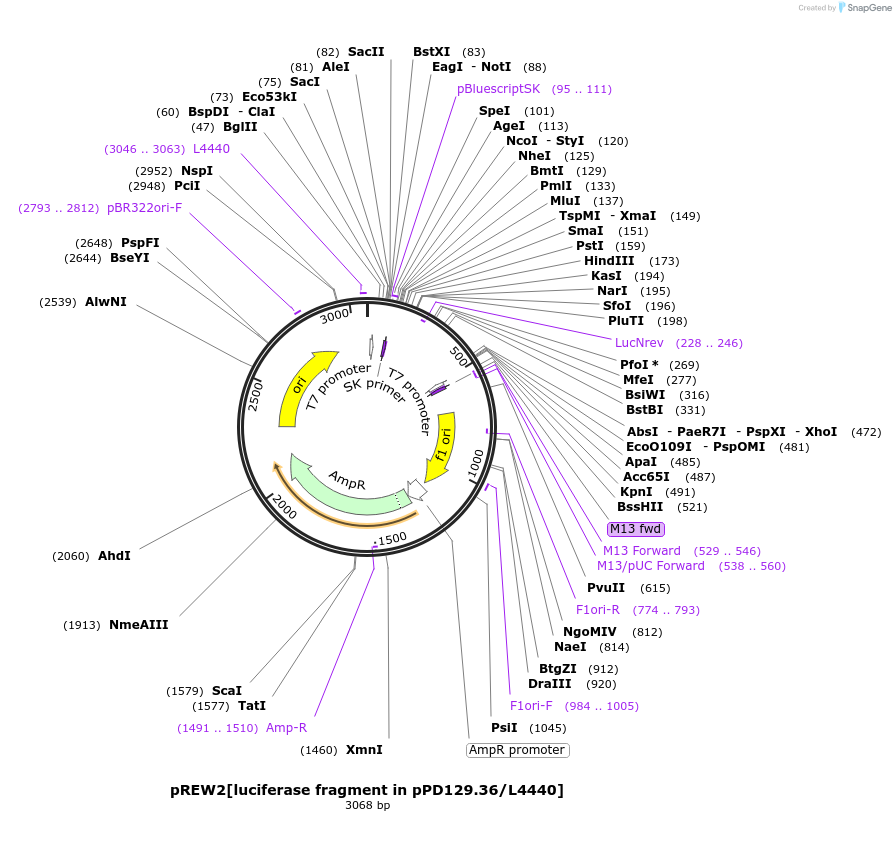
pREW2[luciferase fragment in pPD129.36/L4440]
(Plasmid
#253297)
-
PurposeIn HT115 host, expresses dsRNA corresponding to a luciferase sequence with no matches in the C. elegans genome. Excellent for negative control bacterially mediated RNAi
-
Depositing Lab
-
Depositing OrganizationTexas A&M Health Science Center
Located in the United States of America -
Sequence Information
Ordering
This material is available to academics and nonprofits only.
| Item | Catalog # | Description | Quantity | Price (USD) | |
|---|---|---|---|---|---|
| Plasmid | 253297 | Standard format: Plasmid sent in bacteria as agar stab | 1 | $94 | |
Backbone
-
Vector backbonepPD129.36
-
Backbone manufacturerAndy Fire
- Backbone size w/o insert (bp) 4346
- Total vector size (bp) 4639
-
Vector typeBacterial Expression
Growth in Bacteria
-
Bacterial Resistance(s)Ampicillin, 100 μg/mL
-
Growth Temperature37°C
-
Growth Strain(s)DH5alpha
-
Copy numberHigh Copy
Gene/Insert
-
Gene/Insert nameluciferase fragment
-
Insert Size (bp)293
- Promoter Twin T7 promoters
Cloning Information
- Cloning method Restriction Enzyme
- 5′ cloning site AAGCTT (not destroyed)
- 3′ cloning site CTCGAG (not destroyed)
- 5′ sequencing primer CGAGTCAGTGAGCGAGGAAGC
- 3′ sequencing primer GTAAAACGACGGCCAGT
- (Common Sequencing Primers)
Terms and Licenses
-
Academic/Nonprofit Terms
-
Industry Terms
- Not Available to Industry
Trademarks:
- Zeocin® is an InvivoGen trademark.
Depositor Comments
Must be used in strain HT115 or equivalent strain optimized for bacterially mediated RNAi in C. elegans.
How to cite this plasmid
( Back to top)
These plasmids were created by your colleagues. Please acknowledge the Principal Investigator, cite the article in which the plasmids were described, and include Addgene in the Materials and Methods of your future publications.
-
For your Materials & Methods section:
pREW2[luciferase fragment in pPD129.36/L4440] was a gift from David Reiner (Addgene plasmid # 253297 ; http://n2t.net/addgene:253297 ; RRID:Addgene_253297) -
For your References section:
Ral Signals through a MAP4 Kinase-p38 MAP Kinase Cascade in C. elegans Cell Fate Patterning. Shin H, Kaplan REW, Duong T, Fakieh R, Reiner DJ. Cell Rep. 2018 Sep 4;24(10):2669-2681.e5. doi: 10.1016/j.celrep.2018.08.011. 10.1016/j.celrep.2018.08.011 PubMed 30184501