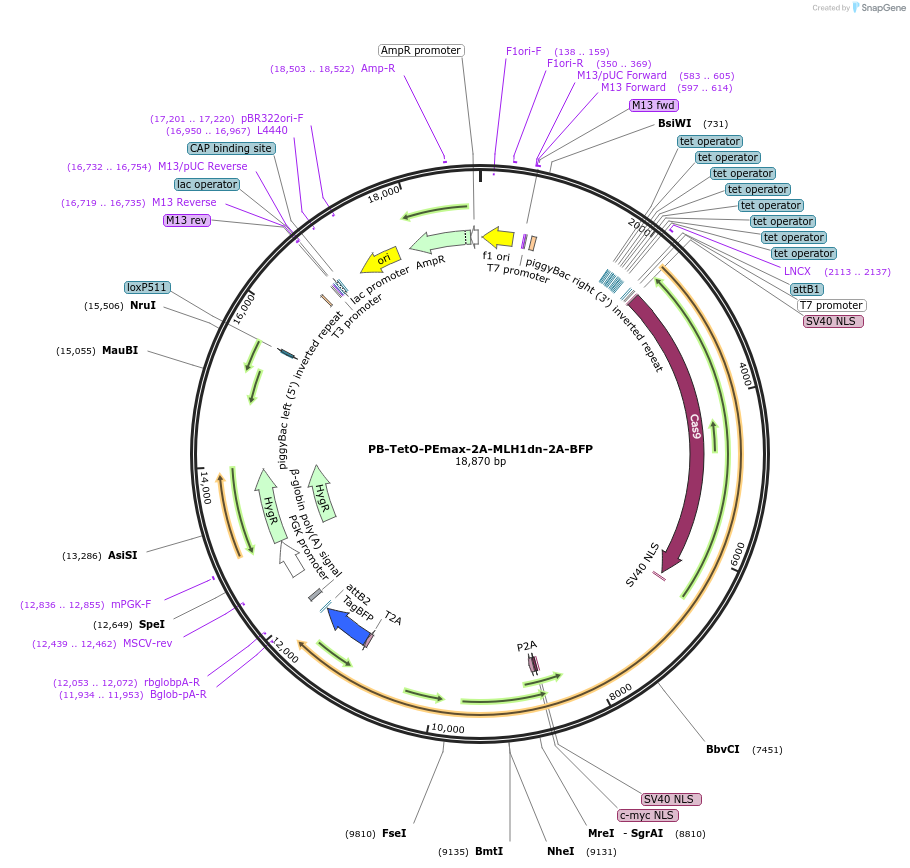
PB-TetO-PEmax-2A-MLH1dn-2A-BFP
(Plasmid
#253728)
-
PurposeThe plasmid confers dox-inducible expression of the prime editor, BFP reporter and mismatch repair inhibitor (dominant negative MLH1)
-
Depositing Lab
-
Depositing OrganizationInstitute of Cancer Research
Located in the United Kingdom of Great Britain and Northern Ireland -
Sequence Information
Ordering
This material is available to academics and nonprofits only.
| Item | Catalog # | Description | Quantity | Price (USD) | |
|---|---|---|---|---|---|
| Plasmid | 253728 | Standard format: Plasmid sent in bacteria as agar stab | 1 | $94 | |
Backbone
-
Vector backbonePB_TetO_Hygro_GW
-
Selectable markersHygromycin
Growth in Bacteria
-
Bacterial Resistance(s)Ampicillin, 100 μg/mL
-
Growth Temperature30°C
-
Growth Strain(s)NEB Stable
-
Copy numberUnknown
Gene/Insert
-
Gene/Insert namePEmax
-
Tags
/ Fusion Proteins
- BFP
- MLH1dn
Resource Information
-
A portion of this plasmid was derived from a plasmid made byThe plasmid was cloned using three inserts from the following plasmids: PEmax: https://www.addgene.org/174820/; MLH1dn: https://www.addgene.org/174827/sequences/; BFP: https://www.addgene.org/46911/. The original plasmids were purchased from Addgene. There is an Evrogen limited use label licence for the fluorescent protein:
Terms and Licenses
-
Academic/Nonprofit Terms
-
Industry Terms
- Not Available to Industry
Trademarks:
- Zeocin® is an InvivoGen trademark.
How to cite this plasmid
( Back to top)
These plasmids were created by your colleagues. Please acknowledge the Principal Investigator, cite the article in which the plasmids were described, and include Addgene in the Materials and Methods of your future publications.
-
For your Materials & Methods section:
PB-TetO-PEmax-2A-MLH1dn-2A-BFP was a gift from Alex Radzisheuskaya (Addgene plasmid # 253728 ; http://n2t.net/addgene:253728 ; RRID:Addgene_253728) -
For your References section:
Identifying critical lysines in mammalian histone H3 with high-throughput CRISPR prime editing. Price D, Zemlyanskiy G, Trakarnphornsombat W, Forne I, Volkova N, Dubusse L, Cooper AJ, Imhof A, Radzisheuskaya A. Nat Genet. 2026 Jul 8. doi: 10.1038/s41588-026-02675-y. 10.1038/s41588-026-02675-y PubMed 42420522