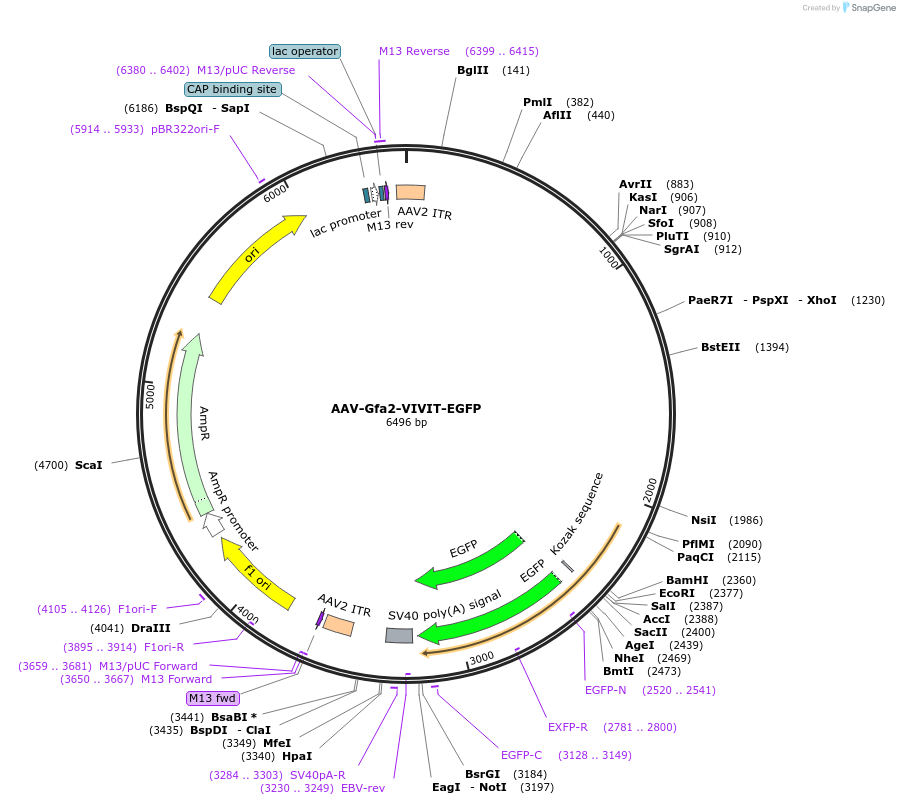
AAV-Gfa2-VIVIT-EGFP
(Plasmid
#254430)
-
PurposeFor production of AAV containing VIVT-EGFP
-
Depositing Lab
-
Depositing OrganizationUniversity of Kentucky
Located in the United States of America -
Sequence Information
Ordering
| Item | Catalog # | Description | Quantity | Price (USD) | |
|---|---|---|---|---|---|
| Plasmid | 254430 | Standard format: Plasmid sent in bacteria as agar stab | 1 | $94 | |
Backbone
-
Vector backboneAAV2 packaging
-
Vector typeAAV
Growth in Bacteria
-
Bacterial Resistance(s)Ampicillin, 100 μg/mL
-
Growth Temperature37°C
-
Growth Strain(s)NEB Stable
-
Copy numberHigh Copy
Gene/Insert
-
Gene/Insert nameVIVIT-Green Fluorescent Protein
-
Alt nameVIVIT-EGFP
-
SpeciesSynthetic
- Promoter Gfa2
Cloning Information
- Cloning method Restriction Enzyme
- 5′ cloning site Unknown (unknown if destroyed)
Resource Information
Terms and Licenses
-
Academic/Nonprofit Terms
-
Industry Terms
- Not Available to Industry
Trademarks:
- Zeocin® is an InvivoGen trademark.
Depositor Comments
The VIVIT-EGFP fusion blocks the calcineurin-NFAT interaction, blocking that pathway.
Also referenced in:
Furman JL, Sama DM, Gant JC, Beckett TL, Murphy MP, Bachstetter AD, Van Eldik LJ, Norris CM. Targeting astrocytes ameliorates neurologic changes in a mouse model of Alzheimer's disease. J Neurosci. 2012 Nov 14;32(46):16129-40. doi: https://doi.org/10.1523/jneurosci.2323-12.2012. PMID: 23152597.
These plasmids were created by your colleagues. Please acknowledge the Principal Investigator, cite the article in which the plasmids were described, and include Addgene in the Materials and Methods of your future publications.
-
For your Materials & Methods section:
AAV-Gfa2-VIVIT-EGFP was a gift from Christopher Norris (Addgene plasmid # 254430 ; http://n2t.net/addgene:254430 ; RRID:Addgene_254430) -
For your References section:
Blockade of Astrocytic Calcineurin/NFAT Signaling Helps to Normalize Hippocampal Synaptic Function and Plasticity in a Rat Model of Traumatic Brain Injury. Furman JL, Sompol P, Kraner SD, Pleiss MM, Putman EJ, Dunkerson J, Mohmmad Abdul H, Roberts KN, Scheff SW, Norris CM. J Neurosci. 2016 Feb 3;36(5):1502-15. doi: 10.1523/JNEUROSCI.1930-15.2016. 10.1523/JNEUROSCI.1930-15.2016 PubMed 26843634