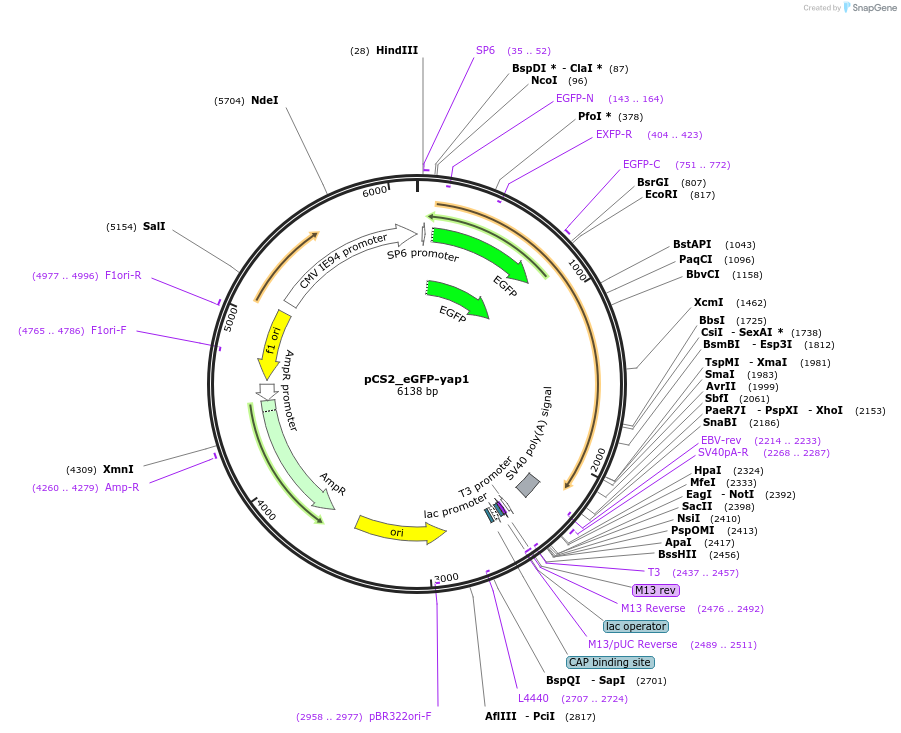
pCS2_eGFP-yap1
(Plasmid
#254510)
-
PurposeGFP-tagged zebrafish yap1. For in vitro transcription (SP6) and RNA injection
-
Depositing Lab
-
Depositing OrganizationGoethe-Universitaet Frankfurt am Main
Located in Germany -
Publication
-
Sequence Information
Ordering
This material is available to academics and nonprofits only.
| Item | Catalog # | Description | Quantity | Price (USD) | |
|---|---|---|---|---|---|
| Plasmid | 254510 | Standard format: Plasmid sent in bacteria as agar stab | 1 | $94 | |
Backbone
-
Vector backbonepCS2+
- Backbone size w/o insert (bp) 4097
-
Vector typeZebrafish Expression
Growth in Bacteria
-
Bacterial Resistance(s)Ampicillin, 100 μg/mL
-
Growth Temperature37°C
-
Growth Strain(s)DH5alpha
-
Copy numberHigh Copy
Gene/Insert
-
Gene/Insert nameyap1
-
Alt nameNM_001139480.1
-
SpeciesD. rerio (zebrafish)
-
Insert Size (bp)1329
-
Entrez Geneyap1 (a.k.a. YAP65, cb194, sb:cb194, si:ch211-181p1.5, si:dkey-3b8.3, wu:fc18c04, zYAP, zgc:158380)
- Promoter SP6
-
Tag
/ Fusion Protein
- eGFP (N terminal on insert)
Cloning Information
- Cloning method Restriction Enzyme
- 5′ cloning site EcoRI (not destroyed)
- 3′ cloning site XhoI (not destroyed)
- 5′ sequencing primer SP6
- 3′ sequencing primer M13 rev
- (Common Sequencing Primers)
Resource Information
Terms and Licenses
-
Academic/Nonprofit Terms
-
Industry Terms
- Not Available to Industry
Trademarks:
- Zeocin® is an InvivoGen trademark.
Depositor Comments
Please note: This plasmid contains a G370S mutation in yap1. This mutation is not known to impact plasmid function.
How to cite this plasmid
( Back to top)
These plasmids were created by your colleagues. Please acknowledge the Principal Investigator, cite the article in which the plasmids were described, and include Addgene in the Materials and Methods of your future publications.
-
For your Materials & Methods section:
pCS2_eGFP-yap1 was a gift from Virginie Lecaudey (Addgene plasmid # 254510 ; http://n2t.net/addgene:254510 ; RRID:Addgene_254510) -
For your References section:
Vgll4 Proteins limit Organ Size in Zebrafish through Yap1-Dependent and -Independent Mechanisms. Lardennois A, Dingare C, Duda V, Klemmt PA, Heinzen C, Kleinhans D, Falk T, Schelmbauer C, Mozolewska O, Papadopoulou S, Lai JJK, Stainier DYR, Lecaudey V. bioRxiv 2025.05.08.652796 10.1101/2025.05.08.652796