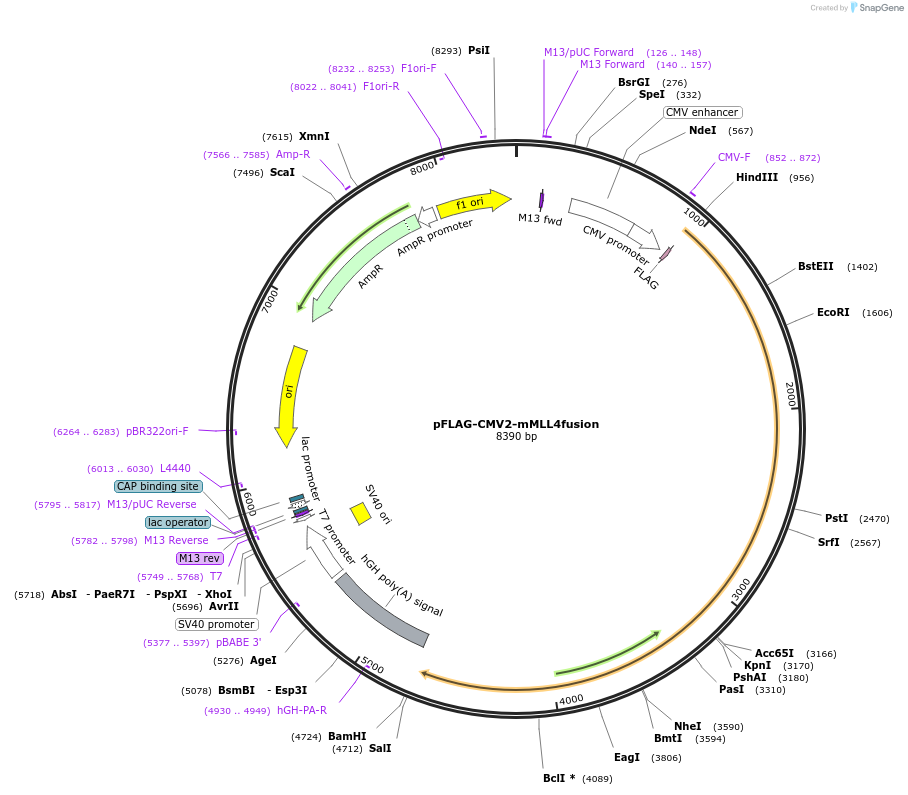
pFLAG-CMV2-mMLL4fusion
(Plasmid
#256014)
-
PurposeThis plasmid expresses a mutant mini-version of human MLL4 (KMT2D) composed of a mutant PHD4-6 (1358–1572aa) bearing E1516A/E1517A/D1518A/E1544A and a SET-containing C-terminal region (4507–5537aa).
-
Depositing Lab
-
Depositing OrganizationUniversity of Texas MD Anderson Cancer Center
Located in the United States of America -
Sequence Information
Ordering
This material is available to academics and nonprofits only.
| Item | Catalog # | Description | Quantity | Price (USD) | |
|---|---|---|---|---|---|
| Plasmid | 256014 | Standard format: Plasmid sent in bacteria as agar stab | 1 | $94 | |
Backbone
-
Vector backbonepFLAG-CMV-2
-
Vector typeMammalian Expression
Growth in Bacteria
-
Bacterial Resistance(s)Ampicillin, 100 μg/mL
-
Growth Temperature37°C
-
Growth Strain(s)DH5alpha
-
Copy numberUnknown
Gene/Insert
-
Gene/Insert namemMLL4 fusion
-
Alt nameKMT2D
-
SpeciesH. sapiens (human)
-
MutationPHD(PHD4-6) and SET(Catalytic domain) along with mutation in PHD4-6(E1516A/E1517A/D1518A/E1544A)
-
Entrez GeneKMT2D (a.k.a. AAD10, ALR, BCAHH, CAGL114, KABUK1, KMS, MLL2, MLL4, TNRC21)
- Promoter CMV
-
Tag
/ Fusion Protein
- FLAG (N terminal on insert)
Cloning Information
- Cloning method Unknown
- 5′ sequencing primer CGCAAATGGGCGGTAGGCGTG
- (Common Sequencing Primers)
Resource Information
-
A portion of this plasmid was derived from a plasmid made byDr. Lee Lab
Terms and Licenses
-
Academic/Nonprofit Terms
-
Industry Terms
- Not Available to Industry
Trademarks:
- Zeocin® is an InvivoGen trademark.
How to cite this plasmid
( Back to top)
These plasmids were created by your colleagues. Please acknowledge the Principal Investigator, cite the article in which the plasmids were described, and include Addgene in the Materials and Methods of your future publications.
-
For your Materials & Methods section:
pFLAG-CMV2-mMLL4fusion was a gift from Min Gyu Lee (Addgene plasmid # 256014 ; http://n2t.net/addgene:256014 ; RRID:Addgene_256014) -
For your References section:
Trans-tail regulation of MLL4-catalyzed H3K4 methylation by H4R3 symmetric dimethylation is mediated by a tandem PHD of MLL4. Dhar SS, Lee SH, Kan PY, Voigt P, Ma L, Shi X, Reinberg D, Lee MG. Genes Dev. 2012 Dec 15;26(24):2749-62. doi: 10.1101/gad.203356.112. 10.1101/gad.203356.112 PubMed 23249737