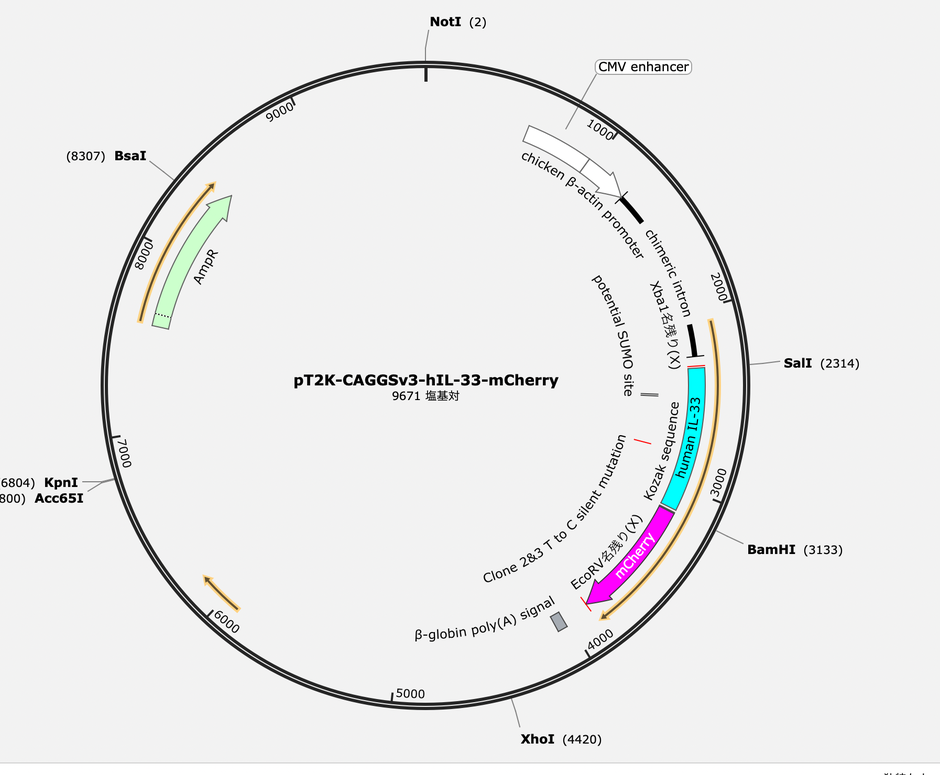



pT2K-CAGGSv3-human IL-33-mCherry
(Plasmid
#256115)
-
PurposeFor real-time monitoring of IL-33-mCherry release at the single-cell level.
-
Depositing Lab
-
Depositing OrganizationToho University
Located in Japan -
Sequence Information


Ordering
This material is available to academics and nonprofits only.
| Item | Catalog # | Description | Quantity | Price (USD) | |
|---|---|---|---|---|---|
| Plasmid | 256115 | Standard format: Plasmid sent in bacteria as agar stab | 1 | $94 | |
Backbone
-
Vector backbonepT2K-CAGGSv3-EGFP
-
Backbone manufacturerK. Kawakami
- Backbone size w/o insert (bp) 8960
- Total vector size (bp) 8126
-
Vector typeMammalian Expression ; transposon-based vector
Growth in Bacteria
-
Bacterial Resistance(s)Ampicillin, 100 μg/mL
-
Growth Temperature37°C
-
Growth Strain(s)DH5alpha
-
Copy numberHigh Copy
Gene/Insert
-
Gene/Insert nameIL-33
-
Alt nameInterleukin-33
-
SpeciesH. sapiens (human)
-
Insert Size (bp)810
-
GenBank IDNM_001314045.2
-
Entrez GeneIL33 (a.k.a. C9orf26, DVS27, IL1F11, NF-HEV, NFEHEV)
- Promoter CAG
-
Tag
/ Fusion Protein
- mCherry (C terminal on insert)
Cloning Information
- Cloning method Restriction Enzyme
- 5′ cloning site XbaI (destroyed during cloning)
- 3′ cloning site EcoRV (destroyed during cloning)
- 5′ sequencing primer cgccggcaggaaggaaat
- 3′ sequencing primer CCCTTGGTCACCTTCAGCTT
- (Common Sequencing Primers)
Terms and Licenses
-
Academic/Nonprofit Terms
-
Industry Terms
- Not Available to Industry
Trademarks:
- Zeocin® is an InvivoGen trademark.
How to cite this plasmid
( Back to top)
These plasmids were created by your colleagues. Please acknowledge the Principal Investigator, cite the article in which the plasmids were described, and include Addgene in the Materials and Methods of your future publications.
-
For your Materials & Methods section:
pT2K-CAGGSv3-human IL-33-mCherry was a gift from Hiroyasu Nakano (Addgene plasmid # 256115 ; http://n2t.net/addgene:256115 ; RRID:Addgene_256115) -
For your References section:
Temporal control of Ninj1 activation determines cell-to-cell heterogeneity in IL-33 release. Kanokogi T, Komazawa-Sakon S, Murai S, Moriwaki K, Shirasaki Y, Yamagishi M, Sumiyama K, Kishi K, Nakano H. Commun Biol. 2026 May 21. doi: 10.1038/s42003-026-10300-1. 10.1038/s42003-026-10300-1 PubMed 42168568

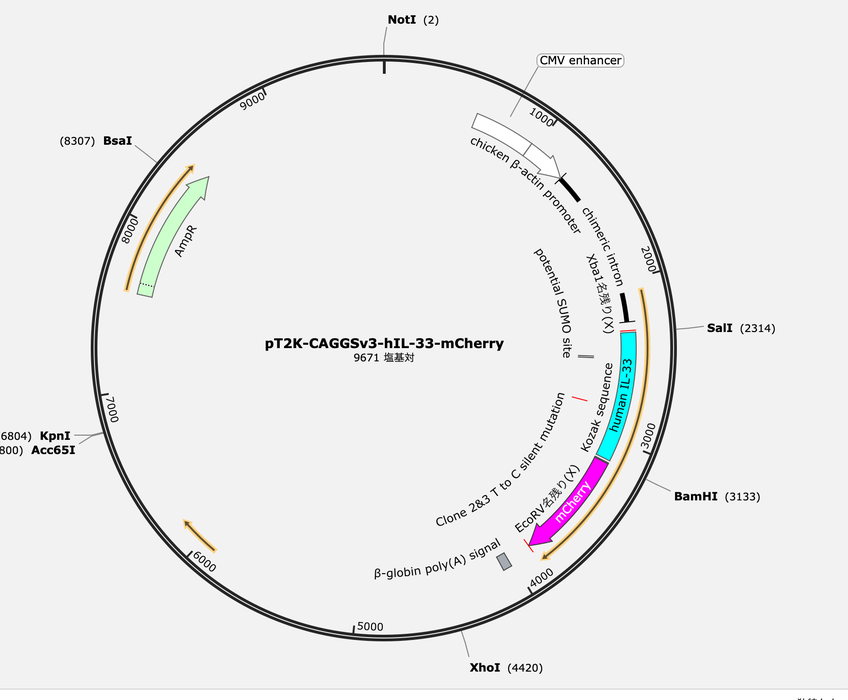
Map uploaded by the depositor.