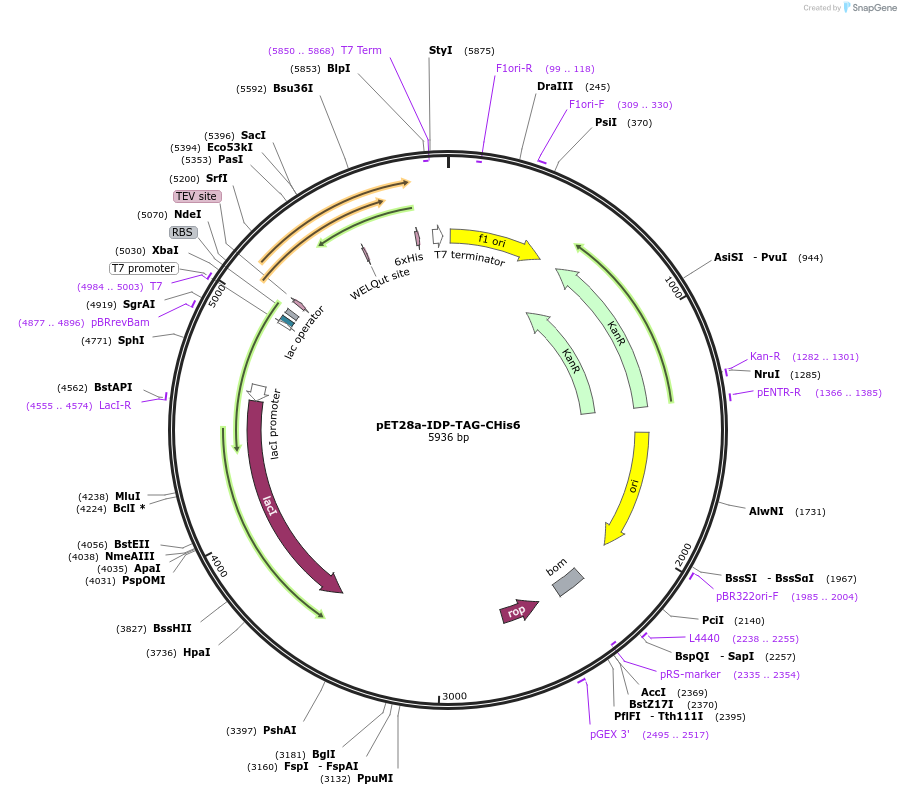
pET28a-IDP-TAG-CHis6
(Plasmid
#264002)
-
PurposeE. coli expression of FUS-derived IDP containing amber codon for site-specific DOPA incorporation and antifouling surface coating.
-
Depositing Lab
-
Depositing OrganizationRice University
Located in the United States of America -
Sequence Information
Ordering
This material is available to academics and nonprofits only.
| Item | Catalog # | Description | Quantity | Price (USD) | |
|---|---|---|---|---|---|
| Plasmid | 264002 | Standard format: Plasmid sent in bacteria as agar stab | 1 | $94 | |
Backbone
-
Vector backbonepET-28a(+)
-
Vector typeBacterial Expression
Growth in Bacteria
-
Bacterial Resistance(s)Kanamycin, 50 μg/mL
-
Growth Temperature37°C
-
Growth Strain(s)DH5alpha
-
Copy numberLow Copy
Gene/Insert
-
Gene/Insert nameFUS-derived IDP
-
Alt nameIDP-FUS
-
SpeciesH. sapiens (human)
-
Insert Size (bp)729
-
MutationY33TAG (amber stop codon replacing Tyr33)
- Promoter T7
-
Tag
/ Fusion Protein
- 6xHis (C terminal on insert)
Cloning Information
- Cloning method Gibson Cloning
Terms and Licenses
-
Academic/Nonprofit Terms
-
Industry Terms
- Not Available to Industry
Trademarks:
- Zeocin® is an InvivoGen trademark.
Depositor Comments
Small Methods SI p.11: pET28a(+)-T7-IDP construct using g-block and Gibson (mz88/mz89; mz77/mz78). SI Table S2 confirms Y33TAG and C-terminal ...GHHHHHH*. Confirm precise TAG codon and plasmid map. | MAP QC: IDP Y33TAG verified: map positions 5134-5136 change TAT > TAG. | Complete sequence length: 5935 bp. Sequence from supplied SnapGene map, not confirmed by independent resequencing.
How to cite this plasmid
( Back to top)
These plasmids were created by your colleagues. Please acknowledge the Principal Investigator, cite the article in which the plasmids were described, and include Addgene in the Materials and Methods of your future publications.
-
For your Materials & Methods section:
pET28a-IDP-TAG-CHis6 was a gift from Han Xiao (Addgene plasmid # 264002 ; http://n2t.net/addgene:264002 ; RRID:Addgene_264002) -
For your References section:
Harnessing Nature-Inspired Catechol Amino Acid to Engineer Sticky Proteins and Bacteria. Zhang M, Chen Y, Chung A, Yang S, Choi CH, Zhang S, Han Y, Xiao H. Small Methods. 2024 Sep 17:e2400230. doi: 10.1002/smtd.202400230. 10.1002/smtd.202400230 PubMed 39285836