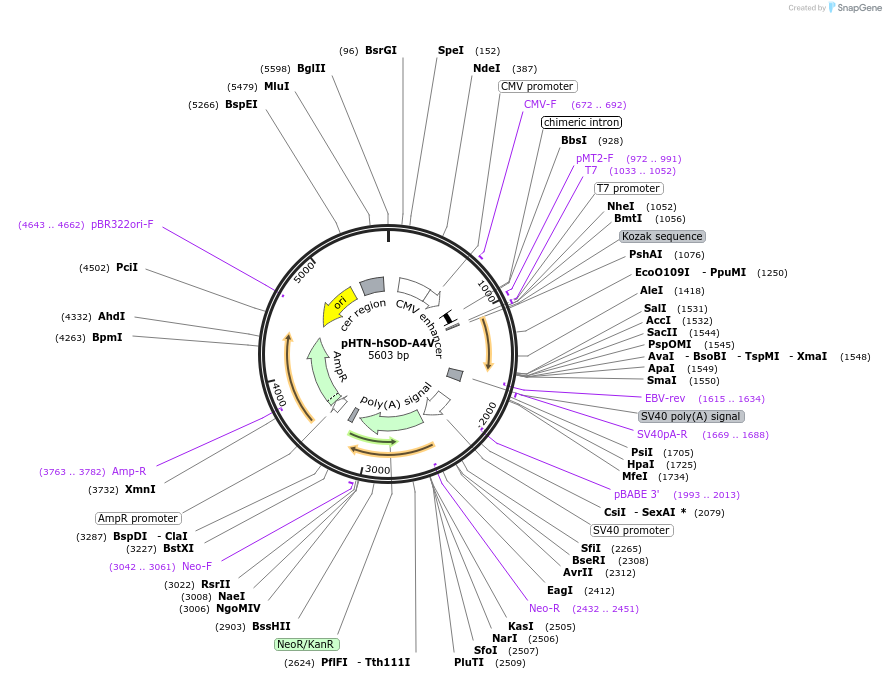
pHTN-hSOD-A4V
(Plasmid
#264006)
-
PurposeMammalian expression of ALS-associated hSOD1-A4V for protein aggregation imaging experiments.
-
Depositing Lab
-
Depositing OrganizationRice University
Located in the United States of America -
Sequence Information
Ordering
| Item | Catalog # | Description | Quantity | Price (USD) | |
|---|---|---|---|---|---|
| Plasmid | 264006 | Standard format: Plasmid sent in bacteria as agar stab | 1 | $94 | |
Backbone
-
Vector backbonepHTN
-
Vector typeMammalian Expression
-
Selectable markersNeomycin
Growth in Bacteria
-
Bacterial Resistance(s)Ampicillin, 100 μg/mL
-
Growth Temperature37°C
-
Growth Strain(s)NEB Stable
-
Copy numberHigh Copy
Gene/Insert
-
Gene/Insert nameSOD1
-
Alt namehuman superoxide dismutase 1
-
SpeciesH. sapiens (human)
-
Insert Size (bp)498
-
MutationA4V; W32 is wild-type Trp (TGG); no W32TAG mutation
- Promoter CMV
Cloning Information
- Cloning method Gibson Cloning
Terms and Licenses
-
Academic/Nonprofit Terms
-
Industry Terms
- Not Available to Industry
Trademarks:
- Zeocin® is an InvivoGen trademark.
Depositor Comments
NCB Methods: hSOD1-A4V gene g-block mz498/mz499; pHTN-Halo derived vector mz500/mz502; Gibson assembly. NCB SI Table 3 documents these primers. Confirm actual C-terminal His6 for this particular vial: His6 separately added using mz773/mz774. | MAP QC UPDATED: Corrected plasmid #7 SnapGene map (7_pHTN-SOD1-A4V(1).dna) verifies W32 TGG (Trp), while #8 has W32 TAG; both 5603 bp. A4V retained. Topology marked linear; physical plasmid topology must be checked. Sequence from map, not independently resequenced.
These plasmids were created by your colleagues. Please acknowledge the Principal Investigator, cite the article in which the plasmids were described, and include Addgene in the Materials and Methods of your future publications.
-
For your Materials & Methods section:
pHTN-hSOD-A4V was a gift from Han Xiao (Addgene plasmid # 264006 ; http://n2t.net/addgene:264006 ; RRID:Addgene_264006) -
For your References section:
Real-time imaging of protein microenvironment changes in cells with rotor-based fluorescent amino acids. Yang S, Jin S, Zhang M, Chen Y, Guo Y, Hu Y, Wolynes PG, Xiao H. Nat Chem Biol. 2026 Jan;22(1):97-108. doi: 10.1038/s41589-025-02003-1. Epub 2025 Sep 11. 10.1038/s41589-025-02003-1 PubMed 40935896