



-
PurposeCAG-driven ubiquitous expression of catalytically inactive Cas9 fused to KRAB repressor domain. Contains 2A-EGFP reporter. For targeted enhancer inactivation in chicken embryos.
-
Depositing Lab
-
Depositing OrganizationUniversity of Oxford
Located in the United Kingdom of Great Britain and Northern Ireland -
Citations
-
Sequence Information


Ordering
| Item | Catalog # | Description | Quantity | Price (USD) | |
|---|---|---|---|---|---|
| Plasmid | 92396 | Standard format: Plasmid sent in bacteria as agar stab | 1 | $94 | |
| DNA | 92396-D50 | 50 μg of DNA in Tris buffer | $495 | ||
| DNA | 92396-D100 | 100 μg of DNA in Tris buffer | $585 | ||
Backbone
-
Vector backbonepCAGG
- Backbone size w/o insert (bp) 4951
- Total vector size (bp) 10183
-
Vector typeMammalian Expression, CRISPR
Growth in Bacteria
-
Bacterial Resistance(s)Ampicillin, 100 μg/mL
-
Growth Temperature37°C
-
Growth Strain(s)DH5alpha
-
Copy numberHigh Copy
Gene/Insert
-
Gene/Insert namedCas9_KRAB_2A_EGFP
-
Insert Size (bp)5232
- Promoter CAG
Cloning Information
- Cloning method Gibson Cloning
- 5′ sequencing primer CGTGCTGGTTATTGTGCTGT
- 3′ sequencing primer CCAGCCACCACCTTCTGATA
- (Common Sequencing Primers)
Resource Information
-
A portion of this plasmid was derived from a plasmid made bydCas9-KRAB-2A-GFP was amplified from pLV hUbC dCas9 KRAB T2A GFP (Addgene #71237) and cloned into the pCI-H2B-RFP vector linearised with NotI and XhoI.
Terms and Licenses
-
Academic/Nonprofit Terms
-
Industry Terms
- Not Available to Industry
Trademarks:
- Zeocin® is an InvivoGen trademark.
Depositor Comments
Highly specific epigenome editing by CRISPR-Cas9 repressors for silencing of distal regulatory elements. Thakore PI, D'Ippolito AM, Song L, Safi A, Shivakumar NK, Kabadi AM, Reddy TE, Crawford GE, Gersbach CA. Nat Methods. 2015 Dec;12(12):1143-9. doi: 10.1038/nmeth.3630. Epub 2015 Oct 26. 10.1038/nmeth.3630 PubMed 26501517
Please visit https://www.biorxiv.org/content/early/2017/05/08/135525 for bioRxiv preprint.
DNA (Catalog # 92396-D50)
Purpose
Ready-to-use, high-purity DNA prep. DNA aliquots are suitable for use in mammalian cell transfections and other molecular biology applications.
Delivery
- Amount 50 μg
- Concentration 1 μg/μL
- Pricing $495 USD
- Storage 4 ℃ (short-term) or -20 ℃ (long-term)
Terms and Licenses
-
Academic/Nonprofit Terms
-
Industry Terms
- Not Available to Industry
Quality Control
Every DNA prep is verified by next-generation sequencing, confirming plasmid identity, sequence integrity, and absence of DNA contaminants. Concentration is confirmed to be within ±2.5% of the stated concentration.
Our production process has been validated to consistently yield endotoxin levels below 1.0 EU/μg. Individual lots are not tested for endotoxin.
DNA (Catalog # 92396-D100)
Purpose
Ready-to-use, high-purity DNA prep. DNA aliquots are suitable for use in mammalian cell transfections and other molecular biology applications.
Delivery
- Amount 100 μg
- Concentration 1 μg/μL
- Pricing $585 USD
- Storage 4 ℃ (short-term) or -20 ℃ (long-term)
Terms and Licenses
-
Academic/Nonprofit Terms
-
Industry Terms
- Not Available to Industry
Quality Control
Every DNA prep is verified by next-generation sequencing, confirming plasmid identity, sequence integrity, and absence of DNA contaminants. Concentration is confirmed to be within ±2.5% of the stated concentration.
Our production process has been validated to consistently yield endotoxin levels below 1.0 EU/μg. Individual lots are not tested for endotoxin.
These plasmids were created by your colleagues. Please acknowledge the Principal Investigator, cite the article in which the plasmids were described, and include Addgene in the Materials and Methods of your future publications.
-
For your Materials & Methods section:
pCAG dCas9-KRAB-2A-EGFP was a gift from Tatjana Sauka-Spengler (Addgene plasmid # 92396 ; http://n2t.net/addgene:92396 ; RRID:Addgene_92396) -
For your References section:
Genome and epigenome engineering CRISPR toolkit for in vivo modulation of cis-regulatory interactions and gene expression in the chicken embryo. Williams RM, Senanayake U, Artibani M, Taylor G, Wells D, Ahmed AA, Sauka-Spengler T. Development. 2018 Feb 23;145(4). pii: dev.160333. doi: 10.1242/dev.160333. 10.1242/dev.160333 PubMed 29386245
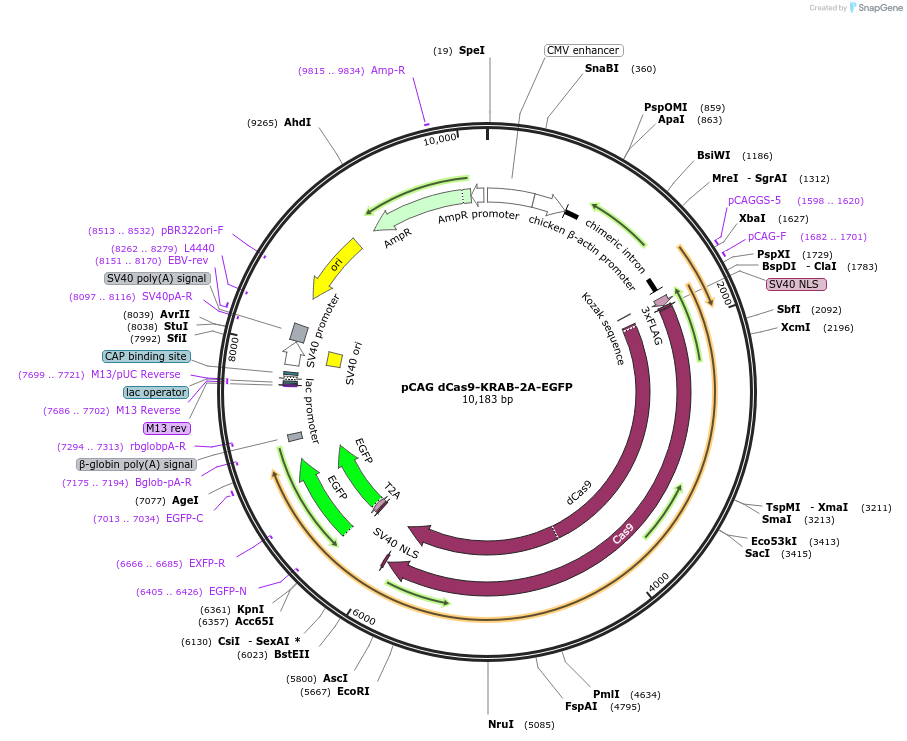
Map uploaded by the depositor.
