


Imine Reductase Enantioselectivity Screening Kit
(Kit #
1000000260
)
Depositing Lab: Simon d'Oelsnitz, Pamela Silver
This kit contains two screening plasmids and 45 expression plasmids for imine reductase (IRED) variants, used for monitoring IRED enantioselectivity in bacteria via GFP/RFP fluorescence.
This kit will be sent as bacterial glycerol stocks in 96-well plate format.
Original Publication
Using enantioselective biosensors to evolve asymmetric biocatalysts. d'Oelsnitz S, Kim W, Zhao NN, Hardtke H, Ikonomova SP, Alperovich N, Vasilyeva O, James MJ, Zigon ES, Cory MB, Johnson CD, Ellington AD, Justman QA, Springer M, Zhang YJ, Silver PA, Ross D. Nat Chem Biol. 2026 Jul 23. doi: 10.1038/s41589-026-02275-1. Article (Link opens in a new window) PubMed (Link opens in a new window) Research Square [preprint] (Link opens in a new window)
Description
This kit contains two screening plasmids and 45 imine reductase (IRED) expression plasmids. The screening plasmids use enantioselective biosensors to trigger either GFP or RFP expression upon binding to (S)-1-phenyl-tetrahydroisoquinoline or (R)-1-phenyl-tetrahydroisoquinoline, respectively. The IRED expression plasmids express sequence-diverse IRED enzyme variants using a medium-strength constitutive promoter and medium-strength ribosome-binding site. When bacteria containing both a screening plasmid and an IRED expression plasmid are grown in media supplemented with the precursor 1-phenyl-3,4-dihydroisoquinoline, IRED enantioselectivity can be quantified via fluorescence.
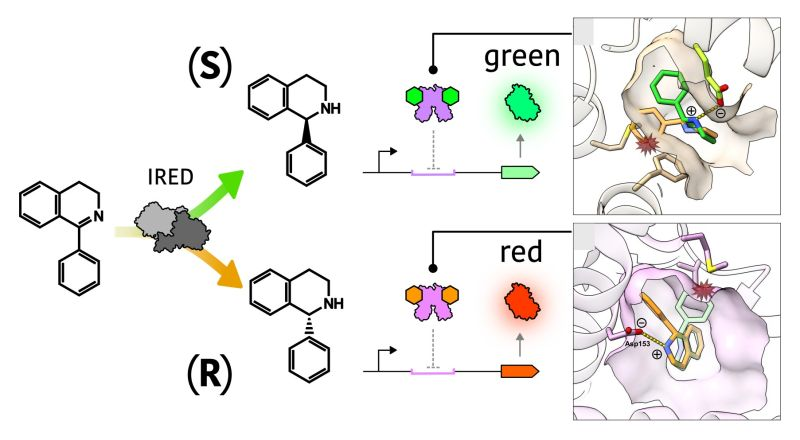
Figure 1: Overview of enzyme enantioselectivity sensing with fluorescent readout. An imine reductase enzyme (IRED) reduces the precursor imine into either the (R) or (S) amine product. Two screening plasmids express enantioselective transcription factors that have been evolved to recognize their cognate enantiomer with high specificity: one responds to the (S) enantiomer to express GFP while the other responds to the (R) enantiomer to express RFP.
Kit Documentation
For protocols and additional details for using these plasmids, please see the original article (d'Oelsnitz et al., 2026 (Link opens in a new window)) or the preprint (d'Oelsnitz et al., 2025 (Link opens in a new window)).
How to Cite this Kit
These plasmids were created by your colleagues. Please acknowledge the Principal Investigator, cite the article in which they were created, and include Addgene in the Materials and Methods of your future publications.
For your Materials and Methods section:
“The Imine Reductase Enantioselectivity Screening Kit was a gift from Simon d'Oelsnitz (Addgene kit #1000000260).”
For your Reference section:
Using enantioselective biosensors to evolve asymmetric biocatalysts. d'Oelsnitz S, Kim W, Zhao NN, Hardtke H, Ikonomova SP, Alperovich N, Vasilyeva O, James MJ, Zigon ES, Cory MB, Johnson CD, Ellington AD, Justman QA, Springer M, Zhang YJ, Silver PA, Ross D. Nat Chem Biol. 2026 Jul 23. doi: 10.1038/s41589-026-02275-1. Article (Link opens in a new window) PubMed (Link opens in a new window)
Imine reductase enantioselectivity screening kit - #1000000260
- Resistance Color Key
Each circle corresponds to a specific antibiotic resistance in the kit plate map wells.
- Inventory
Searchable and sortable table of all plasmids in kit. The Well column lists the plasmid well location in its plate. The Plasmid column links to a plasmid's individual web page.
- Kit Plate Map
96-well plate map for plasmid layout. Hovering over a well reveals the plasmid name, while clicking on a well opens the plasmid page.
Resistance Color Key
| Kanamycin | |
| Ampicillin |
Inventory
| Well | Plasmid | Resistance |
|---|---|---|
| A / 1 | pScreen-S1.3 |
|
| A / 2 | pScreen-R2.1 |
|
| A / 3 | pIR01-AUD39529.1 |
|
| A / 4 | pIR02-AUD39583.1 |
|
| A / 5 | pIR03-EMF01349.1 |
|
| A / 6 | pIR04-NUT93668.1 |
|
| A / 7 | pIR05-WP_009080771.1 |
|
| A / 8 | pIR06-WP_013019548.1 |
|
| A / 9 | pIR07-WP_083466898.1 |
|
| A / 10 | pIR08-WP_123102485.1 |
|
| A / 11 | pIR09-WP_123993384.1 |
|
| A / 12 | pIR10-WP_132480478.1 |
|
| B / 1 | pIR11-WP_232847731.1 |
|
| B / 2 | pIR12-WP_240033132.1 |
|
| B / 3 | pIR13-WP_253870842.1 |
|
| B / 4 | pIR14-WP_277212655.1 |
|
| B / 5 | pIR15-MF540792.1 |
|
| B / 6 | pIR16-AUD39487.1 |
|
| B / 7 | pIR17-ATL31837.1 |
|
| B / 8 | pIR18-ATW48861.1 |
|
| B / 9 | pIR19-AUD39517.1 |
|
| B / 10 | pIR20-EME99395.1 |
|
| B / 11 | pIR21-OMI34305.1 |
|
| B / 12 | pIR22-PRX45020.1 |
|
| C / 1 | pIR23-WP_030629722.1 |
|
| C / 2 | pIR24-WP_037254083.1 |
|
| C / 3 | pIR25-WP_111548309.1 |
|
| C / 4 | pIR26-WP_112256886.1 |
|
| C / 5 | pIR27-WP_116022473.1 |
|
| C / 6 | pIR28-WP_220260546.1 |
|
| C / 7 | pIR29-WP_230421476.1 |
|
| C / 8 | pIR30-WP_240598438.1 |
|
| C / 9 | pIR31-GHE75528.1 |
|
| C / 10 | pIR32-MCP2166807.1 |
|
| C / 11 | pIR33-PFG99428.1 |
|
| C / 12 | pIR34-WP_029384055.1 |
|
| D / 1 | pIR35-WP_073484372.1 |
|
| D / 2 | pIR36-WP_073486480.1 |
|
| D / 3 | pIR37-WP_084468547.1 |
|
| D / 4 | pIR38-WP_172381658.1 |
|
| D / 5 | pIR39-WP_184965005.1 |
|
| D / 6 | pIR40-WP_187234818.1 |
|
| D / 7 | pIR41-WP_189878949.1 |
|
| D / 8 | pIR42-WP_191257941.1 |
|
| D / 9 | pIR43-WP_229347914.1 |
|
| D / 10 | pIR44-WP_242906400.1 |
|
| D / 11 | pIR45-WP_253669224.1 |
|
| D / 12 | pIR46-WP_266533875.1 |
|