



-
PurposeMammalian expression vector for cloning and expressing your gene under the CAG promoter
-
Depositing Lab
-
Citations
-
Sequence Information


Ordering
| Item | Catalog # | Description | Quantity | Price (USD) | |
|---|---|---|---|---|---|
| Plasmid | 11160 | Standard format: Plasmid sent in bacteria as agar stab | 1 | $94 | |
Backbone
-
Vector backbonepCAGGS
- Backbone size w/o insert (bp) 4698
-
Vector typeMammalian Expression
Growth in Bacteria
-
Bacterial Resistance(s)Ampicillin, 100 μg/mL
-
Growth Temperature37°C
-
Growth Strain(s)DH5alpha
-
Copy numberHigh Copy
Gene/Insert
-
Gene/Insert namemodified multiple cloning sites
-
Insert Size (bp)100
Cloning Information
- Cloning method Restriction Enzyme
- 5′ cloning site EcoRI (not destroyed)
- 3′ cloning site BglII (not destroyed)
- 5′ sequencing primer pCAG-F
- (Common Sequencing Primers)
Resource Information
-
A portion of this plasmid was derived from a plasmid made bypCAGGS (Niwa et al. Gene 108, 193-199 (1991)) was obtained from Dr. J. Miyazaki (Osaka University).
Terms and Licenses
-
Academic/Nonprofit Terms
-
Industry Terms
- Not Available to Industry
Trademarks:
- Zeocin® is an InvivoGen trademark.
Depositor Comments
The multiple cloning sites of pCAGGS was modified to make pCAGEN (pCAGGS with EcoRI, XhoI, EcoRV and NotI sites).
Note that the Addgene quality control sequence and the author-supplied sequence do not match exactly, but critical features (such as the MCS restriction sites) appear to be intact. If you believe there is something functionally wrong with this plasmid, please report your concern to [email protected]
These plasmids were created by your colleagues. Please acknowledge the Principal Investigator, cite the article in which the plasmids were described, and include Addgene in the Materials and Methods of your future publications.
-
For your Materials & Methods section:
pCAGEN was a gift from Connie Cepko (Addgene plasmid # 11160 ; http://n2t.net/addgene:11160 ; RRID:Addgene_11160) -
For your References section:
Electroporation and RNA interference in the rodent retina in vivo and in vitro. Matsuda T, Cepko CL. Proc Natl Acad Sci U S A. 2004 Jan 6. 101(1):16-22. 10.1073/pnas.2235688100 PubMed 14603031
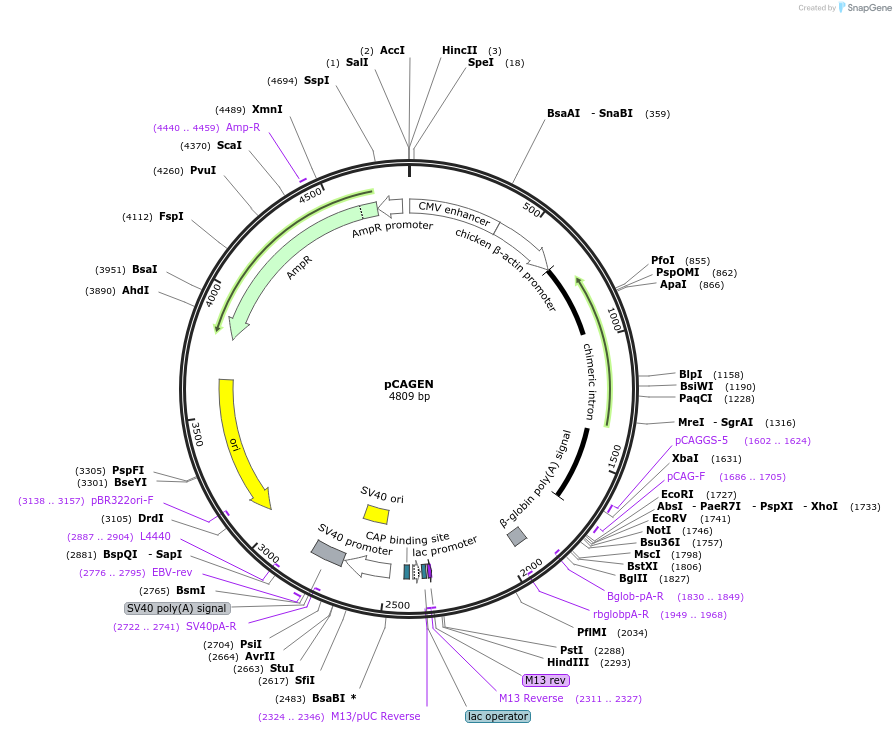
Map uploaded by the depositor.
