


Yeast MoClo Secretion and Surface Display (YSD) Toolkit 2.0
(Kit #
1000000290
)
Depositing Lab: Paul Young
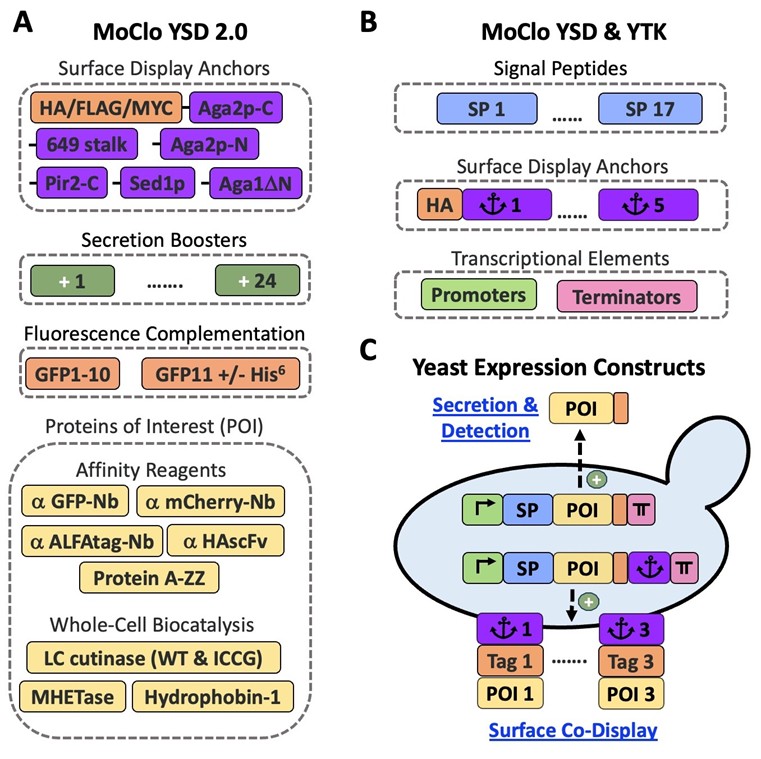
The Modular Cloning (MoClo) Yeast Secretion and Display (YSD) Toolkit 2.0 is a collection of 95 plasmids that can be used in conjunction with an earlier MoClo YSD Toolkit (Addgene Kit #1000000240) and the MoClo Yeast Toolkit (YTK) (Addgene Kit #1000000061) to optimize secretion and cell surface display of proteins of interest in Saccharomyces cerevisiae. It also provides parts and surface display expression cassettes that enable the generation of whole-cell biocatalysts and analysis of protein–protein interactions by either yeast-based immunoprecipitation or flow cytometry.
This kit will be sent as bacterial glycerol stocks in 96-well plate format.
Original Publication
Yeast MoClo Secretion and Surface Display Toolkit 2.0: Improvements and Applications for Analysis of protein-protein Interactions and Whole-Cell Biocatalysis. Jurić V, Erwin LG, O'Riordan NM, Maher E, Holmes JD, Young PW. ACS Synth Biol. 2026 May 15;15(5):2032–2053. doi: 10.1021/acssynbio.6c00085. PubMed (Link opens in a new window) Article (Link opens in a new window)
Description
The MoClo YSD 2.0 toolkit extends the MoClo YSD toolkit which provided a panel of parts encoding signal peptides as well as some anchor proteins. MoClo YSD 2.0 provides parts enabling high-throughput detection of secreted proteins through GFP fluorescence complementation and a panel of 24 “secretion boosting” cDNAs that can be screened for enhancement of protein secretion or display. The toolkit also includes additional anchor proteins for yeast surface display, including those facilitating C-terminal fusion of proteins of interest — with a choice of three epitope tags (HA, FLAG, and MYC) for most anchor proteins providing flexibility for co-display experiments.
In addition, the kit contains expression cassettes for yeast surface display of several affinity reagents that can be used for analysis of protein–protein interaction. These include anti-GFP, anti-mCherry and anti-ALFA-tag nanobodies, an anti-HA epitope tag scFv antibody, and an IgG-binding domain derived from Protein-A. The toolkit also provides plasmids to generate a whole-cell biocatalyst for polyethylene terephthalate (PET) plastic degradation, featuring co-display of two enzymes and a substrate attachment enhancing protein.
The combined MoClo YSD toolkits, used in conjunction with the MoClo YTK and its many compatible derivative kits, constitute a comprehensive resource to design, build, and optimize yeast-based systems that involve secretion and/or surface display of proteins.
Note that pYSD731, while mentioned as being part of the toolkit in the associated publication, has been omitted from the final toolkit as it failed the Addgene QC process.
How to Cite this Kit
These plasmids were created by your colleagues. Please acknowledge the Principal Investigator, cite the article in which they were created, and include Addgene in the Materials and Methods of your future publications.
For your Materials and Methods section:
"The Yeast MoClo Secretion and Surface Display (YSD) Toolkit 2.0 was a gift from Paul Young (Addgene kit #1000000290)."
For your Reference section:
Yeast MoClo Secretion and Surface Display Toolkit 2.0: Improvements and Applications for Analysis of protein-protein Interactions and Whole-Cell Biocatalysis. Jurić V, Erwin LG, O'Riordan NM, Maher E, Holmes JD, Young PW. ACS Synth Biol. 2026 May 15;15(5):2032–2053. doi: 10.1021/acssynbio.6c00085. PubMed (Link opens in a new window) Article (Link opens in a new window)
Yeast MoClo Secretion and Surface Display (YSD) Toolkit 2.0 - #1000000290
- Resistance Color Key
Each circle corresponds to a specific antibiotic resistance in the kit plate map wells.
- Inventory
Searchable and sortable table of all plasmids in kit. The Well column lists the plasmid well location in its plate. The Plasmid column links to a plasmid's individual web page.
- Kit Plate Map
96-well plate map for plasmid layout. Hovering over a well reveals the plasmid name, while clicking on a well opens the plasmid page.
Resistance Color Key
| Chloramphenicol | |
| Ampicillin | |
| Kanamycin |
Inventory
| Well | Plasmid | Resistance |
|---|---|---|
| A / 1 | pYSD045 |
|
| A / 2 | pYSD046 |
|
| A / 3 | pYSD047 |
|
| A / 4 | pYSD051 |
|
| A / 5 | pYSD052 |
|
| A / 6 | pYSD053 |
|
| A / 7 | pYSD054 |
|
| A / 8 | pYSD055 |
|
| A / 9 | pYSD056 |
|
| A / 10 | pYSD057 |
|
| A / 11 | pYSD058 |
|
| A / 12 | pYSD068 |
|
| B / 1 | pYSD069 |
|
| B / 2 | pYSD070 |
|
| B / 3 | pYSD078 |
|
| B / 4 | pYSD086 |
|
| B / 5 | pYSD087 |
|
| B / 6 | pYSD088 |
|
| B / 7 | pYSD089 |
|
| B / 8 | pYSD090 |
|
| B / 9 | pYSD091 |
|
| B / 10 | pYSD092 |
|
| B / 11 | pYSD093 |
|
| B / 12 | pYSD094 |
|
| C / 1 | pYSD095 |
|
| C / 2 | pYSD503 |
|
| C / 3 | pYSD504 |
|
| C / 4 | pYSD505 |
|
| C / 5 | pYSD506 |
|
| C / 6 | pYSD507 |
|
| C / 7 | pYSD508 |
|
| C / 8 | pYSD509 |
|
| C / 9 | pYSD510 |
|
| C / 10 | pYSD511 |
|
| C / 11 | pYSD512 |
|
| C / 12 | pYSD513 |
|
| D / 1 | pYSD514 |
|
| D / 2 | pYSD515 |
|
| D / 3 | pYSD516 |
|
| D / 4 | pYSD517 |
|
| D / 5 | pYSD518 |
|
| D / 6 | pYSD519 |
|
| D / 7 | pYSD520 |
|
| D / 8 | pYSD521 |
|
| D / 9 | pYSD522 |
|
| D / 10 | pYSD523 |
|
| D / 11 | pYSD524 |
|
| D / 12 | pYSD525 |
|
| E / 1 | pYSD526 |
|
| E / 2 | pYSD703 |
|
| E / 3 | pYSD704 |
|
| E / 4 | pYSD861 |
|
| E / 5 | pYSD862 |
|
| E / 6 | pYSD890 |
|
| E / 7 | pYSD097 |
|
| E / 8 | pYSD098 |
|
| E / 9 | pYSD891 |
|
| E / 10 | pYSD892 |
|
| E / 11 | pYSD893 |
|
| E / 12 | pYSD894 |
|
| F / 1 | pYSD274 |
|
| F / 2 | pYSD281 |
|
| F / 3 | pYSD288 |
|
| F / 4 | pYSD291 |
|
| F / 5 | pYSD292 |
|
| F / 6 | pYSD293 |
|
| F / 7 | pYSD294 |
|
| F / 8 | pYSD295 |
|
| F / 9 | pYSD297 |
|
| F / 10 | pYSD299 |
|
| F / 11 | pYSD301 |
|
| F / 12 | pYSD310 |
|
| G / 1 | pYSD311 |
|
| G / 2 | pYSD315 |
|
| G / 3 | pYSD316 |
|
| G / 4 | pYSD319 |
|
| G / 5 | pYSD322 |
|
| G / 6 | pYSD325 |
|
| G / 7 | pYSD326 |
|
| G / 8 | pYSD328 |
|
| G / 9 | pYSD329 |
|
| G / 10 | pYSD332 |
|
| G / 11 | pYSD335 |
|
| G / 12 | pYSD344 |
|
| H / 1 | pYSD353 |
|
| H / 2 | pYSD354 |
|
| H / 3 | pYSD371 |
|
| H / 4 | pYSD373 |
|
| H / 5 | pYSD726 |
|
| H / 6 | pYSD728 |
|
| H / 7 | pYSD741 |
|
| H / 8 | pET24-His6-GFP1-10 |
|
| H / 9 | pET24-His6-Hatag-mCherry |
|
| H / 10 | pET24-His6-Hatag-mCherry-ALFAtag |
|
| H / 11 | pET24d-ALFA-tag EGFP HA HA His6 |
|