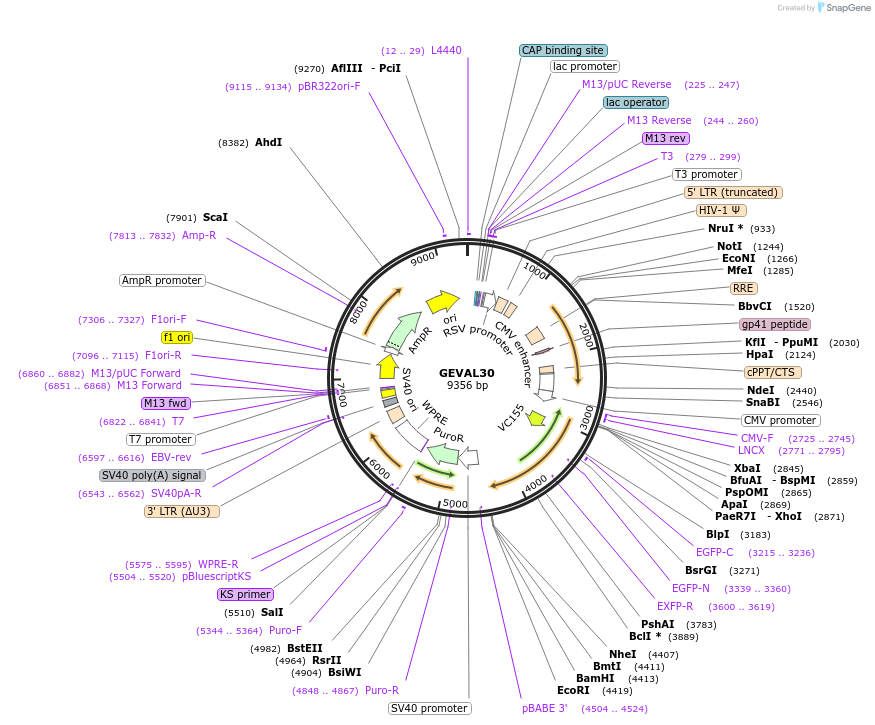
GEVAL30
(Plasmid
#104178)
-
PurposeFluorescent reporter for GTP
-
Depositing Lab
-
Sequence Information
Ordering
This material is available to academics and nonprofits only.
| Item | Catalog # | Description | Quantity | Price (USD) | |
|---|---|---|---|---|---|
| Plasmid | 104178 | Standard format: Plasmid sent in bacteria as agar stab | 1 | $89 | |
Backbone
-
Vector backbonepLV-SV4-puro lentiviral vector
- Backbone size w/o insert (bp) 7740
- Total vector size (bp) 9270
-
Vector typeMammalian Expression, Lentiviral
-
Selectable markersPuromycin
Growth in Bacteria
-
Bacterial Resistance(s)Ampicillin, 100 μg/mL
-
Growth Temperature37°C
-
Growth Strain(s)NEB Stable
-
Copy numberUnknown
Gene/Insert
-
Gene/Insert nameGEVAL30
-
SpeciesSynthetic
-
Insert Size (bp)1530
Cloning Information
- Cloning method Restriction Enzyme
- 5′ cloning site XhoI (not destroyed)
- 3′ cloning site NheI (not destroyed)
- 5′ sequencing primer pLV-SV4-puro forward TAGTGAACCGTCAGATCGCC
- 3′ sequencing primer pLV-SV4-puro reverse TTCCACACCTGGTTGCTGAC
- (Common Sequencing Primers)
Resource Information
-
A portion of this plasmid was derived from a plasmid made byRui Sousa Dept. of Biochemistry University of Texas Health Science Center
Terms and Licenses
-
Academic/Nonprofit Terms
-
Industry Terms
- Not Available to Industry
Trademarks:
- Zeocin® is an InvivoGen trademark.
How to cite this plasmid
( Back to top)
These plasmids were created by your colleagues. Please acknowledge the Principal Investigator, cite the article in which the plasmids were described, and include Addgene in the Materials and Methods of your future publications.
-
For your Materials & Methods section:
GEVAL30 was a gift from Mikhail Nikiforov (Addgene plasmid # 104178) -
For your References section:
Internally ratiometric fluorescent sensors for evaluation of intracellular GTP levels and distribution. Bianchi-Smiraglia A, Rana MS, Foley CE, Paul LM, Lipchick BC, Moparthy S, Moparthy K, Fink EE, Bagati A, Hurley E, Affronti HC, Bakin AV, Kandel ES, Smiraglia DJ, Feltri ML, Sousa R, Nikiforov MA. Nat Methods. 2017 Oct;14(10):1003-1009. doi: 10.1038/nmeth.4404. Epub 2017 Sep 4. 10.1038/nmeth.4404 PubMed 28869758