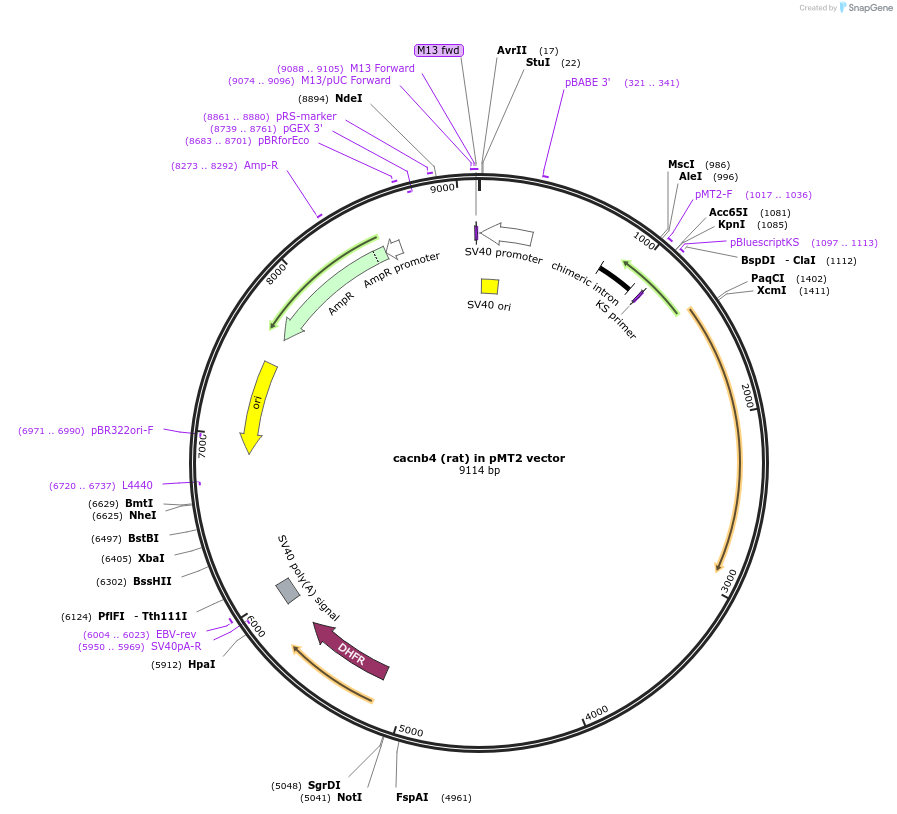
cacnb4 (rat) in pMT2 vector
(Plasmid
#107426)
-
PurposeExpresses Calcium channel beta4 auxillary subunit in mammalian cells
-
Depositing Lab
-
Depositing OrganizationUniversity College London
Located in United Kingdom of Great Britain and Northern Ireland -
Citations
-
Sequence Information
Ordering
| Item | Catalog # | Description | Quantity | Price (USD) | |
|---|---|---|---|---|---|
| Plasmid | 107426 | Standard format: Plasmid sent in bacteria as agar stab | 1 | $94 | |
| DNA | 107426-D50 | 50 μg of DNA in Tris buffer | $495 | ||
| DNA | 107426-D100 | 100 μg of DNA in Tris buffer | $585 | ||
Backbone
-
Vector backbonepMT2
-
Backbone manufacturerGenetics Institute, Inc, Cambridge, MA, USA
- Backbone size w/o insert (bp) 5163
- Total vector size (bp) 9114
-
Vector typeMammalian Expression
Growth in Bacteria
-
Bacterial Resistance(s)Ampicillin, 100 μg/mL
-
Growth Temperature37°C
-
Growth Strain(s)DH5alpha
-
Copy numberHigh Copy
Gene/Insert
-
Gene/Insert namecacnb4
-
Alt namecalcium channel beta4 subunit
-
SpeciesR. norvegicus (rat)
-
Insert Size (bp)3953
-
GenBank IDL02315
-
Entrez GeneCacnb4 (a.k.a. CAB4)
- Promoter Ad MLP
Cloning Information
- Cloning method Restriction Enzyme
- 5′ cloning site KpnI (not destroyed)
- 3′ cloning site NotI (not destroyed)
- 5′ sequencing primer AGCTTGAGGTGTGGCAGGCTT
- 3′ sequencing primer GGTCGAACCATGATGGCAGC
- (Common Sequencing Primers)
Resource Information
-
A portion of this plasmid was derived from a plasmid made byDr Edward Perez-Reyes,Stritch School of Medicine, Dept of Physiology, Loyola University Chicago, Illinois, USA
Terms and Licenses
-
Academic/Nonprofit Terms
-
Industry Terms
- Not Available to Industry
Trademarks:
- Zeocin® is an InvivoGen trademark.
Depositor Comments
We received it in pBluescript and subcloned it into pMT2 plasmid.
DNA (Catalog # 107426-D50)
Purpose
Ready-to-use, high-purity DNA prep. DNA aliquots are suitable for use in mammalian cell transfections and other molecular biology applications.
Delivery
- Amount 50 μg
- Concentration 1 μg/μL
- Pricing $495 USD
- Storage 4 ℃ (short-term) or -20 ℃ (long-term)
Terms and Licenses
-
Academic/Nonprofit Terms
-
Industry Terms
- Not Available to Industry
Quality Control
Every DNA prep is verified by next-generation sequencing, confirming plasmid identity, sequence integrity, and absence of DNA contaminants. Concentration is confirmed to be within ±2.5% of the stated concentration.
Our production process has been validated to consistently yield endotoxin levels below 1.0 EU/μg. Individual lots are not tested for endotoxin.
DNA (Catalog # 107426-D100)
Purpose
Ready-to-use, high-purity DNA prep. DNA aliquots are suitable for use in mammalian cell transfections and other molecular biology applications.
Delivery
- Amount 100 μg
- Concentration 1 μg/μL
- Pricing $585 USD
- Storage 4 ℃ (short-term) or -20 ℃ (long-term)
Terms and Licenses
-
Academic/Nonprofit Terms
-
Industry Terms
- Not Available to Industry
Quality Control
Every DNA prep is verified by next-generation sequencing, confirming plasmid identity, sequence integrity, and absence of DNA contaminants. Concentration is confirmed to be within ±2.5% of the stated concentration.
Our production process has been validated to consistently yield endotoxin levels below 1.0 EU/μg. Individual lots are not tested for endotoxin.
These plasmids were created by your colleagues. Please acknowledge the Principal Investigator, cite the article in which the plasmids were described, and include Addgene in the Materials and Methods of your future publications.
-
For your Materials & Methods section:
cacnb4 (rat) in pMT2 vector was a gift from Annette Dolphin (Addgene plasmid # 107426 ; http://n2t.net/addgene:107426 ; RRID:Addgene_107426) -
For your References section:
The ducky mutation in Cacna2d2 results in altered Purkinje cell morphology and is associated with the expression of a truncated alpha 2 delta-2 protein with abnormal function. Brodbeck J, Davies A, Courtney JM, Meir A, Balaguero N, Canti C, Moss FJ, Page KM, Pratt WS, Hunt SP, Barclay J, Rees M, Dolphin AC. J Biol Chem. 2002 Mar 8;277(10):7684-93. doi: 10.1074/jbc.M109404200. Epub 2001 Dec 26. 10.1074/jbc.M109404200 PubMed 11756448
Ready-to-use antibodies

Looking for antibodies related to this plasmid? Check out this option:
Learn More