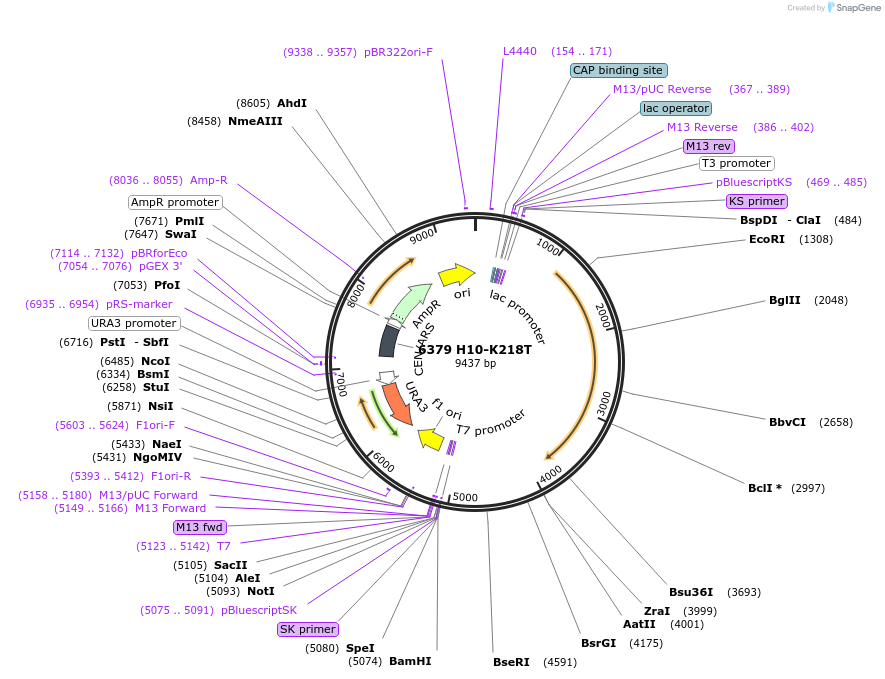
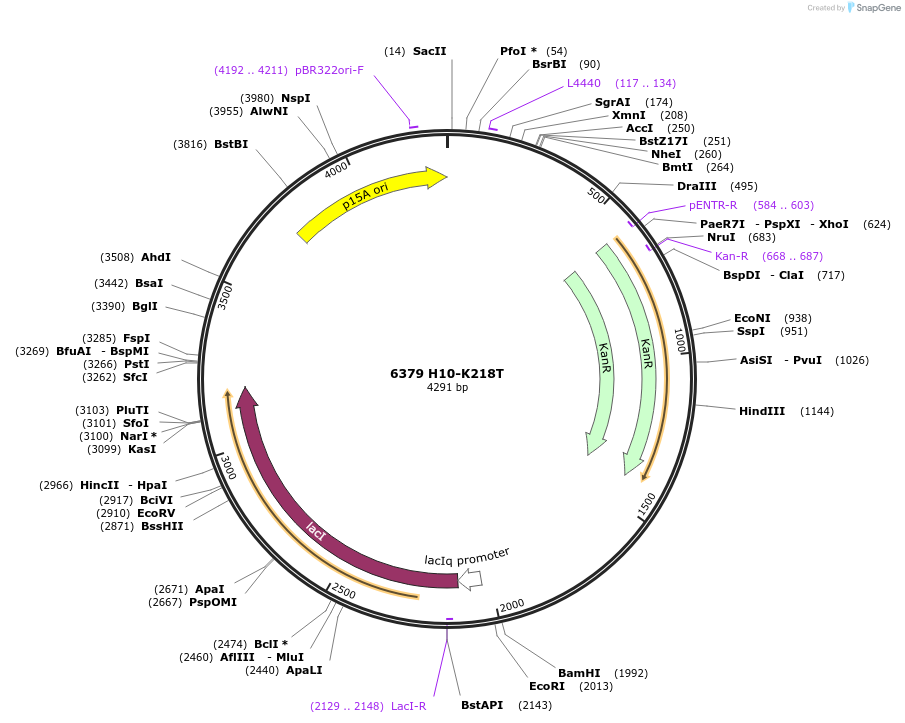
6379 H10-K218T
(Plasmid
#1250)
-
Depositing Lab
-
Publication
-
Sequence Information
Ordering
This material is available to academics and nonprofits only.
| Item | Catalog # | Description | Quantity | Price (USD) | |
|---|---|---|---|---|---|
| Plasmid | 1250 | Standard format: Plasmid sent in bacteria as agar stab | 1 | $89 | |
Backbone
-
Vector backbonepJC45S
-
Modifications to backbone*See Comments section below
-
Vector typeBacterial Expression
Growth in Bacteria
-
Bacterial Resistance(s)Ampicillin and Kanamycin, 100 & 50 μg/mL
-
Growth Temperature37°C
-
Growth Strain(s)Unknown
-
Copy numberHigh Copy
Gene/Insert
-
Gene/Insert nameHsp104 (K218T)
-
Alt nameHsp104
-
SpeciesS. cerevisiae (budding yeast)
-
MutationK218T
-
Entrez GeneHSP104 (a.k.a. YLL026W)
-
Tag
/ Fusion Protein
- his tag (N terminal on backbone)
Cloning Information
- Cloning method Restriction Enzyme
- 5′ sequencing primer n/a
- (Common Sequencing Primers)
Resource Information
-
A portion of this plasmid was derived from a plasmid made byJohn Glover
Terms and Licenses
-
Academic/Nonprofit Terms
-
Industry Terms
- Not Available to Industry
Trademarks:
- Zeocin® is an InvivoGen trademark.
Depositor Comments
Addgene comment: Please note that the plasmid backbone does not match the pJC45 backbone. The depositor described this plasmid as having a "pJC45S" backbone. Full plasmid sequencing shows features similar to other yeast expression vectors. The lab is closed so were were unable to ask if this difference was intended.
How to cite this plasmid
( Back to top)
These plasmids were created by your colleagues. Please acknowledge the Principal Investigator, cite the article in which the plasmids were described, and include Addgene in the Materials and Methods of your future publications.
-
For your Materials & Methods section:
6379 H10-K218T was a gift from Susan Lindquist (Addgene plasmid # 1250 ; http://n2t.net/addgene:1250 ; RRID:Addgene_1250) -
For your References section:
Hsp104, Hsp70, and Hsp40: a novel chaperone system that rescues previously aggregated proteins. Glover JR, Lindquist S. Cell 1998 Jul 10;94(1):73-82. 10.1016/S0092-8674(00)81223-4 PubMed 9674429