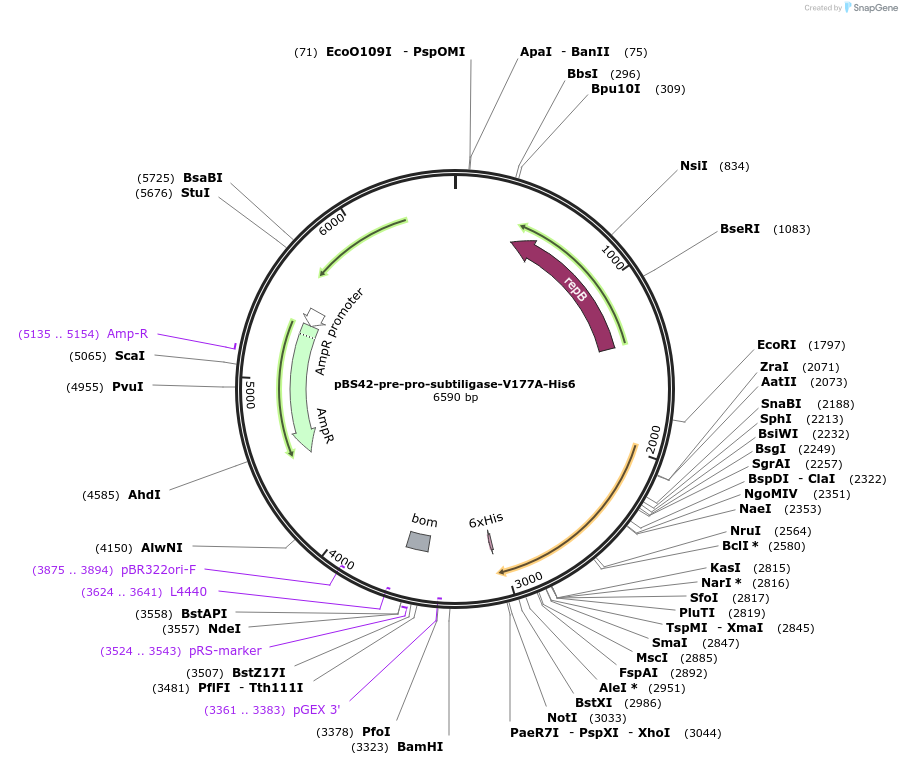
pBS42-pre-pro-subtiligase-V177A-His6
(Plasmid
#129137)
-
PurposeFor expression of subtiligase V177A (subtilisin BPN' S221C P225A V177A) in Bacillus subtilis
-
Depositing Lab
-
Sequence Information
Ordering
This material is available to academics and nonprofits only.
| Item | Catalog # | Description | Quantity | Price (USD) | |
|---|---|---|---|---|---|
| Plasmid | 129137 | Standard format: Plasmid sent in bacteria as agar stab | 1 | $94 | |
Backbone
-
Vector backbonepBS42
- Backbone size w/o insert (bp) 5337
- Total vector size (bp) 6590
-
Vector typeBacterial Expression
Growth in Bacteria
-
Bacterial Resistance(s)Chloramphenicol and Ampicillin, 25 & 100 μg/mL
-
Growth Temperature37°C
-
Growth Strain(s)DH5alpha
-
Growth instructionsThis is an E. coli / B. subtilis shuttle vector. It has an ampicillin resistance cassette that functions in E. coli and a chloramphenicol resistance cassette that functions in B. subtilis.
-
Copy numberLow Copy
Gene/Insert
-
Gene/Insert namepre-pro-subtiligase-V177A-His6
-
Alt nameSubtiligase-V177A
-
SpeciesSynthetic
-
Insert Size (bp)1253
- Promoter subtilisin promoter from Bacillus amyloliquefaciens
-
Tag
/ Fusion Protein
- His6 (C terminal on insert)
Cloning Information
- Cloning method Gibson Cloning
- 5′ sequencing primer TGTTTTTCTTGGAATTGTGCTG
- 3′ sequencing primer GGGAGCCATCCGTCGATTATG
- (Common Sequencing Primers)
Resource Information
-
A portion of this plasmid was derived from a plasmid made byThis is a synthetic, codon optimized gene that was purchased from Integrated DNA Technologies.
Terms and Licenses
-
Academic/Nonprofit Terms
-
Industry Terms
- Not Available to Industry
Trademarks:
- Zeocin® is an InvivoGen trademark.
How to cite this plasmid
( Back to top)
These plasmids were created by your colleagues. Please acknowledge the Principal Investigator, cite the article in which the plasmids were described, and include Addgene in the Materials and Methods of your future publications.
-
For your Materials & Methods section:
pBS42-pre-pro-subtiligase-V177A-His6 was a gift from Jim Wells (Addgene plasmid # 129137) -
For your References section:
Engineering peptide ligase specificity by proteomic identification of ligation sites. Weeks AM, Wells JA. Nat Chem Biol. 2018 Jan;14(1):50-57. doi: 10.1038/nchembio.2521. Epub 2017 Nov 20. 10.1038/nchembio.2521 PubMed 29155430