



Venus-Bik-pEGFP-C1
(Plasmid
#166737)
-
PurposeExpress Venus fused to the N-terminus of the Bcl-2 family protein, Bik
-
Depositing Lab
-
Depositing OrganizationSunnybrook Research Institute
Located in Canada -
Sequence Information


Ordering
| Item | Catalog # | Description | Quantity | Price (USD) | |
|---|---|---|---|---|---|
| Plasmid | 166737 | Standard format: Plasmid sent in bacteria as agar stab | 1 | $94 | |
| DNA | 166737-D50 | 50 μg of DNA in Tris buffer | $495 | ||
| DNA | 166737-D100 | 100 μg of DNA in Tris buffer | $585 | ||
Backbone
-
Vector backbonepEGFP-C1
-
Vector typeMammalian Expression
-
Selectable markersNeomycin (select with G418)
Growth in Bacteria
-
Bacterial Resistance(s)Kanamycin, 50 μg/mL
-
Growth Temperature37°C
-
Growth Strain(s)DH5alpha
-
Copy numberHigh Copy
Gene/Insert
-
Gene/Insert nameBik
-
Alt nameBcl-2-interacting killer, or Apoptosis inducer NBK
-
SpeciesH. sapiens (human)
-
Entrez GeneBIK (a.k.a. BIP1, BP4, NBK)
- Promoter CMV
-
Tag
/ Fusion Protein
- Venus (N terminal on backbone)
Cloning Information
- Cloning method Restriction Enzyme
- 5′ cloning site Unknown (unknown if destroyed)
- 3′ cloning site Unknown (unknown if destroyed)
- 5′ sequencing primer TGACGCAAATGGGCGGTAGG
- 3′ sequencing primer TCGCCCTTTGACGTTGGAGTCCAC
- (Common Sequencing Primers)
Resource Information
-
A portion of this plasmid was derived from a plasmid made byBik sequence aligns with Homo sapiens BCL2 interacting killer (BIK), mRNA; NCBI Reference Sequence: NM_001197.5.
Terms and Licenses
-
Academic/Nonprofit Terms
-
Industry Terms
- Not Available to Industry
Trademarks:
- Zeocin® is an InvivoGen trademark.
Depositor Comments
Transfection of this plasmid will express "VBik" (Venus fused to the N-terminus of the BH3-only protein, Bik) in live cells. There is an 8 amino acid flexible linker between Venus and Bik proteins. When compared with EYFP, Venus fluorophore contains the following mutations: F46L, F64L, M153T, V163A and S175G. This Venus protein contains an F224R mutation to make it monomeric.
DNA (Catalog # 166737-D50)
Purpose
Ready-to-use, high-purity DNA prep. DNA aliquots are suitable for use in mammalian cell transfections and other molecular biology applications.
Delivery
- Amount 50 μg
- Concentration 1 μg/μL
- Pricing $495 USD
- Storage 4 ℃ (short-term) or -20 ℃ (long-term)
Terms and Licenses
-
Academic/Nonprofit Terms
-
Industry Terms
- Not Available to Industry
Quality Control
Every DNA prep is verified by next-generation sequencing, confirming plasmid identity, sequence integrity, and absence of DNA contaminants. Concentration is confirmed to be within ±2.5% of the stated concentration.
Our production process has been validated to consistently yield endotoxin levels below 1.0 EU/μg. Individual lots are not tested for endotoxin.
DNA (Catalog # 166737-D100)
Purpose
Ready-to-use, high-purity DNA prep. DNA aliquots are suitable for use in mammalian cell transfections and other molecular biology applications.
Delivery
- Amount 100 μg
- Concentration 1 μg/μL
- Pricing $585 USD
- Storage 4 ℃ (short-term) or -20 ℃ (long-term)
Terms and Licenses
-
Academic/Nonprofit Terms
-
Industry Terms
- Not Available to Industry
Quality Control
Every DNA prep is verified by next-generation sequencing, confirming plasmid identity, sequence integrity, and absence of DNA contaminants. Concentration is confirmed to be within ±2.5% of the stated concentration.
Our production process has been validated to consistently yield endotoxin levels below 1.0 EU/μg. Individual lots are not tested for endotoxin.
These plasmids were created by your colleagues. Please acknowledge the Principal Investigator, cite the article in which the plasmids were described, and include Addgene in the Materials and Methods of your future publications.
-
For your Materials & Methods section:
Venus-Bik-pEGFP-C1 was a gift from David Andrews (Addgene plasmid # 166737 ; http://n2t.net/addgene:166737 ; RRID:Addgene_166737) -
For your References section:
Efficacy and specificity of inhibitors of BCL-2 family protein interactions assessed by affinity measurements in live cells. Osterlund EJ, Hirmiz N, Pemberton JM, Nougarede A, Liu Q, Leber B, Fang Q, Andrews DW. Sci Adv. 2022 Apr 22;8(16):eabm7375. doi: 10.1126/sciadv.abm7375. Epub 2022 Apr 20. 10.1126/sciadv.abm7375 PubMed 35442739
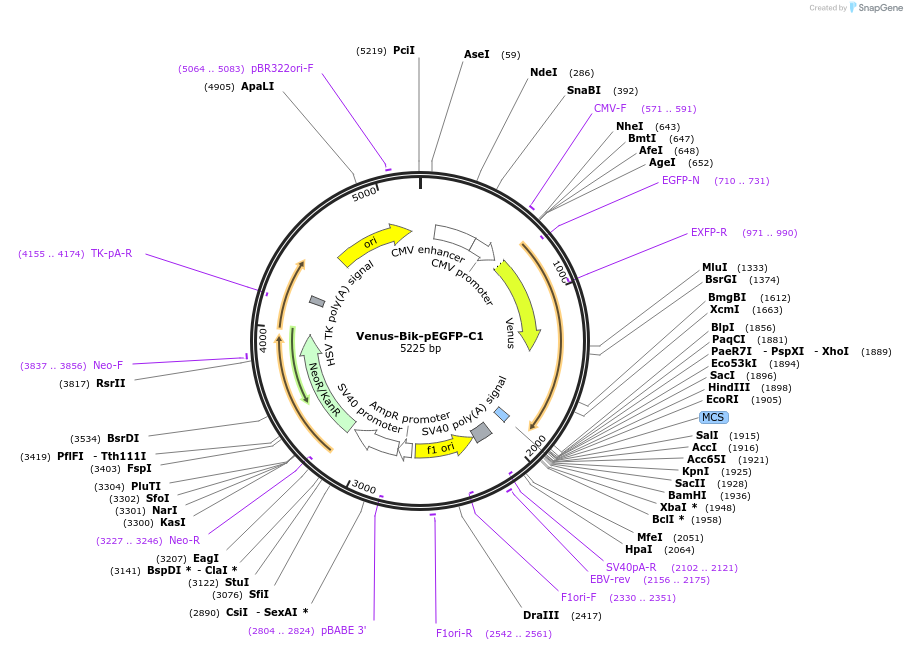
Map uploaded by the depositor.
