-
Depositing Lab
-
Depositing OrganizationNYU Grossman School of Medicine
Located in United States of America -
Publication
-
Citations
-
Sequence Information
Ordering
| Item | Catalog # | Description | Quantity | Price (USD) | |
|---|---|---|---|---|---|
| Plasmid | 21815 | Standard format: Plasmid sent in bacteria as agar stab | 1 | $94 | |
| DNA | 21815-D50 | 50 μg of DNA in Tris buffer | $495 | ||
| DNA | 21815-D100 | 100 μg of DNA in Tris buffer | $585 | ||
Backbone
-
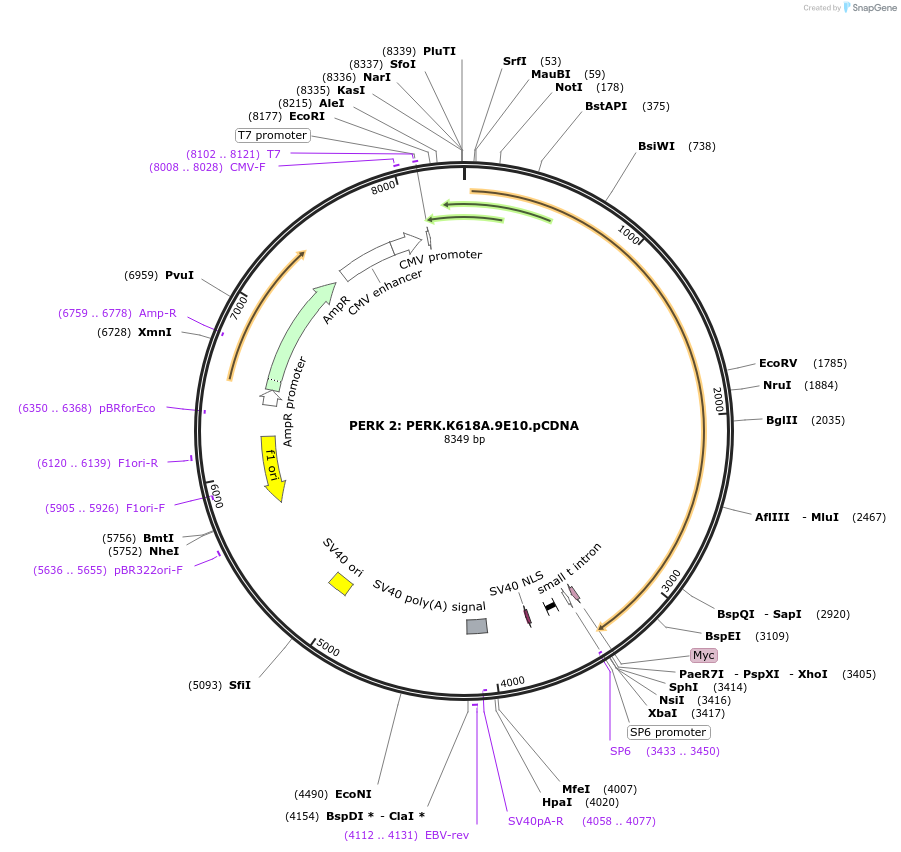
Vector backbonepCDNA
- Backbone size w/o insert (bp) 4756
-
Vector typeMammalian Expression
Growth in Bacteria
-
Bacterial Resistance(s)Ampicillin, 100 μg/mL
-
Growth Temperature30°C
-
Growth Strain(s)Stbl2
-
Growth instructionsWe have found that the PERK cDNA confers instability (low replication ability) to plasmids. The plasmid will be provided in the STBL2 bacterial strain (gibco) which helps alleviate this problem. To recover the plasmid, stick a sterile toothpick into the stab and streak on an LB amp plate and grow at 30C. Pick an individual colony and grow in LB amp at 30C for the highest yield of plasmid.
-
Copy numberLow Copy
Gene/Insert
-
Gene/Insert namePERK (K618A)
-
Alt nameEif2ak3 eukaryotic translation initiation factor 2 alpha kinase 3
-
SpeciesM. musculus (mouse)
-
Insert Size (bp)3577
-
Mutationkinase dead K618A mutant
-
Entrez GeneEif2ak3 (a.k.a. Pek, Perk)
-
Tag
/ Fusion Protein
- Myc (9E10) (C terminal on insert)
Cloning Information
- Cloning method Restriction Enzyme
- 5′ cloning site EcoRI (not destroyed)
- 3′ cloning site XhoI (not destroyed)
- 5′ sequencing primer CMV-F
- (Common Sequencing Primers)
Terms and Licenses
-
Academic/Nonprofit Terms
-
Industry Terms
- Not Available to Industry
Trademarks:
- Zeocin® is an InvivoGen trademark.
Depositor Comments
Mouse PERK, K618A, 9E10-tagged at C-terminus, mammalian expression vector pCDNAamp.
The K->A mutation introduces a unique Nru1 site at position 5070. An EcoR1-Nru1 digest thus readily distinguishes the wild-type and mutant plasmids
DNA (Catalog # 21815-D50)
Purpose
Ready-to-use, high-purity DNA prep. DNA aliquots are suitable for use in mammalian cell transfections and other molecular biology applications.
Delivery
- Amount 50 μg
- Concentration 1 μg/μL
- Pricing $495 USD
- Storage 4 ℃ (short-term) or -20 ℃ (long-term)
Terms and Licenses
-
Academic/Nonprofit Terms
-
Industry Terms
- Not Available to Industry
Quality Control
Every DNA prep is verified by next-generation sequencing, confirming plasmid identity, sequence integrity, and absence of DNA contaminants. Concentration is confirmed to be within ±2.5% of the stated concentration.
Our production process has been validated to consistently yield endotoxin levels below 1.0 EU/μg. Individual lots are not tested for endotoxin.
DNA (Catalog # 21815-D100)
Purpose
Ready-to-use, high-purity DNA prep. DNA aliquots are suitable for use in mammalian cell transfections and other molecular biology applications.
Delivery
- Amount 100 μg
- Concentration 1 μg/μL
- Pricing $585 USD
- Storage 4 ℃ (short-term) or -20 ℃ (long-term)
Terms and Licenses
-
Academic/Nonprofit Terms
-
Industry Terms
- Not Available to Industry
Quality Control
Every DNA prep is verified by next-generation sequencing, confirming plasmid identity, sequence integrity, and absence of DNA contaminants. Concentration is confirmed to be within ±2.5% of the stated concentration.
Our production process has been validated to consistently yield endotoxin levels below 1.0 EU/μg. Individual lots are not tested for endotoxin.
These plasmids were created by your colleagues. Please acknowledge the Principal Investigator, cite the article in which the plasmids were described, and include Addgene in the Materials and Methods of your future publications.
-
For your Materials & Methods section:
PERK 2: PERK.K618A.9E10.pCDNA was a gift from David Ron (Addgene plasmid # 21815 ; http://n2t.net/addgene:21815 ; RRID:Addgene_21815) -
For your References section:
Protein translation and folding are coupled by an endoplasmic-reticulum-resident kinase. Harding HP, Zhang Y, Ron D. Nature. 1999 Jan 21. 397(6716):271-4. 10.1038/16729 PubMed 9930704