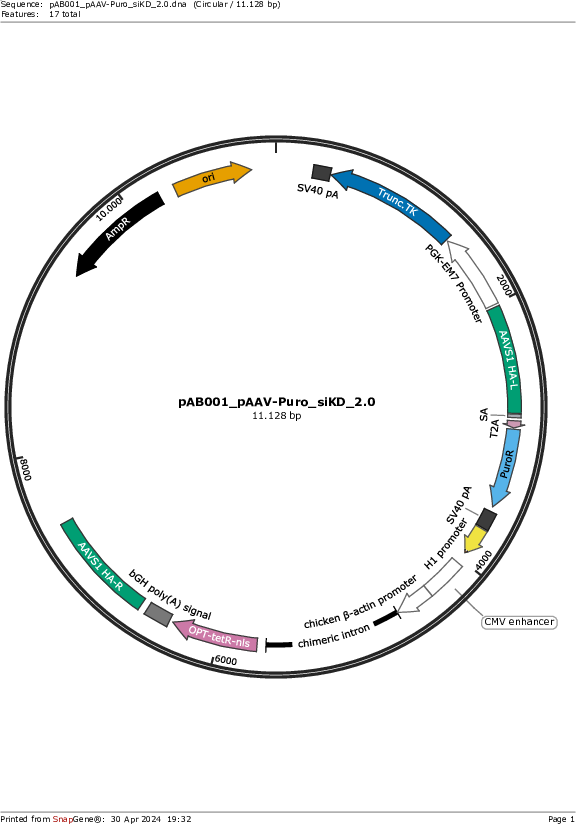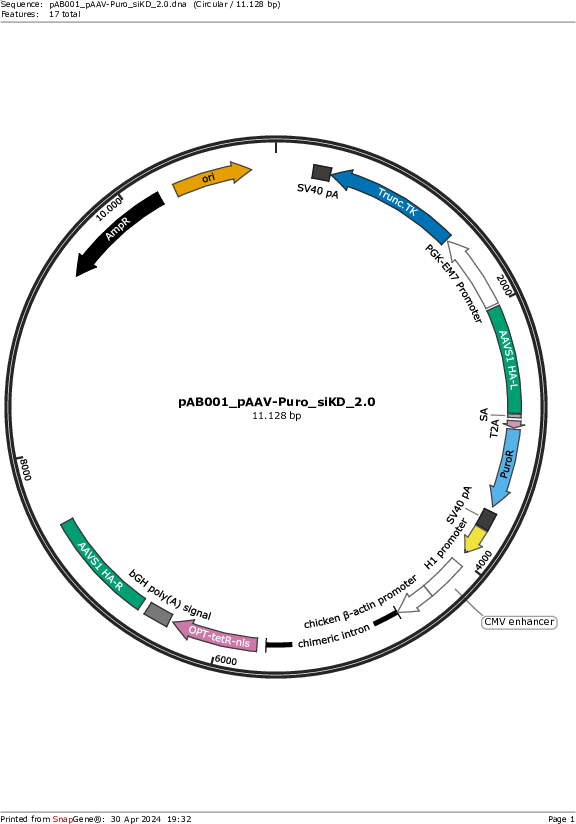



pAAV-Puro_siKD2.0
(Plasmid
#220536)
-
Purpose(Empty Backbone) AAVS1-targeting vector designed for the iPS2-seq platform to express a single-copy, tetracycline-inducible shRNA in human pluripotent stem cells
-
Depositing Lab
-
Sequence Information

Ordering
| Item | Catalog # | Description | Quantity | Price (USD) | |
|---|---|---|---|---|---|
| Plasmid | 220536 | Standard format: Plasmid sent in bacteria as agar stab | 1 | $89 | |
Backbone
-
Vector backbonepAAV-Puro_sikD
-
Vector typeBacterial Expression
-
Selectable markersPuromycin
Growth in Bacteria
-
Bacterial Resistance(s)Ampicillin, 100 μg/mL
-
Growth Temperature37°C
-
Growth Strain(s)DH5alpha
-
Copy numberUnknown
Cloning Information
- Cloning method Gibson Cloning
Resource Information
Terms and Licenses
-
Academic/Nonprofit Terms
-
Industry Terms
- Not Available to Industry
Trademarks:
- Zeocin® is an InvivoGen trademark.
Depositor Comments
pAAV-Puro_siKD2.0 is an AAVS1-targeting vector designed for the iPS2-seq platform to express a single-copy, tetracycline-inducible shRNA in human pluripotent stem cells. Custom shRNAs are cloned into the vector together with a unique barcode (BC) and a random unique clonal identifier (UCI), enabling perturbation assignment and clonal tracking in single-cell RNA-seq. The plasmid includes a puromycin gene-trap cassette for positive selection after AAVS1 integration and is co-delivered with a filler plasmid (pAAV-Neo_CAG, Plasmid #220537) for efficient biallelic targeting.
Please visit https://dx.doi.org/10.17504/protocols.io.e6nvw4q29lmk/v1 for a detailed protocol for use.
These plasmids were created by your colleagues. Please acknowledge the Principal Investigator, cite the article in which the plasmids were described, and include Addgene in the Materials and Methods of your future publications.
-
For your Materials & Methods section:
pAAV-Puro_siKD2.0 was a gift from Alessandro Bertero (Addgene plasmid # 220536 ; http://n2t.net/addgene:220536 ; RRID:Addgene_220536) -
For your References section:
Single cell transcriptional perturbome in pluripotent stem cell models. Balmas E, Ratto ML, Snijders KE, Becca S, Liaci C, Ricca I, Merlo GR, Calogero RA, Alessandri L, Mendjan S, Bertero A. Mol Syst Biol. 2025 Dec 10. doi: 10.1038/s44320-025-00172-8. 10.1038/s44320-025-00172-8 PubMed 41372705
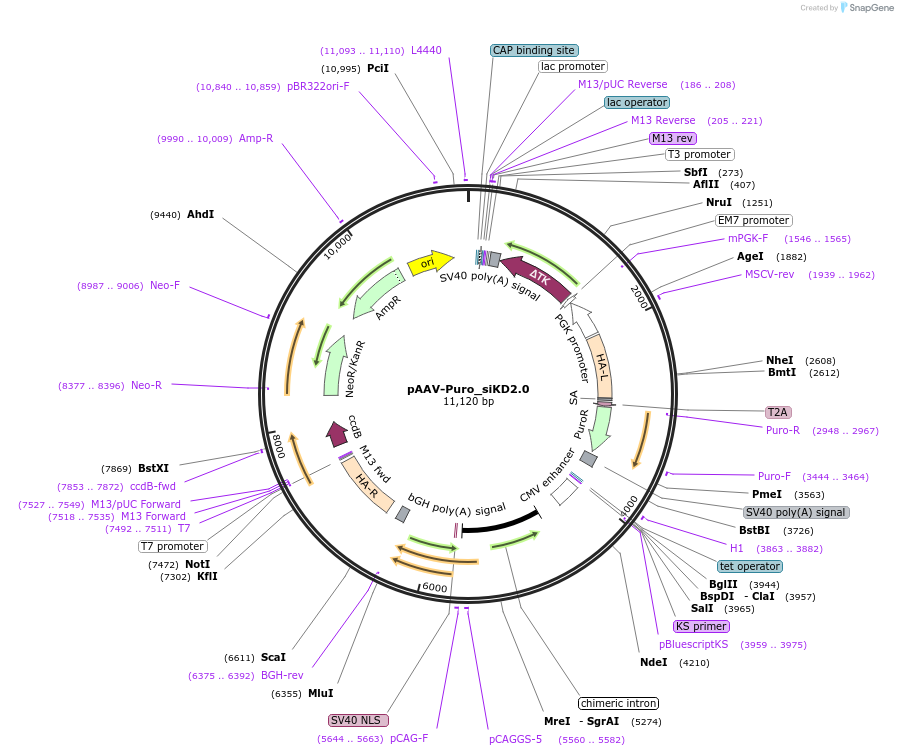
Map uploaded by the depositor.