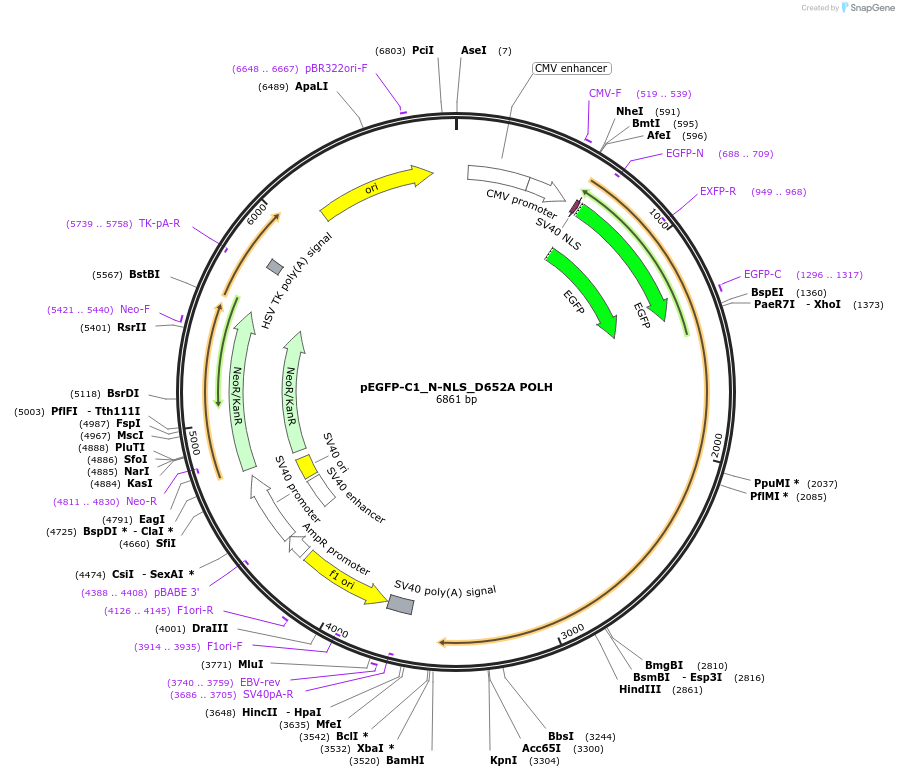
pEGFP-C1_N-NLS_D652A POLH
(Plasmid
#221871)
-
PurposeExpresses D652A POLH with an N-terminal NLS-GFP tag in mammalian cells
-
Depositing Lab
-
Sequence Information
Ordering
This material is available to academics and nonprofits only.
| Item | Catalog # | Description | Quantity | Price (USD) | |
|---|---|---|---|---|---|
| Plasmid | 221871 | Standard format: Plasmid sent in bacteria as agar stab | 1 | $89 | |
Backbone
-
Vector backbonepEGFP-C1_N-NLS
- Total vector size (bp) 6861
-
Vector typeMammalian Expression
Growth in Bacteria
-
Bacterial Resistance(s)Kanamycin, 50 μg/mL
-
Growth Temperature37°C
-
Growth Strain(s)DH5alpha
-
Copy numberHigh Copy
Gene/Insert
-
Gene/Insert namePOLH
-
Alt nameDNA polymerase eta
-
SpeciesH. sapiens (human)
-
MutationD652A
-
Entrez GenePOLH (a.k.a. RAD30, RAD30A, XP-V, XPV)
- Promoter CMV
-
Tag
/ Fusion Protein
- NLS-EGFP (N terminal on backbone)
Cloning Information
- Cloning method Restriction Enzyme
- 5′ cloning site XhoI (not destroyed)
- 3′ cloning site BamHI (not destroyed)
- 5′ sequencing primer CATGGTCCTGCTGGAGTTCGTG
- (Common Sequencing Primers)
Resource Information
Terms and Licenses
-
Academic/Nonprofit Terms
-
Industry Terms
- Not Available to Industry
Trademarks:
- Zeocin® is an InvivoGen trademark.
Depositor Comments
This plasmid is a variant of pEGFP-C1_N-NLS_WT POLH (Addgene #221868) with the POLH CDS mutated at D652A. This mutation prevents the ubiquitin-binding zinc finger from interacting with ubiquitin and NEDD8.
Please visit https://doi.org/10.1101/2024.10.12.618026 for bioRxiv preprint.
How to cite this plasmid
( Back to top)
These plasmids were created by your colleagues. Please acknowledge the Principal Investigator, cite the article in which the plasmids were described, and include Addgene in the Materials and Methods of your future publications.
-
For your Materials & Methods section:
pEGFP-C1_N-NLS_D652A POLH was a gift from Roger Woodgate (Addgene plasmid # 221871 ; http://n2t.net/addgene:221871 ; RRID:Addgene_221871) -
For your References section:
Human DNA polymerase eta is regulated by mutually exclusive mono-ubiquitination and mono-NEDDylation. Moreno NC, Korchak EJ, Latancia MT, D'Orlando DA, Adegbenro T, Barnes RP, Bezsonova I, Woodgate R, Ashton NW. Nucleic Acids Res. 2026 Feb 5;54(4):gkag098. doi: 10.1093/nar/gkag098. 10.1093/nar/gkag098 PubMed 41693564