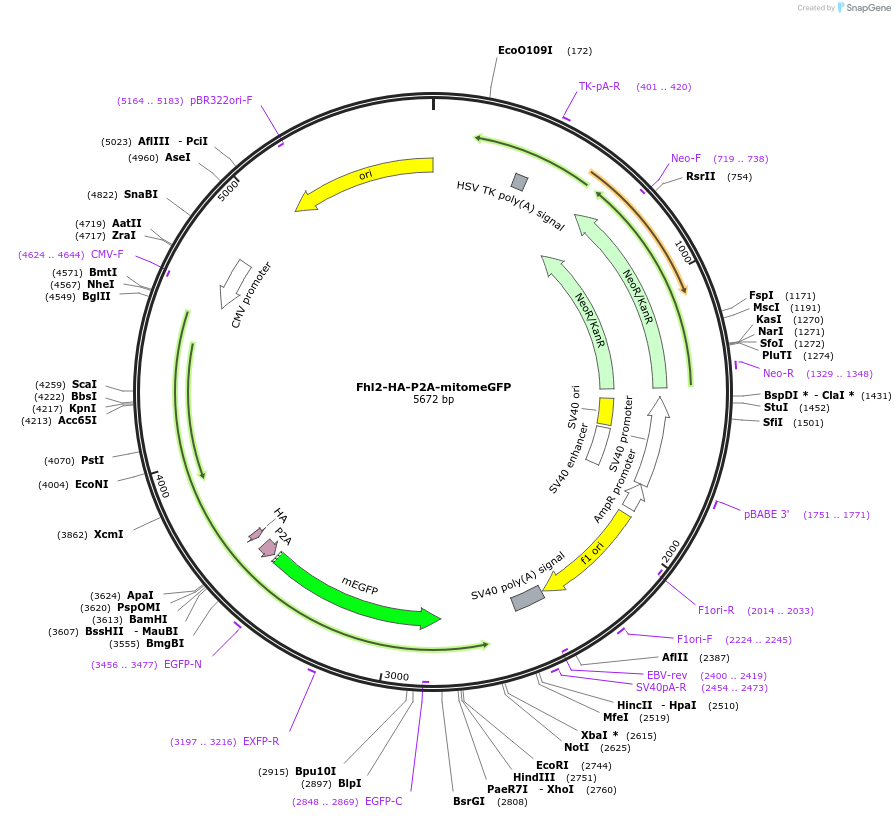
Fhl2-HA-P2A-meGFP(omp25mts)
(Plasmid
#225231)
-
PurposeConstruct expressing HA-tagged Fhl2 followed by a P2A ribosome skip sequence and then a mitochondria targeted mEGFP
-
Depositing Lab
-
Sequence Information
Ordering
This material is available to academics and nonprofits only.
| Item | Catalog # | Description | Quantity | Price (USD) | |
|---|---|---|---|---|---|
| Plasmid | 225231 | Standard format: Plasmid sent in bacteria as agar stab | 1 | $89 | |
Backbone
-
Vector backboneAddgene plasmid 225270
-
Vector typeMammalian Expression
Growth in Bacteria
-
Bacterial Resistance(s)Kanamycin, 50 μg/mL
-
Growth Temperature37°C
-
Growth Strain(s)DH5alpha
-
Copy numberHigh Copy
Gene/Insert
-
Gene/Insert nameFhl2
-
SpeciesR. norvegicus (rat)
-
Entrez GeneFhl2 (a.k.a. SLIM 3)
- Promoter CMV
-
Tag
/ Fusion Protein
- HA-P2A-mitomeGFP- (N terminal on insert)
Cloning Information
- Cloning method Restriction Enzyme
- 5′ cloning site BglII (not destroyed)
- 3′ cloning site PspOMI (not destroyed)
- 5′ sequencing primer CMV
- (Common Sequencing Primers)
Resource Information
-
A portion of this plasmid was derived from a plasmid made byThe Fhl2 gene was amplified from a plasmid reported in the following publication: Basu, H., Pekkurnaz, G., Falk, J., Wei, W., Chin, M., Steen, J., and Schwarz, T.L. (2021). Fhl2 anchors mitochondria to actin and adapts mitochondrial dynamics to glucose supply. Journal of Cell Biology 220. https://doi.org/10.1083/jcb.201912077.
Terms and Licenses
-
Academic/Nonprofit Terms
-
Industry Terms
- Not Available to Industry
Trademarks:
- Zeocin® is an InvivoGen trademark.
How to cite this plasmid
( Back to top)
These plasmids were created by your colleagues. Please acknowledge the Principal Investigator, cite the article in which the plasmids were described, and include Addgene in the Materials and Methods of your future publications.
-
For your Materials & Methods section:
Fhl2-HA-P2A-meGFP(omp25mts) was a gift from Thomas Schwarz (Addgene plasmid # 225231 ; http://n2t.net/addgene:225231 ; RRID:Addgene_225231) -
For your References section:
Energy stress activates AMPK to arrest mitochondria via phosphorylation of TRAK1. Falk JE, Henke T, Gowrisankaran S, Wanderoy S, Basu H, Greally S, Steen J, Schwarz TL. J Cell Biol. 2026 Apr 6;225(4):e202501023. doi: 10.1083/jcb.202501023. Epub 2026 Jan 30. 10.1083/jcb.202501023 PubMed 41615403