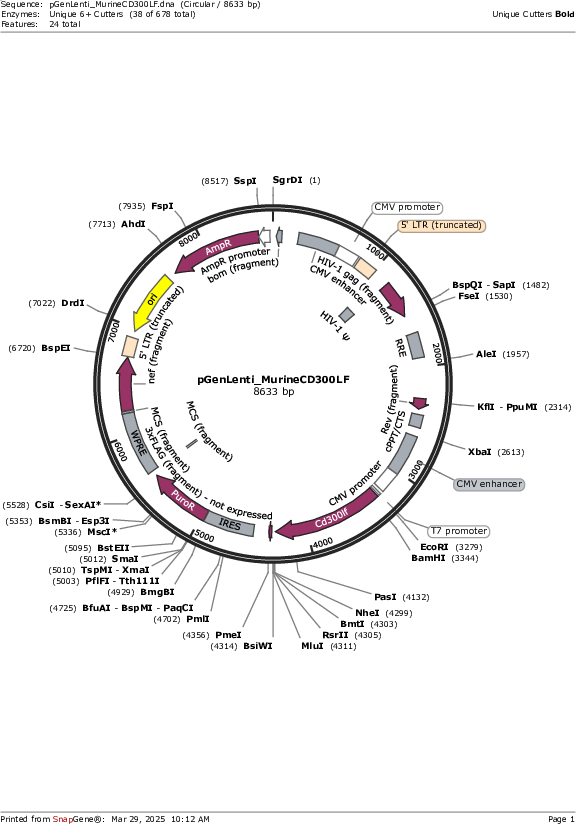



pGenLenti murine CD300LF
(Plasmid
#235668)
-
Purpose3rd Generation lentiviral vector for expression of murine CD300LF. Murine CD300LF is the receptor for murine norovirus, and expression confers susceptibility to this virus. Puromycin resistance.
-
Depositing Lab
-
Sequence Information

Ordering
| Item | Catalog # | Description | Quantity | Price (USD) | |
|---|---|---|---|---|---|
| Plasmid | 235668 | Standard format: Plasmid sent in bacteria as agar stab | 1 | $89 * | |
* Log in to view industry pricing.
Backbone
-
Vector backbonepGenLenti
-
Backbone manufacturerGenscript
- Backbone size w/o insert (bp) 7689
- Total vector size (bp) 8633
-
Vector typeLentiviral
-
Selectable markersPuromycin
Growth in Bacteria
-
Bacterial Resistance(s)Ampicillin, 100 μg/mL
-
Growth Temperature37°C
-
Growth Strain(s)NEB Stable
-
Copy numberHigh Copy
Gene/Insert
-
Gene/Insert nameMurine CD300LF
-
SpeciesM. musculus (mouse)
-
Insert Size (bp)1011
-
GenBank IDAAR27938
-
Entrez GeneCd300lf (a.k.a. CLIM1, CLM-1, CLM1, Digr2, F730004D16Rik, IREM1, IgSF13, LMIR3, Pigr3)
- Promoter CMV
Cloning Information
- Cloning method Unknown
- 5′ sequencing primer T7 promoter
- (Common Sequencing Primers)
Resource Information
-
A portion of this plasmid was derived from a plasmid made byGenscript - paid synthesis.
Terms and Licenses
-
Academic/Nonprofit Terms
-
Industry Terms
Trademarks:
- Zeocin® is an InvivoGen trademark.
Depositor Comments
Please visit https://doi.org/10.64898/2026.03.19.712921 for bioRxiv preprint.
How to cite this plasmid
( Back to top)
These plasmids were created by your colleagues. Please acknowledge the Principal Investigator, cite the article in which the plasmids were described, and include Addgene in the Materials and Methods of your future publications.
-
For your Materials & Methods section:
pGenLenti murine CD300LF was a gift from Edward Emmott (Addgene plasmid # 235668 ; http://n2t.net/addgene:235668 ; RRID:Addgene_235668) -
For your References section:
Efficient plasmid-based rescue of T7 RNA polymerase-driven calicivirus reverse genetics systems in mammalian cells using vaccinia virus RNA capping enzymes. Frazer J.T. Buchanan, Markella Loi, Charlotte Chim, ShuXian Zhou, Rebekah Penrice-Randal, Leandro X. Neves, Maximillian Erdmann, Edward Emmott. bioRxiv 2026.03.19.712921; doi: 10.64898/2026.03.19.712921 10.64898/2026.03.19.712921
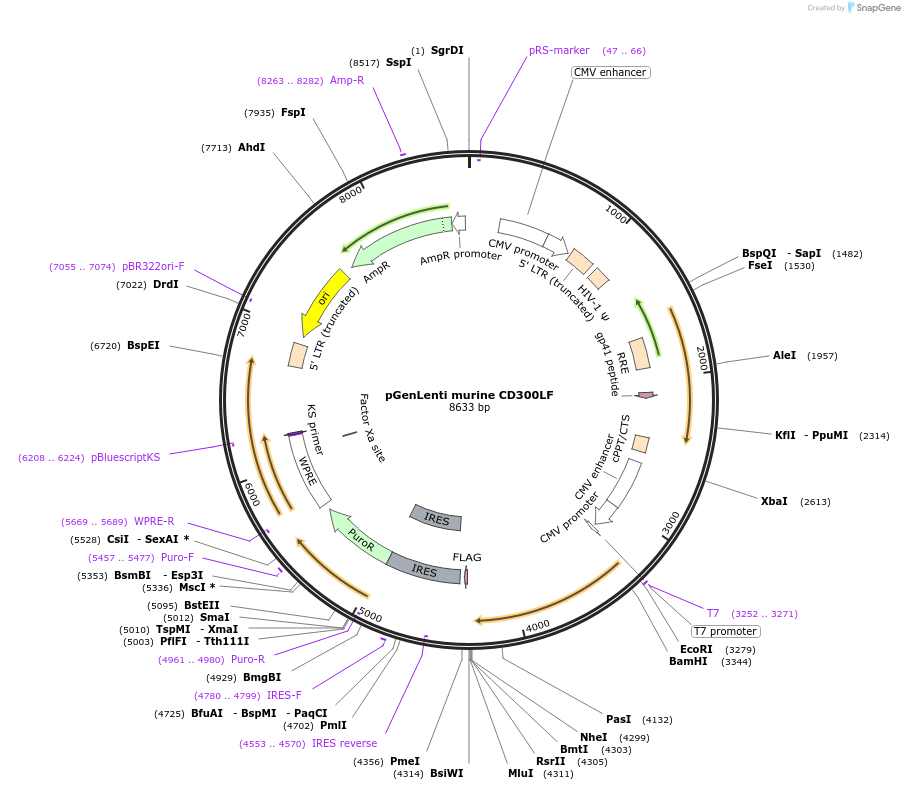
Map uploaded by the depositor.