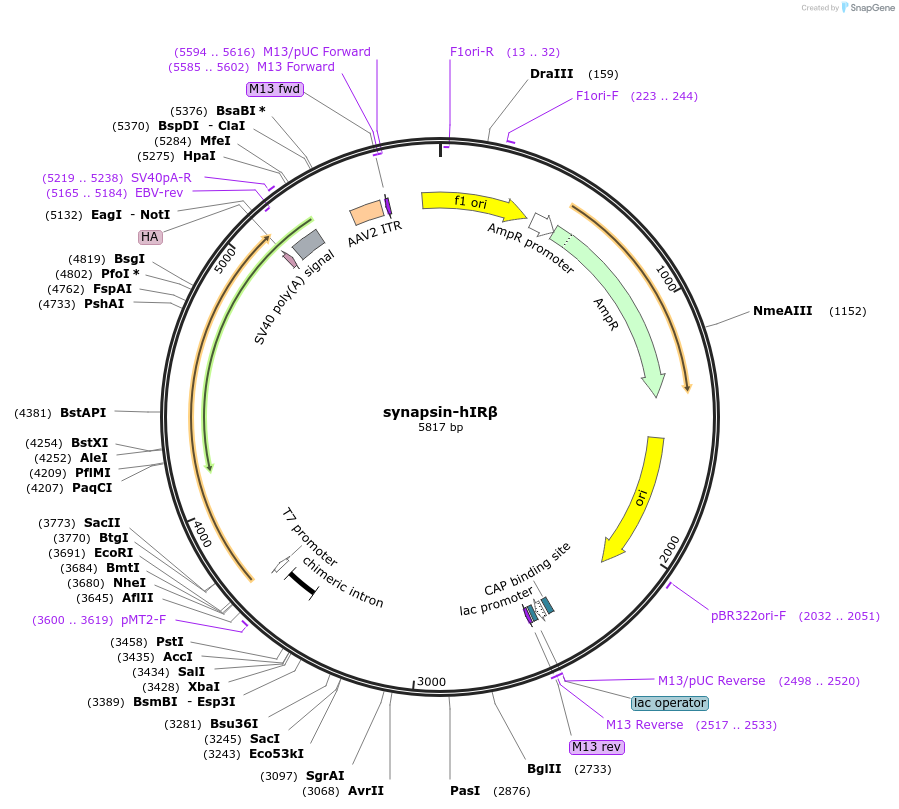
synapsin-hIRβ
(Plasmid
#236226)
-
PurposeExpressing a truncated, constitutively active human insulin receptor (IRβ) in neurons
-
Depositing Lab
-
Sequence Information
Ordering
This material is available to academics and nonprofits only.
| Item | Catalog # | Description | Quantity | Price (USD) | |
|---|---|---|---|---|---|
| Plasmid | 236226 | Standard format: Plasmid sent in bacteria as agar stab | 1 | $89 | |
Backbone
-
Vector backbonepCi-IRES-HA-IRβ-dsRed
-
Modifications to backboneReplace the promoter to neuron specific (synapse) promoter
-
Vector typeBacterial Expression, AAV
Growth in Bacteria
-
Bacterial Resistance(s)Ampicillin, 100 μg/mL
-
Growth Temperature37°C
-
Growth Strain(s)NEB Stable
-
Copy numberHigh Copy
Gene/Insert
-
Gene/Insert namehuman Insulin Receptor beta subunit
-
Alt namehIR beta
-
SpeciesH. sapiens (human)
-
Insert Size (bp)1404
-
Entrez GeneINSR (a.k.a. CD220, HHF5)
- Promoter neuron-specific synapsin promote
Cloning Information
- Cloning method Restriction Enzyme
- 5′ cloning site BglII (unknown if destroyed)
- 3′ cloning site EcoRI (unknown if destroyed)
- 5′ sequencing primer tgacgtcactcgccggt
- (Common Sequencing Primers)
Resource Information
Terms and Licenses
-
Academic/Nonprofit Terms
-
Industry Terms
- Not Available to Industry
Trademarks:
- Zeocin® is an InvivoGen trademark.
How to cite this plasmid
( Back to top)
These plasmids were created by your colleagues. Please acknowledge the Principal Investigator, cite the article in which the plasmids were described, and include Addgene in the Materials and Methods of your future publications.
-
For your Materials & Methods section:
synapsin-hIRβ was a gift from Olivier Thibault (Addgene plasmid # 236226 ; http://n2t.net/addgene:236226 ; RRID:Addgene_236226) -
For your References section:
Expression of a Constitutively Active Human Insulin Receptor in Hippocampal Neurons Does Not Alter VGCC Currents. Frazier HN, Anderson KL, Maimaiti S, Ghoweri AO, Kraner SD, Popa GJ, Hampton KK, Mendenhall MD, Norris CM, Craven RJ, Thibault O. Neurochem Res. 2019 Jan;44(1):269-280. doi: 10.1007/s11064-018-2510-2. Epub 2018 Mar 23. 10.1007/s11064-018-2510-2 PubMed 29572644