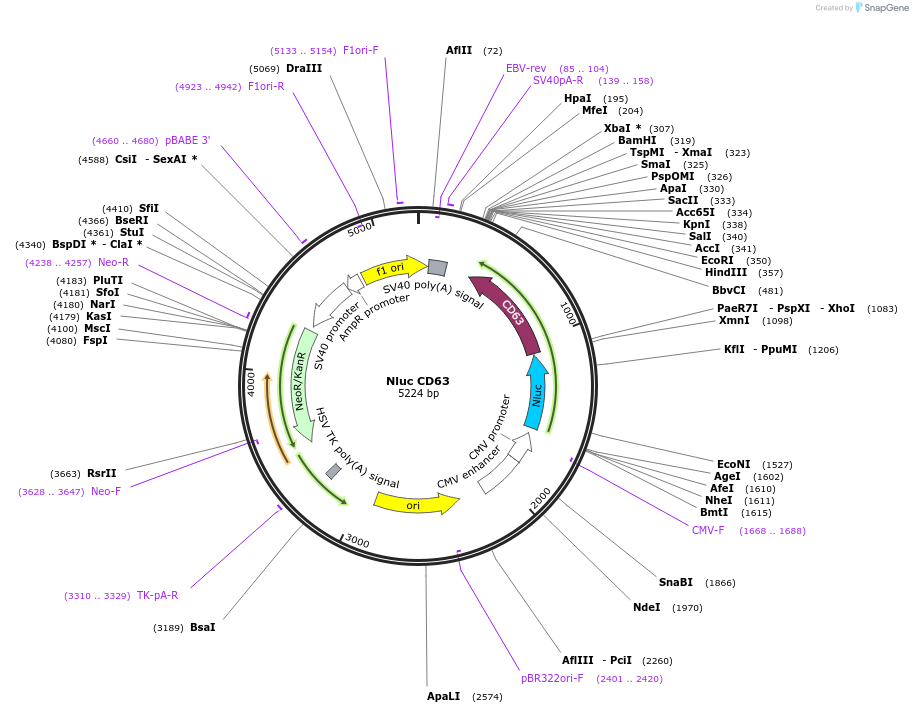
Nluc CD63
(Plasmid
#242528)
-
PurposeThis plasmid can be used to quantify CD63 by luminescence signal upon providing substrate, in particular in the secretome, especially in the extracellular vesicles of cells expressing this construct.
-
Depositing Lab
-
Sequence Information
Ordering
This material is available to academics and nonprofits only.
| Item | Catalog # | Description | Quantity | Price (USD) | |
|---|---|---|---|---|---|
| Plasmid | 242528 | Standard format: Plasmid sent in bacteria as agar stab | 1 | $89 | |
Backbone
-
Vector backbonepmRFP1-C1
-
Backbone manufacturerClontech
- Backbone size w/o insert (bp) 4689
- Total vector size (bp) 5224
-
Vector typeMammalian Expression, Luciferase
-
Selectable markersNeomycin (select with G418)
Growth in Bacteria
-
Bacterial Resistance(s)Kanamycin, 50 μg/mL
-
Growth Temperature37°C
-
Growth Strain(s)DH5alpha
-
Copy numberHigh Copy
Gene/Insert
-
Gene/Insert nameCD63
-
SpeciesH. sapiens (human)
-
Insert Size (bp)714
-
GenBank IDNM_001780.6
-
Entrez GeneCD63 (a.k.a. AD1, HOP-26, ME491, MLA1, OMA81H, Pltgp40, TSPAN30)
- Promoter CMV
-
Tag
/ Fusion Protein
- Nanoluciferase (N terminal on insert)
Cloning Information
- Cloning method Restriction Enzyme
- 5′ cloning site XhoI (not destroyed)
- 3′ cloning site HindIII (not destroyed)
- 5′ sequencing primer CMV Forward: CGCAAATGGGCGGTAGGCGTG
- 3′ sequencing primer polyA Reverse: GTAACCATTATAAGCTGC
- (Common Sequencing Primers)
Resource Information
-
A portion of this plasmid was derived from a plasmid made byW. Mothes
Terms and Licenses
-
Academic/Nonprofit Terms
-
Industry Terms
- Not Available to Industry
Trademarks:
- Zeocin® is an InvivoGen trademark.
How to cite this plasmid
( Back to top)
These plasmids were created by your colleagues. Please acknowledge the Principal Investigator, cite the article in which the plasmids were described, and include Addgene in the Materials and Methods of your future publications.
-
For your Materials & Methods section:
Nluc CD63 was a gift from Clotilde Thery (Addgene plasmid # 242528 ; http://n2t.net/addgene:242528 ; RRID:Addgene_242528) -
For your References section:
Homosalate boosts the release of tumour-derived extracellular vesicles with protection against anchorage-loss property. Grisard E, Nevo N, Lescure A, Doll S, Corbe M, Jouve M, Lavieu G, Joliot A, Nery ED, Martin-Jaular L, Thery C. J Extracell Vesicles. 2022 Jul;11(7):e12242. doi: 10.1002/jev2.12242. 10.1002/jev2.12242 PubMed 35790086