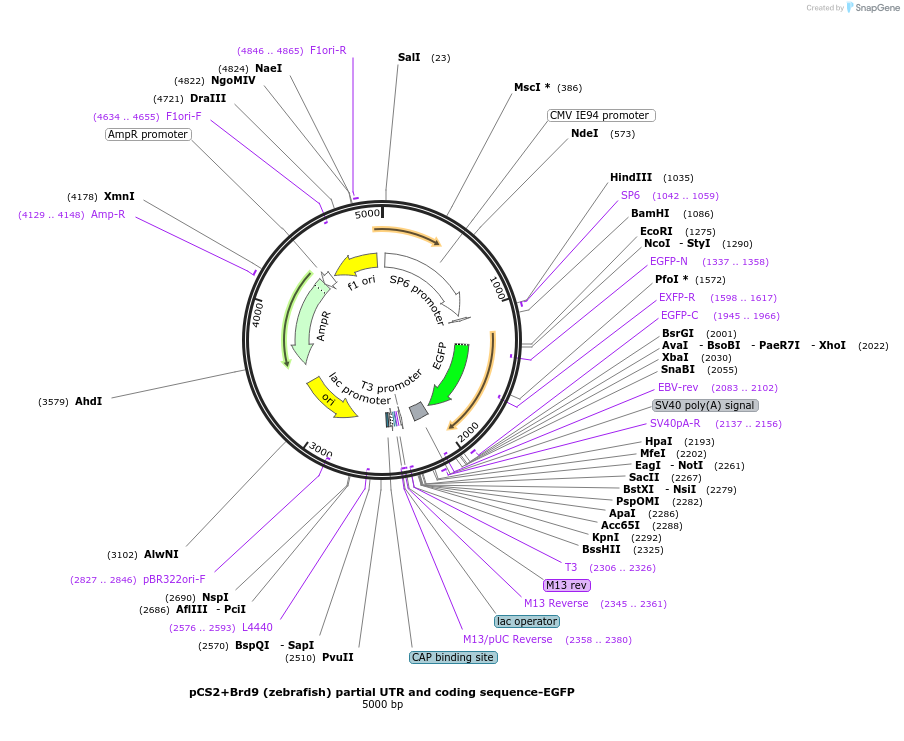
pCS2+Brd9 (zebrafish) partial UTR and coding sequence-EGFP
(Plasmid
#248787)
-
Purposefuse partial UTR and coding sequence of Brd9 (zebrafish) with EGFP reporter
-
Depositing Lab
-
Sequence Information
Ordering
This material is available to academics and nonprofits only.
| Item | Catalog # | Description | Quantity | Price (USD) | |
|---|---|---|---|---|---|
| Plasmid | 248787 | Standard format: Plasmid sent in bacteria as agar stab | 1 | $89 | |
Backbone
-
Vector backbonepCS2+
- Backbone size w/o insert (bp) 4817
- Total vector size (bp) 4998
-
Vector typeBrd9(zebrafish)-EGFP reporter
Growth in Bacteria
-
Bacterial Resistance(s)Ampicillin, 100 μg/mL
-
Growth Temperature37°C
-
Growth Strain(s)DH5alpha
-
Copy numberUnknown
Gene/Insert
-
Gene/Insert namebrd9
-
SpeciesD. rerio (zebrafish)
-
Entrez Genebrd9 (a.k.a. zgc:55797)
- Promoter partial 5'UTR sequence of zebrafish brd9
-
Tag
/ Fusion Protein
- EGFP (C terminal on backbone)
Cloning Information
- Cloning method Restriction Enzyme
- 5′ cloning site BamH1 (not destroyed)
- 3′ cloning site EcoR1 (not destroyed)
- 5′ sequencing primer gcaagcttgatttaggtgaca
- (Common Sequencing Primers)
Terms and Licenses
-
Academic/Nonprofit Terms
-
Industry Terms
- Not Available to Industry
Trademarks:
- Zeocin® is an InvivoGen trademark.
How to cite this plasmid
( Back to top)
These plasmids were created by your colleagues. Please acknowledge the Principal Investigator, cite the article in which the plasmids were described, and include Addgene in the Materials and Methods of your future publications.
-
For your Materials & Methods section:
pCS2+Brd9 (zebrafish) partial UTR and coding sequence-EGFP was a gift from Wenyan Ren (Addgene plasmid # 248787 ; http://n2t.net/addgene:248787 ; RRID:Addgene_248787) -
For your References section:
Integrative analysis reveals synergistic regulation of Sp7 by BRD9 and Wnt/beta-catenin signaling during osteogenic differentiation. Wu L, Wang L, Zhuang Y, Luo Y, Zhu Q, Maimaitizunong M, Wang Y, Cheng Z, Li Y, Sheng X, Li M, Luo Q, Jiang X, Lei S, Lin X, Zhong Y, Ren W. Commun Biol. 2025 Dec 1. doi: 10.1038/s42003-025-09278-z. 10.1038/s42003-025-09278-z PubMed 41326797