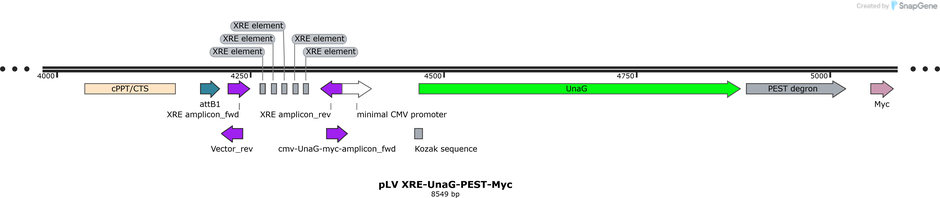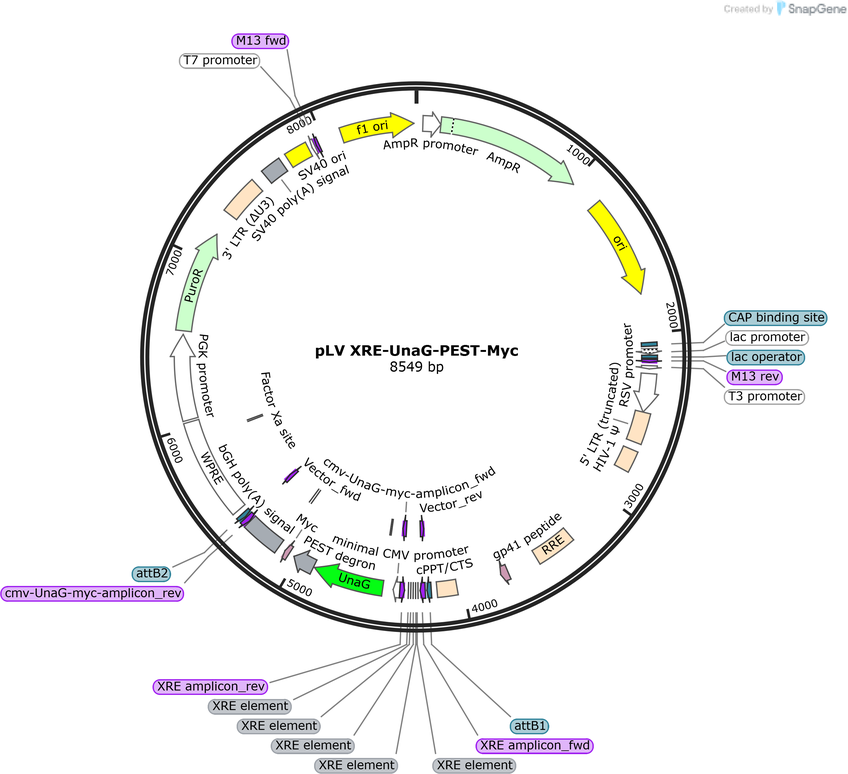
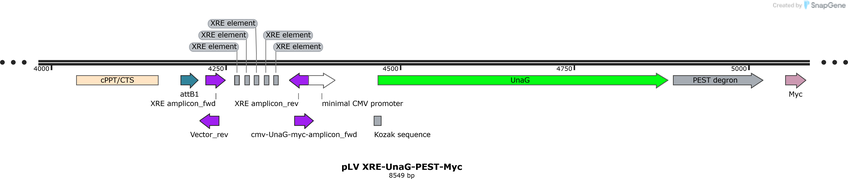



pLV-XRE-dUnaG-PEST-Myc
(Plasmid
#252287)
-
PurposeReporter for Ahr activity
-
Depositing Lab
-
Publication
-
Sequence Information
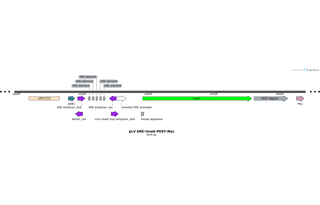


Ordering
This material is available to academics and nonprofits only.
| Item | Catalog # | Description | Quantity | Price (USD) | |
|---|---|---|---|---|---|
| Plasmid | 252287 | Standard format: Plasmid sent in bacteria as agar stab | 1 | $89 | |
Backbone
-
Vector backbonepLenti-HRE-dUnaG (#124372)
-
Backbone manufacturerRoland Friedel
- Backbone size w/o insert (bp) 7728
- Total vector size (bp) 8549
-
Modifications to backboneXREs was inserted instead of the HRE element
-
Vector typeLentiviral
-
Selectable markersPuromycin
Growth in Bacteria
-
Bacterial Resistance(s)Ampicillin, 100 μg/mL
-
Growth Temperature37°C
-
Growth Strain(s)NEB Stable
-
Copy numberHigh Copy
Gene/Insert 1
-
Gene/Insert nameXenobiotic Response Elements (XREs) core motif promoter
-
Alt nameAhR response elements (AHREs)
-
Alt nameDioxin response elements (DREs)
-
SpeciesM. musculus (mouse)
-
Insert Size (bp)145
-
GenBank ID
- Promoter XRE (Xenobiotic response element 5X + CMV minimal promoter)
Cloning Information for Gene/Insert 1
- Cloning method Gateway Cloning
- 5′ sequencing primer ccccttcacccttacttacttagcggccgc
- 3′ sequencing primer ggtcgacctcgaggcatggtcgagatct
- (Common Sequencing Primers)
Gene/Insert 2
-
Gene/Insert namedUnaG-PEST-degron
-
SpeciesAnguilla japonica
-
Insert Size (bp)615
-
Tag
/ Fusion Protein
- c-myc tag (C terminal on insert)
Resource Information
-
A portion of this plasmid was derived from a plasmid made by### The XRE element was obtained form Addgene plasmid pTXRE5-Z #112509 REF: A human aryl hydrocarbon receptor signaling pathway constructed in yeast displays additive responses to ligand mixtures. Miller CA 3rd. Toxicol Appl Pharmacol. 1999 Nov 1;160(3):297-303. doi: 10.1006/taap.1999.8769. 10.1006/taap.1999.8769 PubMed 10544064. ### The dUnaG plasmid was obtained from Dr. Friedemann Kiefer's laboratory REF: A novel family of fluorescent hypoxia sensors reveal strong heterogeneity in tumor hypoxia at the cellular level. R. Erapaneedi, V.V. Belousov, M. Schäfers, F. Kiefer. EMBO J., 35 (2016), pp. 102-113, 10.15252/embj.201592775. ### The pLenti-HRE-dUnaG backbone was obtain from Addgene plasmid #124372 REF: Sattiraju A, Kang S, Giotti B, Chen Z, Marallano VJ, Brusco C, Ramakrishnan A, Shen L, Tsankov AM, Hambardzumyan D, Friedel RH, Zou H. Immunity. 2023 Jul 7:S1074-7613(23)00274-1. doi: 10.1016/j.immuni.2023.06.017. 10.1016/j.immuni.2023.06.017
Terms and Licenses
-
Academic/Nonprofit Terms
-
Industry Terms
- Not Available to Industry
Trademarks:
- Zeocin® is an InvivoGen trademark.
How to cite this plasmid
( Back to top)
These plasmids were created by your colleagues. Please acknowledge the Principal Investigator, cite the article in which the plasmids were described, and include Addgene in the Materials and Methods of your future publications.
-
For your Materials & Methods section:
pLV-XRE-dUnaG-PEST-Myc was a gift from Roland Friedel (Addgene plasmid # 252287 ; http://n2t.net/addgene:252287 ; RRID:Addgene_252287)
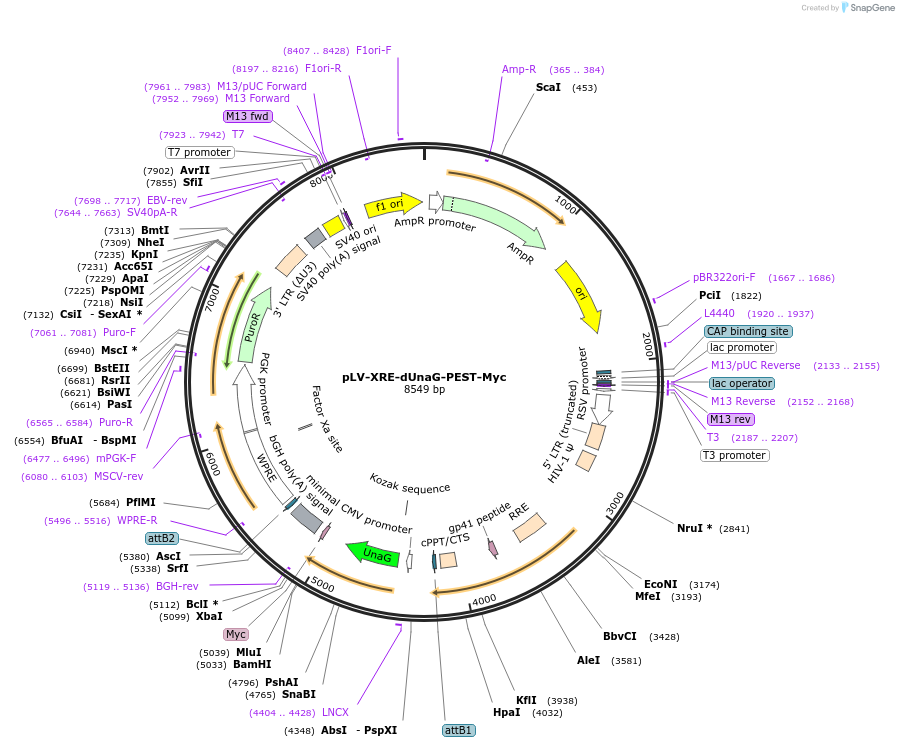
Map uploaded by the depositor.
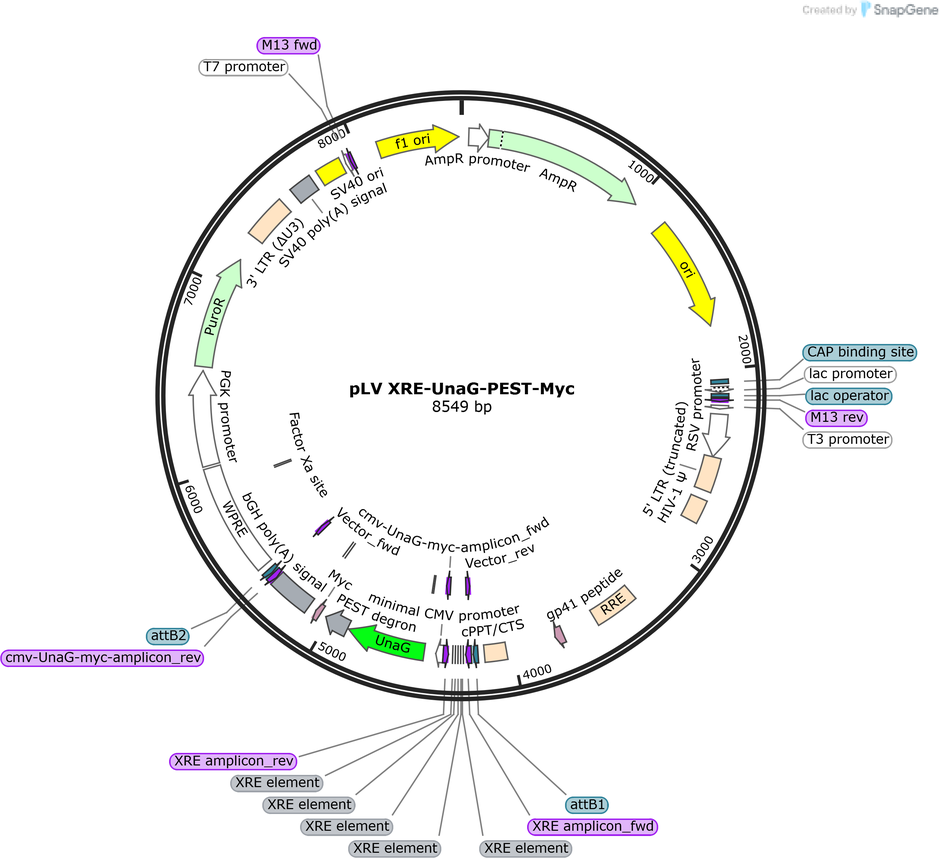
Map uploaded by the depositor.