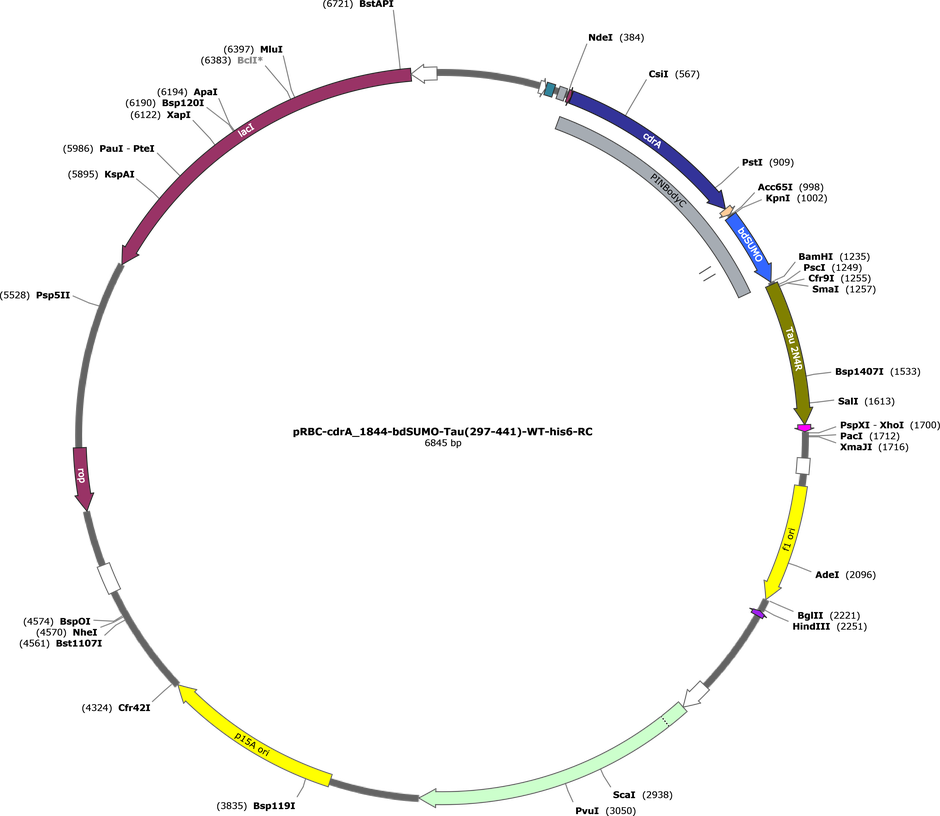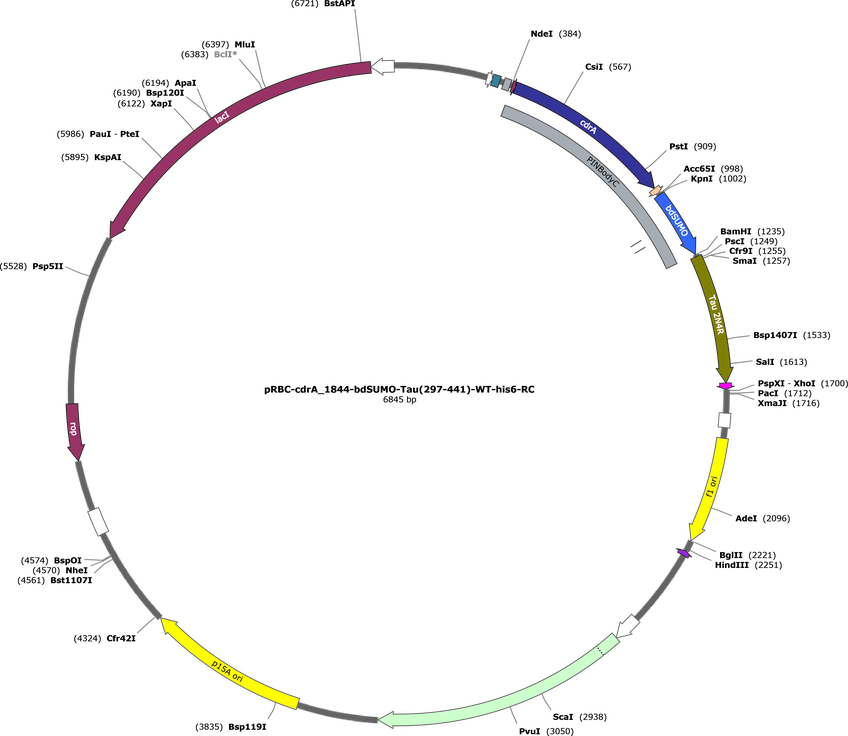



pRBC-PINBodyC-Tau(297-441)-WT-his6
(Plasmid
#253344)
-
PurposeExpress in E.coli, Inclusion body tagged protein expression, Tau 2N4R residues 297-441
-
Depositing Lab
-
Depositing OrganizationOregon State University
Located in the United States of America -
Sequence Information

Ordering
This material is available to academics and nonprofits only.
| Item | Catalog # | Description | Quantity | Price (USD) | |
|---|---|---|---|---|---|
| Plasmid | 253344 | Standard format: Plasmid sent in bacteria as agar stab | 1 | $94 | |
Backbone
-
Vector backbonepRBC
-
Backbone manufacturercustom
- Total vector size (bp) 6845
-
Vector typeBacterial Expression
Growth in Bacteria
-
Bacterial Resistance(s)Ampicillin, 100 μg/mL
-
Growth Temperature37°C
-
Growth Strain(s)DH5alpha
-
Copy numberLow Copy
Gene/Insert
-
Gene/Insert nameTau 2N4R
-
SpeciesH. sapiens (human)
-
Insert Size (bp)456
-
Mutationdeleted amino acids 1-296
-
Entrez GeneMAPT (a.k.a. DDPAC, FTD1, FTDP-17, MAPTL, MSTD, MTBT1, MTBT2, PPND, PPP1R103, TAU, Tau-PHF6, tau-40)
- Promoter T7
-
Tags
/ Fusion Proteins
- His6 (C terminal on insert)
- PINBodyC (N terminal on backbone)
Cloning Information
- Cloning method Gibson Cloning
- 5′ sequencing primer TAATACGACTCACTATAGGG
- 3′ sequencing primer GCTAGTTATTGCTCAGCGG
- (Common Sequencing Primers)
Resource Information
Terms and Licenses
-
Academic/Nonprofit Terms
-
Industry Terms
- Not Available to Industry
Trademarks:
- Zeocin® is an InvivoGen trademark.
How to cite this plasmid
( Back to top)
These plasmids were created by your colleagues. Please acknowledge the Principal Investigator, cite the article in which the plasmids were described, and include Addgene in the Materials and Methods of your future publications.
-
For your Materials & Methods section:
pRBC-PINBodyC-Tau(297-441)-WT-his6 was a gift from Richard Cooley (Addgene plasmid # 253344 ; http://n2t.net/addgene:253344 ; RRID:Addgene_253344) -
For your References section:
Accessing intractable, phosphorylated intrinsically disordered proteins via a protease-cleavable inclusion body tag. Vesely CH, Stanisheuski S, Lien E, Reardon P, Chung PJ, Mehl RA, Cooley RB. Protein Sci. 2026 Apr;35(4):e70520. doi: 10.1002/pro.70520. 10.1002/pro.70520 PubMed 41820804
Ready-to-use antibodies


Looking for antibodies related to this plasmid? Check out this option:
Learn MoreRelated items:
Commonly requested with:
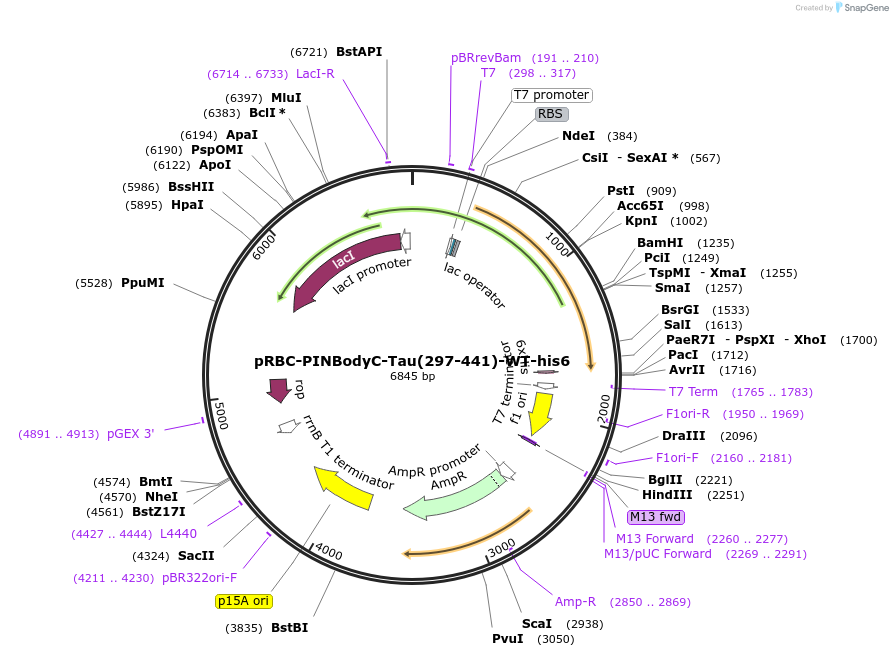
Map uploaded by the depositor.