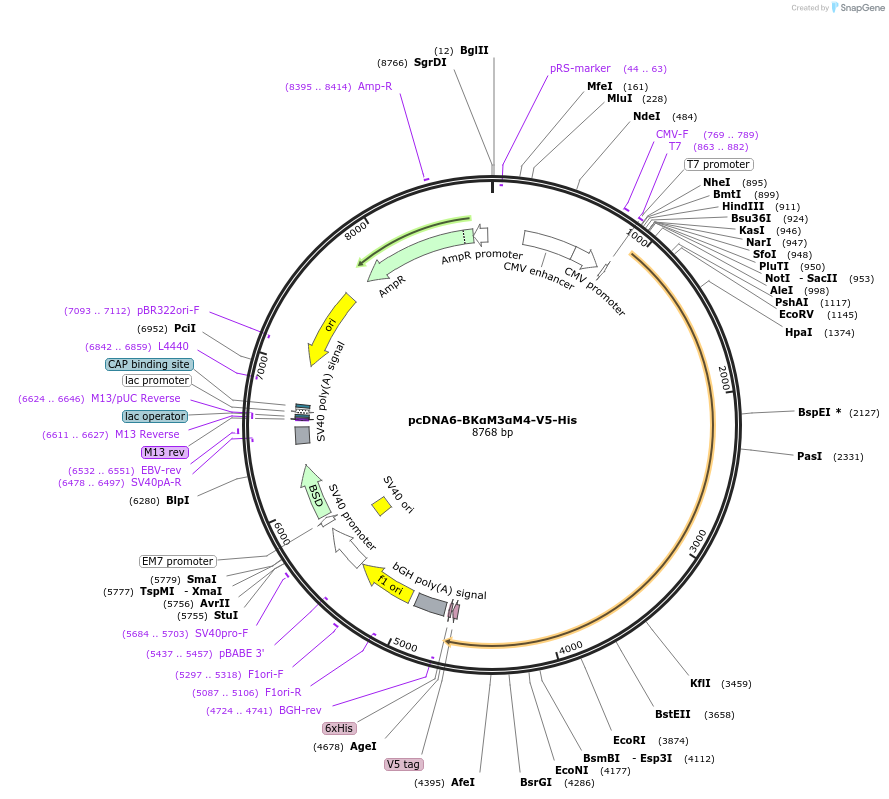
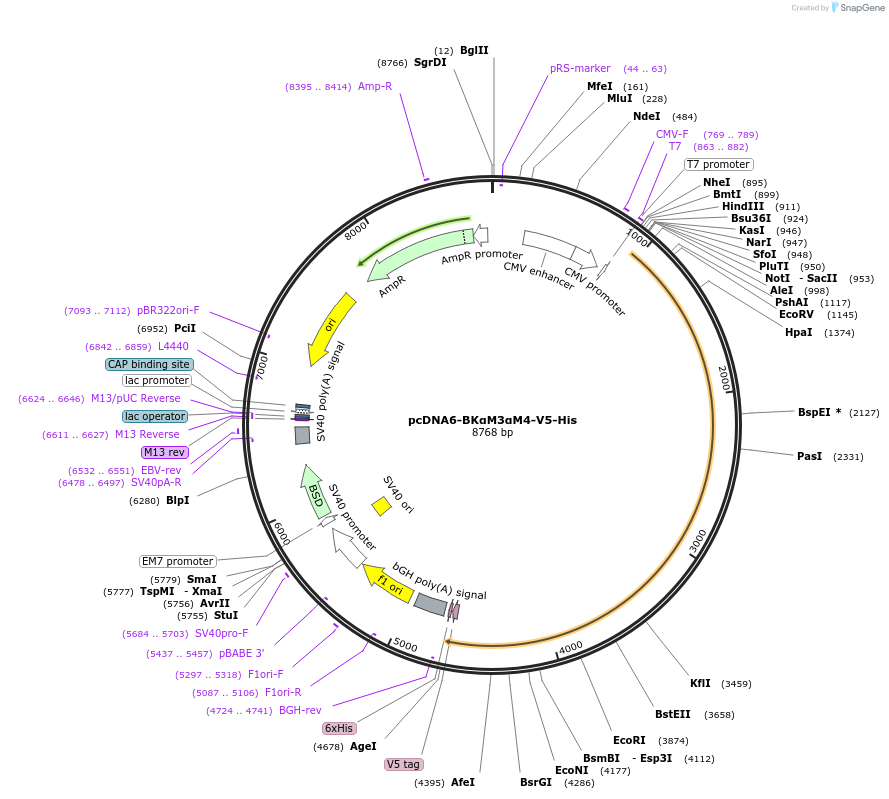
pcDNA6-BKαM3αM4-V5-His
(Plasmid
#255912)
-
PurposeBKαM dual-repeat expressing plasmid in which αM3 (residues 44–649) is preceded by an N-terminal sequence (MGAAAA) containing a NotI site and linked to αM4 (residues 43–649) via a flexible linker.
-
Depositing Lab
-
Depositing OrganizationUniversity of Texas MD Anderson Cancer Center
Located in the United States of America -
Sequence Information
Ordering
This material is available to academics and nonprofits only.
| Item | Catalog # | Description | Quantity | Price (USD) | |
|---|---|---|---|---|---|
| Plasmid | 255912 | Standard format: Plasmid sent in bacteria as agar stab | 1 | $94 | |
Backbone
-
Vector backbonepcDNA6
-
Vector typeMammalian Expression
-
Selectable markersBlasticidin
Growth in Bacteria
-
Bacterial Resistance(s)Ampicillin, 100 μg/mL
-
Growth Temperature37°C
-
Growth Strain(s)DH5alpha
-
Copy numberUnknown
Gene/Insert
-
Gene/Insert nameKCNMA1 (partial)
-
Alt nameBK channel
-
SpeciesH. sapiens (human)
-
Mutationcontains αM3 (residues 44–649) preceded by an N-terminal sequence (MGAAAA) linked to αM4 (residues 43–649) via a flexible linker
-
Entrez GeneKCNMA1 (a.k.a. BKTM, CADEDS, IEG16, KCa1.1, LIWAS, MaxiK, PNKD3, SAKCA, SLO, SLO-ALPHA, SLO1, bA205K10.1, hSlo, mSLO1)
-
Tag
/ Fusion Protein
- V5-6xHis (C terminal on insert)
Cloning Information
- Cloning method Gene Synthesis
- 5′ sequencing primer CMV
- 3′ sequencing primer BGH
- (Common Sequencing Primers)
Resource Information
Terms and Licenses
-
Academic/Nonprofit Terms
-
Industry Terms
- Not Available to Industry
Trademarks:
- Zeocin® is an InvivoGen trademark.
How to cite this plasmid
( Back to top)
These plasmids were created by your colleagues. Please acknowledge the Principal Investigator, cite the article in which the plasmids were described, and include Addgene in the Materials and Methods of your future publications.
-
For your Materials & Methods section:
pcDNA6-BKαM3αM4-V5-His was a gift from Jiusheng Yan (Addgene plasmid # 255912 ; http://n2t.net/addgene:255912 ; RRID:Addgene_255912) -
For your References section:
Concatenated modular BK channel constructs reveal divergent stoichiometry in gating control by LRRC26 (gamma1), pore, and selectivity filter. Chen G, Li Q, Shah K, Yan J. Elife. 2026 Mar 5;14:RP107681. doi: 10.7554/eLife.107681. 10.7554/eLife.107681 PubMed 41784352