



-
PurposeExpresses 3xFLAG-dCas9 in mammalian cells for enChIP analysis to purify specific genomic regions of interest.
-
Depositing Lab
-
Depositing OrganizationThe University of Osaka
Located in Japan -
Citations
-
Sequence Information


Ordering
| Item | Catalog # | Description | Quantity | Price (USD) | |
|---|---|---|---|---|---|
| Plasmid | 47948 | Standard format: Plasmid sent in bacteria as agar stab | 1 | $94 | |
| DNA | 47948-D50 | 50 μg of DNA in Tris buffer | $495 | ||
| DNA | 47948-D100 | 100 μg of DNA in Tris buffer | $585 | ||
Backbone
-
Vector backbonepCMV-7.1
-
Backbone manufacturerSigma-Aldrich
- Backbone size w/o insert (bp) 4636
- Total vector size (bp) 8848
-
Vector typeMammalian Expression, CRISPR
Growth in Bacteria
-
Bacterial Resistance(s)Ampicillin, 100 μg/mL
-
Growth Temperature30°C
-
Growth Strain(s)NEB Stable
-
Copy numberHigh Copy
Gene/Insert
-
Gene/Insert name3xFLAG-dCas9
-
Insert Size (bp)4212
-
Mutationhuman codon-optimized, D10A + H840A (catalytically inactive)
- Promoter CMV
-
Tags
/ Fusion Proteins
- 3xFLAG (N terminal on insert)
- NLS (C terminal on insert)
Cloning Information
- Cloning method Restriction Enzyme
- 5′ cloning site Hind III (destroyed during cloning)
- 3′ cloning site EcoR V (destroyed during cloning)
- 5′ sequencing primer AAT GTC GTA ATA ACC CCG CCC CGT TGA CGC
- 3′ sequencing primer TAT TAG GAC AAG GCT GGT GGG CAC
- (Common Sequencing Primers)
Terms and Licenses
-
Academic/Nonprofit Terms
-
Industry Terms
- Not Available to Industry
Trademarks:
- Zeocin® is an InvivoGen trademark.
Depositor Comments
This plasmid can be used to isolate specific genomic regions of interest using a catalytically inactive Cas9 fused with a tag(s).
Purify: locus-specific chromatin immunoprecipitation (enChIP)
This system is compatible with gRNA_cloning_vector (www.addgene.org/41824) from the Church lab.
Additional information and protocols can be found at:
http://www.med.hirosaki-u.ac.jp/~bgb/iChIP_protocols/index_e.html
DNA (Catalog # 47948-D50)
Purpose
Ready-to-use, high-purity DNA prep. DNA aliquots are suitable for use in mammalian cell transfections and other molecular biology applications.
Delivery
- Amount 50 μg
- Concentration 1 μg/μL
- Pricing $495 USD
- Storage 4 ℃ (short-term) or -20 ℃ (long-term)
Terms and Licenses
-
Academic/Nonprofit Terms
-
Industry Terms
- Not Available to Industry
Quality Control
Every DNA prep is verified by next-generation sequencing, confirming plasmid identity, sequence integrity, and absence of DNA contaminants. Concentration is confirmed to be within ±2.5% of the stated concentration.
Our production process has been validated to consistently yield endotoxin levels below 1.0 EU/μg. Individual lots are not tested for endotoxin.
DNA (Catalog # 47948-D100)
Purpose
Ready-to-use, high-purity DNA prep. DNA aliquots are suitable for use in mammalian cell transfections and other molecular biology applications.
Delivery
- Amount 100 μg
- Concentration 1 μg/μL
- Pricing $585 USD
- Storage 4 ℃ (short-term) or -20 ℃ (long-term)
Terms and Licenses
-
Academic/Nonprofit Terms
-
Industry Terms
- Not Available to Industry
Quality Control
Every DNA prep is verified by next-generation sequencing, confirming plasmid identity, sequence integrity, and absence of DNA contaminants. Concentration is confirmed to be within ±2.5% of the stated concentration.
Our production process has been validated to consistently yield endotoxin levels below 1.0 EU/μg. Individual lots are not tested for endotoxin.
These plasmids were created by your colleagues. Please acknowledge the Principal Investigator, cite the article in which the plasmids were described, and include Addgene in the Materials and Methods of your future publications.
-
For your Materials & Methods section:
3xFLAG-dCas9/pCMV-7.1 was a gift from Hodaka Fujii (Addgene plasmid # 47948 ; http://n2t.net/addgene:47948 ; RRID:Addgene_47948) -
For your References section:
Efficient isolation of specific genomic regions and identification of associated proteins by engineered DNA-binding molecule-mediated chromatin immunoprecipitation (enChIP) using CRISPR. Fujita T, Fujii H. Biochem Biophys Res Commun. 2013 Sep 13;439(1):132-6. doi: 10.1016/j.bbrc.2013.08.013. Epub 2013 Aug 11. 10.1016/j.bbrc.2013.08.013 PubMed 23942116
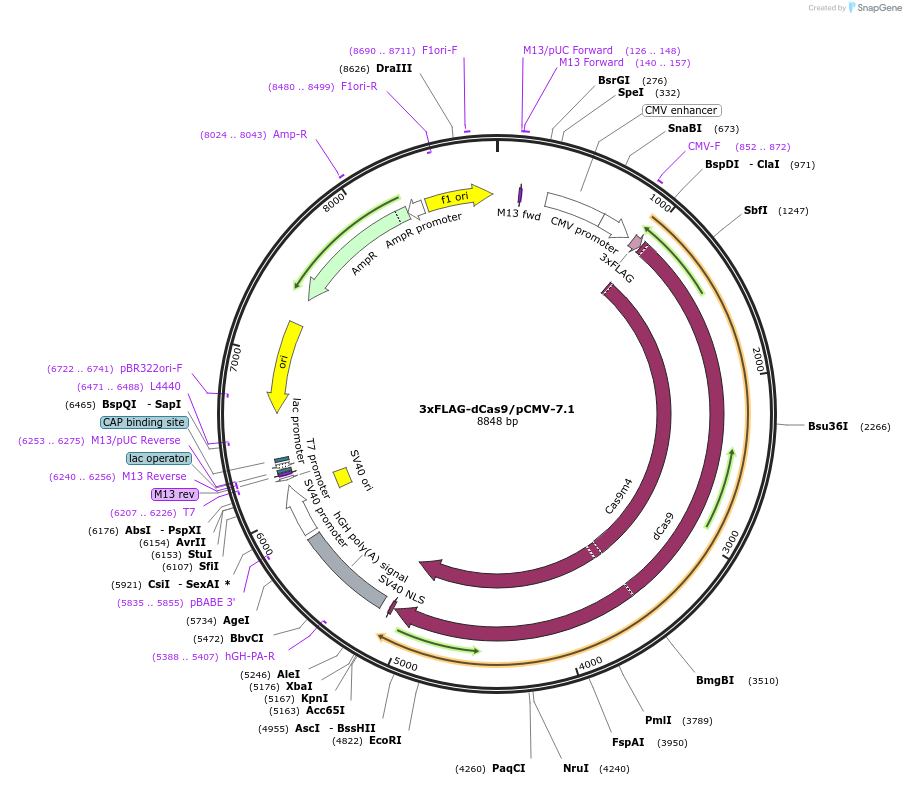
Map uploaded by the depositor.
