



-
PurposeExpresses knockdown-proof human CHC17 tagged with GFP.
-
Depositing Lab
-
Depositing OrganizationUniversity of Liverpool
Located in United Kingdom of Great Britain and Northern Ireland -
Citations
-
Sequence Information


Ordering
| Item | Catalog # | Description | Quantity | Price (USD) | |
|---|---|---|---|---|---|
| Plasmid | 59799 | Standard format: Plasmid sent in bacteria as agar stab | 1 | $94 | |
| DNA | 59799-D50 | 50 μg of DNA in Tris buffer | $495 | ||
| DNA | 59799-D100 | 100 μg of DNA in Tris buffer | $585 | ||
Backbone
-
Vector backbonepEGFP-C1
- Backbone size w/o insert (bp) 4697
- Total vector size (bp) 10646
-
Vector typeMammalian Expression
-
Selectable markersNeomycin (select with G418)
Growth in Bacteria
-
Bacterial Resistance(s)Kanamycin, 50 μg/mL
-
Growth Temperature37°C
-
Growth Strain(s)XL10 Gold
-
Growth instructionsOn transformation of E. coli with normal protocols, colonies take longer to form and are very small. If you have trouble growing the bugs, pick a few colonies and grow at 37°C, 220rpm in 5ml aliquots of LB + Kanamycin (half-strength). If there is little growth after 18-24 h, re-seed 0.5 ml of the culture into a fresh 5 ml aliquot of LB + kanamycin (half-strength). Grow at 37 °C, 220 rpm. Repeat if necessary. Larger volumes can be obtained by normal protocols.
-
Copy numberUnknown
Gene/Insert
-
Gene/Insert nameCHC17
-
Alt nameCLTC
-
Alt nameCHC
-
SpeciesH. sapiens (human)
-
Insert Size (bp)5949
-
MutationSilent mutations in amino acids 61-65 to confer siRNA resistance.
-
GenBank IDNM_001288653.1
-
Entrez GeneCLTC (a.k.a. CHC, CHC17, CLH-17, CLTCL2, Hc, MRD56)
- Promoter CMV
-
Tag
/ Fusion Protein
- GFP (N terminal on backbone)
Cloning Information
- Cloning method Restriction Enzyme
- 5′ cloning site BglII (not destroyed)
- 3′ cloning site SacII (not destroyed)
- 5′ sequencing primer pEGFP-C2_FP
- 3′ sequencing primer pEGFP-C2_RP
- (Common Sequencing Primers)
Terms and Licenses
-
Academic/Nonprofit Terms
-
Industry Terms
- Not Available to Industry
Trademarks:
- Zeocin® is an InvivoGen trademark.
DNA (Catalog # 59799-D50)
Purpose
Ready-to-use, high-purity DNA prep. DNA aliquots are suitable for use in mammalian cell transfections and other molecular biology applications.
Delivery
- Amount 50 μg
- Concentration 1 μg/μL
- Pricing $495 USD
- Storage 4 ℃ (short-term) or -20 ℃ (long-term)
Terms and Licenses
-
Academic/Nonprofit Terms
-
Industry Terms
- Not Available to Industry
Quality Control
Every DNA prep is verified by next-generation sequencing, confirming plasmid identity, sequence integrity, and absence of DNA contaminants. Concentration is confirmed to be within ±2.5% of the stated concentration.
Our production process has been validated to consistently yield endotoxin levels below 1.0 EU/μg. Individual lots are not tested for endotoxin.
DNA (Catalog # 59799-D100)
Purpose
Ready-to-use, high-purity DNA prep. DNA aliquots are suitable for use in mammalian cell transfections and other molecular biology applications.
Delivery
- Amount 100 μg
- Concentration 1 μg/μL
- Pricing $585 USD
- Storage 4 ℃ (short-term) or -20 ℃ (long-term)
Terms and Licenses
-
Academic/Nonprofit Terms
-
Industry Terms
- Not Available to Industry
Quality Control
Every DNA prep is verified by next-generation sequencing, confirming plasmid identity, sequence integrity, and absence of DNA contaminants. Concentration is confirmed to be within ±2.5% of the stated concentration.
Our production process has been validated to consistently yield endotoxin levels below 1.0 EU/μg. Individual lots are not tested for endotoxin.
These plasmids were created by your colleagues. Please acknowledge the Principal Investigator, cite the article in which the plasmids were described, and include Addgene in the Materials and Methods of your future publications.
-
For your Materials & Methods section:
GFP-CHC17KDP was a gift from Stephen Royle (Addgene plasmid # 59799 ; http://n2t.net/addgene:59799 ; RRID:Addgene_59799) -
For your References section:
A TACC3/ch-TOG/clathrin complex stabilises kinetochore fibres by inter-microtubule bridging. Booth DG, Hood FE, Prior IA, Royle SJ. EMBO J. 2011 Mar 2;30(5):906-19. doi: 10.1038/emboj.2011.15. Epub 2011 Feb 4. 10.1038/emboj.2011.15 PubMed 21297582
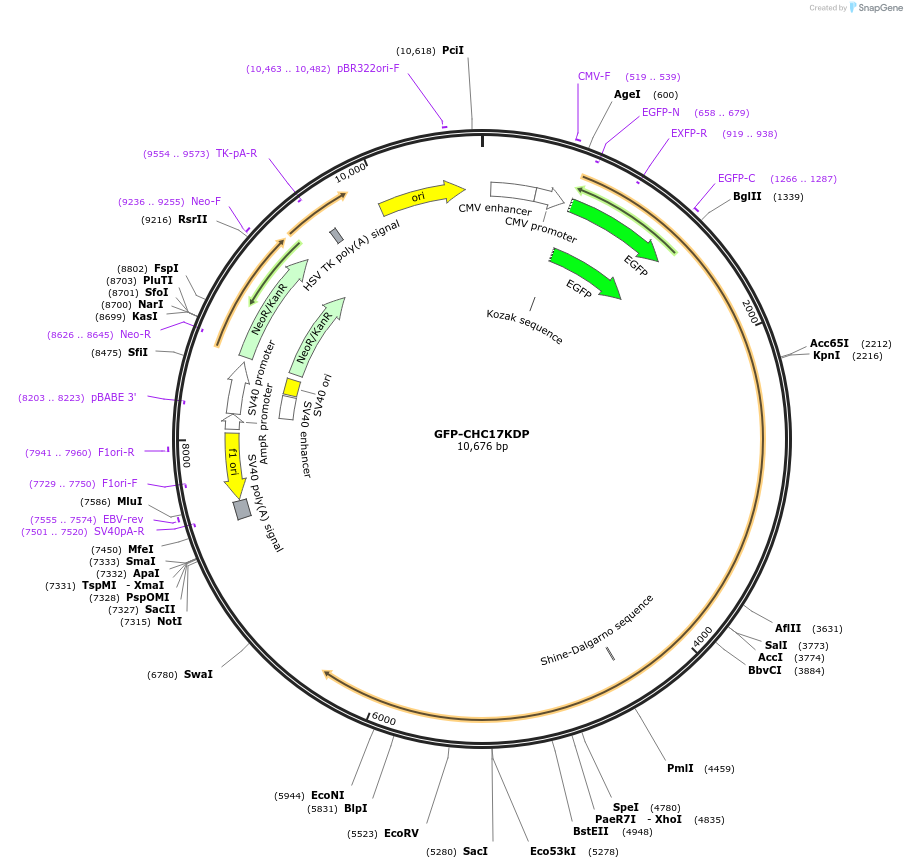
Map uploaded by the depositor.
