



-
PurposeFluorescent FPX sensor for PIP2
-
Depositing Lab
-
Depositing OrganizationMontana Molecular
Located in the United States of America -
Citations
-
Sequence Information


Ordering
| Item | Catalog # | Description | Quantity | Price (USD) | |
|---|---|---|---|---|---|
| Plasmid | 60937 | Standard format: Plasmid sent in bacteria as agar stab | 1 | $94 | |
| DNA | 60937-D50 | 50 μg of DNA in Tris buffer | $495 | ||
| DNA | 60937-D100 | 100 μg of DNA in Tris buffer | $585 | ||
Backbone
-
Vector backbonepUB2.1
- Total vector size (bp) 8093
-
Vector typeMammalian Expression
Growth in Bacteria
-
Bacterial Resistance(s)Ampicillin, 100 μg/mL
-
Growth Temperature37°C
-
Growth Strain(s)DH5alpha
-
Copy numberHigh Copy
Gene/Insert
-
Gene/Insert namePIP2 dimerization dependent sensor RA+B monomers
-
SpeciesSynthetic
-
Insert Size (bp)2604
- Promoter CMV
-
Tag
/ Fusion Protein
- dimerization dependent fluorescent protein monomers RA+B
Cloning Information
- Cloning method Ligation Independent Cloning
- 5′ sequencing primer atggtgagcaagagcgaggag
- 3′ sequencing primer ctggatgttgagctccttcaggaag
- (Common Sequencing Primers)
Resource Information
-
A portion of this plasmid was derived from a plasmid made byThe dimerization-dependent fluorescent protein component of the plasmid was received from Robert Campbell and was originally described in the manuscript below. Alford, S.C., Abdelfattah, A.S., Ding, Y., and Campbell, R.E. (2012). A fluorogenic red fluorescent protein heterodimer. Chem. Biol. 19, 353-360.
Terms and Licenses
-
Academic/Nonprofit Terms
-
Industry Terms
- Not Available to Industry
Trademarks:
- Zeocin® is an InvivoGen trademark.
Depositor Comments
Contains a dimerization dependent fluorescent protein, originally described by Alford, S.C., Ding, Y., Simmen, T., and Campbell, R.E. (2012). Dimerization-Dependent Green and Yellow Fluorescent Proteins. ACS Synth. Biol. 1, 569–575.
Addgene NGS results identified a frameshift mutation in the HygR gene originally indicated in this plasmid. The depositing lab has confirmed that their experiments were done with transient transfection and did not make use of Hygromycin selection. For users who need a mammalian selection marker, they recommend moving the biosensor coding region from this plasmid into a different plasmid backbone.
DNA (Catalog # 60937-D50)
Purpose
Ready-to-use, high-purity DNA prep. DNA aliquots are suitable for use in mammalian cell transfections and other molecular biology applications.
Delivery
- Amount 50 μg
- Concentration 1 μg/μL
- Pricing $495 USD
- Storage 4 ℃ (short-term) or -20 ℃ (long-term)
Terms and Licenses
-
Academic/Nonprofit Terms
-
Industry Terms
- Not Available to Industry
Quality Control
Every DNA prep is verified by next-generation sequencing, confirming plasmid identity, sequence integrity, and absence of DNA contaminants. Concentration is confirmed to be within ±2.5% of the stated concentration.
Our production process has been validated to consistently yield endotoxin levels below 1.0 EU/μg. Individual lots are not tested for endotoxin.
DNA (Catalog # 60937-D100)
Purpose
Ready-to-use, high-purity DNA prep. DNA aliquots are suitable for use in mammalian cell transfections and other molecular biology applications.
Delivery
- Amount 100 μg
- Concentration 1 μg/μL
- Pricing $585 USD
- Storage 4 ℃ (short-term) or -20 ℃ (long-term)
Terms and Licenses
-
Academic/Nonprofit Terms
-
Industry Terms
- Not Available to Industry
Quality Control
Every DNA prep is verified by next-generation sequencing, confirming plasmid identity, sequence integrity, and absence of DNA contaminants. Concentration is confirmed to be within ±2.5% of the stated concentration.
Our production process has been validated to consistently yield endotoxin levels below 1.0 EU/μg. Individual lots are not tested for endotoxin.
These plasmids were created by your colleagues. Please acknowledge the Principal Investigator, cite the article in which the plasmids were described, and include Addgene in the Materials and Methods of your future publications.
-
For your Materials & Methods section:
pPHT-PIP2 was a gift from Anne Marie Quinn (Addgene plasmid # 60937 ; http://n2t.net/addgene:60937 ; RRID:Addgene_60937) -
For your References section:
Ratiometric biosensors based on dimerization-dependent fluorescent protein exchange. Ding Y, Li J, Enterina JR, Shen Y, Zhang I, Tewson PH, Mo GC, Zhang J, Quinn AM, Hughes TE, Maysinger D, Alford SC, Zhang Y, Campbell RE. Nat Methods. 2015 Jan 26. doi: 10.1038/nmeth.3261. 10.1038/nmeth.3261 PubMed 25622108
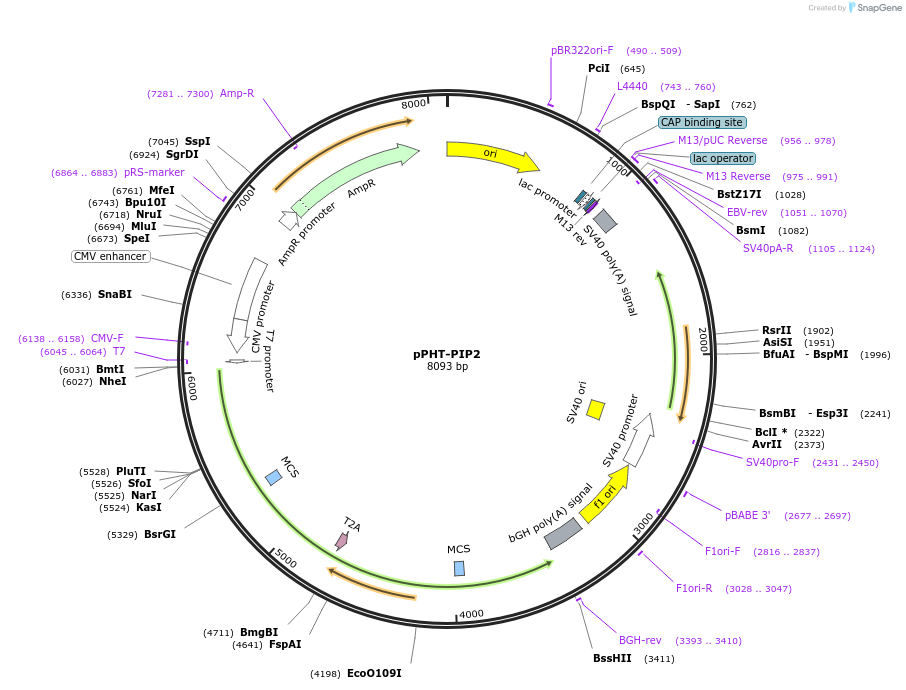
Map uploaded by the depositor.
