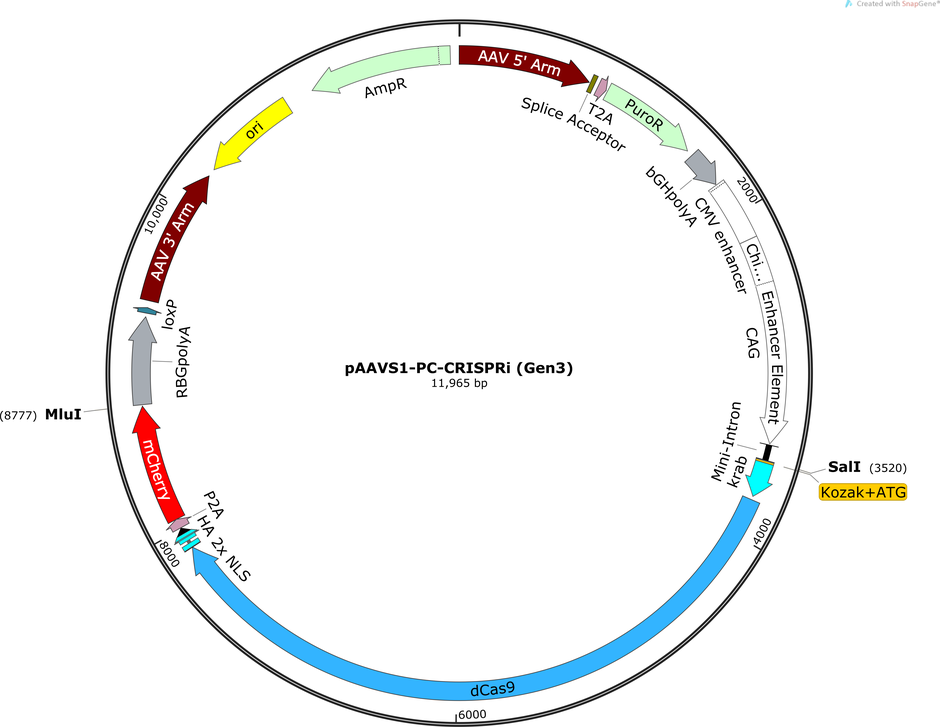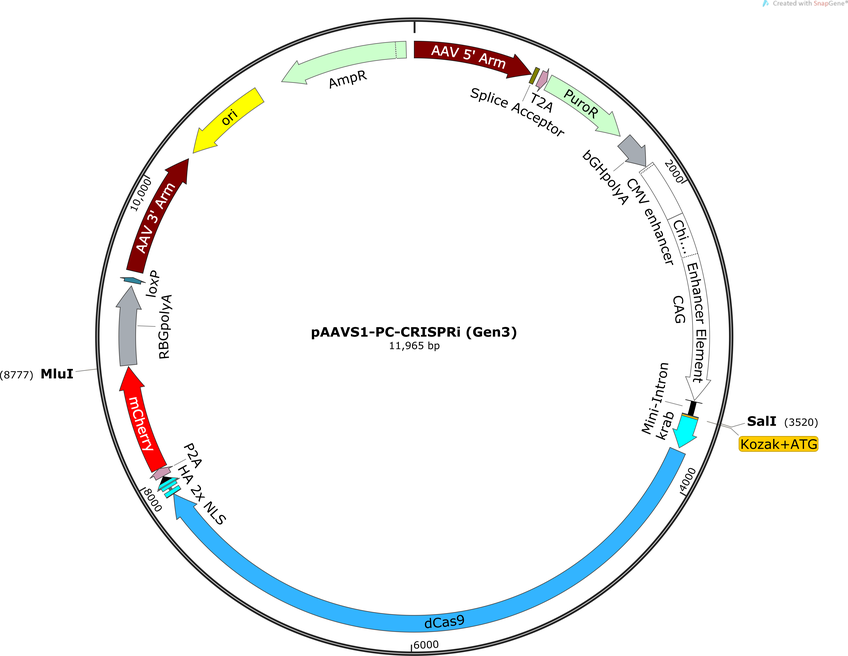


pAAVS1-PC-CRISPRi (Gen3)
(Plasmid
#85507)
-
PurposeConstitutive CRISPR interference (CRISPRi) knock in construct into the AAVS1 locus
-
Depositing Lab
-
Depositing OrganizationJ. David Gladstone Institutes
Located in United States of America -
Sequence Information


Ordering
This material is available to academics and nonprofits only.
| Item | Catalog # | Description | Quantity | Price (USD) | |
|---|---|---|---|---|---|
| Plasmid | 85507 | Standard format: Plasmid sent in bacteria as agar stab | 1 | $94 | |
Backbone
-
Vector backbonepAAVS1
- Backbone size w/o insert (bp) 3356
- Total vector size (bp) 11965
-
Vector typeMammalian Expression, CRISPR
-
Selectable markersNeomycin (select with G418), Puromycin
Growth in Bacteria
-
Bacterial Resistance(s)Ampicillin, 100 μg/mL
-
Growth Temperature37°C
-
Growth Strain(s)NEB Stable
-
Copy numberHigh Copy
Gene/Insert
-
Gene/Insert nameAAVS1
-
SpeciesH. sapiens (human), Synthetic
-
Insert Size (bp)1264
-
Entrez GeneAAVS1 (a.k.a. AAV)
-
Tag
/ Fusion Protein
- gCaMP6f (C terminal on insert)
Resource Information
-
A portion of this plasmid was derived from a plasmid made byThe GCaMP6f transgene was a gift Douglas Kim
Terms and Licenses
-
Academic/Nonprofit Terms
-
Industry Terms
- Not Available to Industry
Trademarks:
- Zeocin® is an InvivoGen trademark.
How to cite this plasmid
( Back to top)
These plasmids were created by your colleagues. Please acknowledge the Principal Investigator, cite the article in which the plasmids were described, and include Addgene in the Materials and Methods of your future publications.
-
For your Materials & Methods section:
pAAVS1-PC-CRISPRi (Gen3) was a gift from Bruce Conklin (Addgene plasmid # 85507) -
For your References section:
CRISPR Interference Efficiently Induces Specific and Reversible Gene Silencing in Human iPSCs. Mandegar MA, Huebsch N, Frolov EB, Shin E, Truong A, Olvera MP, Chan AH, Miyaoka Y, Holmes K, Spencer CI, Judge LM, Gordon DE, Eskildsen TV, Villalta JE, Horlbeck MA, Gilbert LA, Krogan NJ, Sheikh SP, Weissman JS, Qi LS, So PL, Conklin BR. Cell Stem Cell. 2016 Apr 7;18(4):541-53. doi: 10.1016/j.stem.2016.01.022. Epub 2016 Mar 10. 10.1016/j.stem.2016.01.022 PubMed 26971820
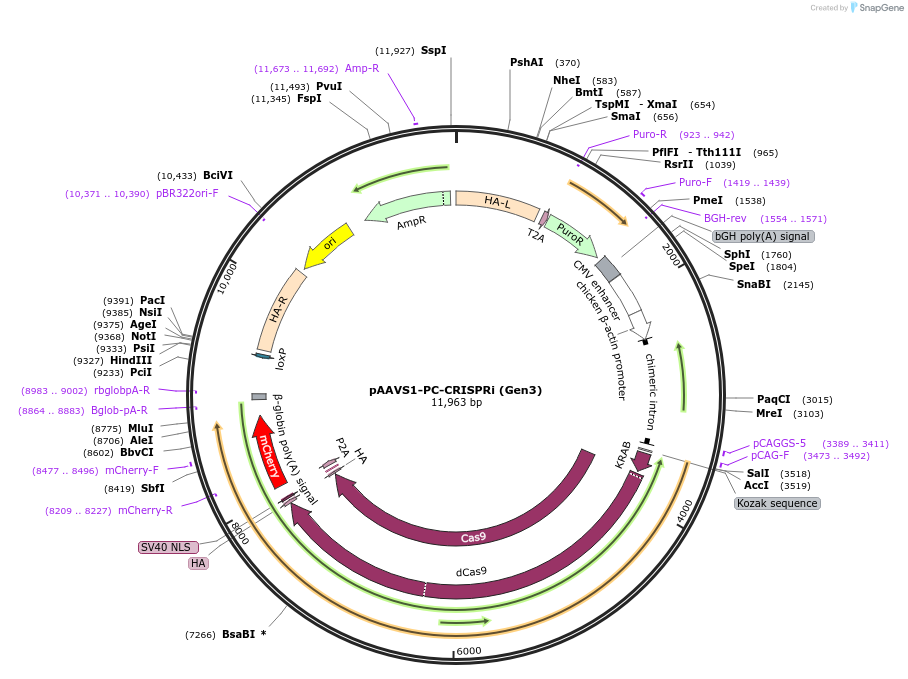
Map uploaded by the depositor.