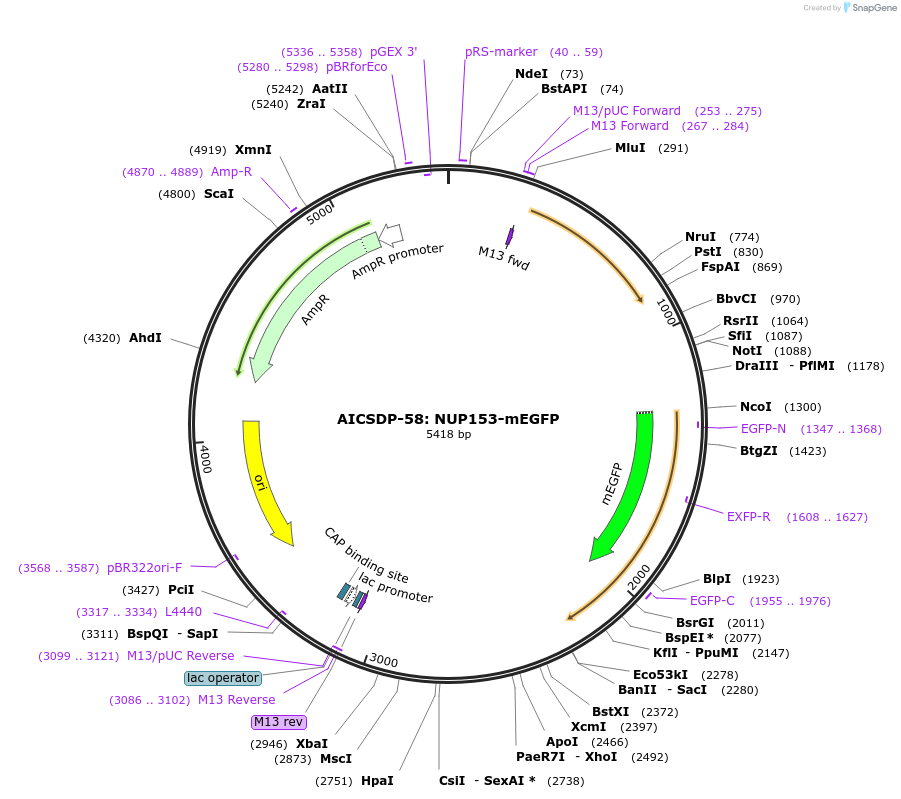
AICSDP-58: NUP153-mEGFP
(Plasmid
#114407)
-
PurposeHomology arms and mEGFP-linker sequence for N-terminus tagging of human NUP153
-
Depositing Lab
-
Depositing OrganizationAllen Institute
Located in the United States of America -
Publication
-
Sequence Information
Ordering
| Item | Catalog # | Description | Quantity | Price (USD) | |
|---|---|---|---|---|---|
| Plasmid | 114407 | Standard format: Plasmid sent in bacteria as agar stab | 1 | $94 * | |
| DNA | 114407-D50 | 50 μg of DNA in Tris buffer | $495 * | ||
| DNA | 114407-D100 | 100 μg of DNA in Tris buffer | $585 * | ||
* Log in to view industry pricing.
Backbone
-
Vector backbonepUC57
-
Vector typeMammalian Expression, CRISPR ; Donor Template
Growth in Bacteria
-
Bacterial Resistance(s)Ampicillin, 100 μg/mL
-
Growth Temperature37°C
-
Growth Strain(s)DH5alpha
-
Copy numberHigh Copy
Gene/Insert
-
Gene/Insert nameNUP153 Homology Arms with mEGFP-linker
-
Alt nameHNUP153
-
SpeciesH. sapiens (human)
-
Insert Size (bp)2729
-
Mutationhomology arms contain point mutations to disrupt crRNA binding sites used
-
Entrez GeneNUP153 (a.k.a. HNUP153, N153)
-
Tag
/ Fusion Protein
- mEGFP-linker (N terminal on insert)
Cloning Information
- Cloning method Unknown
Resource Information
Terms and Licenses
-
Academic/Nonprofit Terms
-
Industry Terms
Trademarks:
- Zeocin® is an InvivoGen trademark.
Depositor Comments
This plasmid has been used with locus-specific CRISPR/Cas9 to add a mEGFP tag to the N-terminus of human NUP153 in WTC human induced pluripotent stem cells by the Allen Institute for Cell Science. Linker (AA) sequence: YSDLE. After protein tagging using this donor template plasmid and CRISPR/Cas9 reagents, transfected cells may exhibit varying intensity levels of fluorescence, likely due to editing precision. To obtain cells of uniform intensity levels, see our protocol for fluorescence-assisted cell sorting and subcloning of transfected cells (https://www.allencell.org/instructional-videos-and-tutorials-for-cell-methods.html) Further, we recommend PCR-based assays for identifying precisely edited clones as previously described (https://www.molbiolcell.org/doi/abs/10.1091/mbc.e17-03-0209) For more information on the entire plasmid collection, please see https://www.addgene.org/allen-institute-cell-science/ .
DNA (Catalog # 114407-D50)
Purpose
Ready-to-use, high-purity DNA prep. DNA aliquots are suitable for use in mammalian cell transfections and other molecular biology applications.
Delivery
- Amount 50 μg
- Concentration 1 μg/μL
- Pricing $495 USD
- Storage 4 ℃ (short-term) or -20 ℃ (long-term)
Terms and Licenses
-
Academic/Nonprofit Terms
-
Industry Terms
Quality Control
Every DNA prep is verified by next-generation sequencing, confirming plasmid identity, sequence integrity, and absence of DNA contaminants. Concentration is confirmed to be within ±2.5% of the stated concentration.
Our production process has been validated to consistently yield endotoxin levels below 1.0 EU/μg. Individual lots are not tested for endotoxin.
DNA (Catalog # 114407-D100)
Purpose
Ready-to-use, high-purity DNA prep. DNA aliquots are suitable for use in mammalian cell transfections and other molecular biology applications.
Delivery
- Amount 100 μg
- Concentration 1 μg/μL
- Pricing $585 USD
- Storage 4 ℃ (short-term) or -20 ℃ (long-term)
Terms and Licenses
-
Academic/Nonprofit Terms
-
Industry Terms
Quality Control
Every DNA prep is verified by next-generation sequencing, confirming plasmid identity, sequence integrity, and absence of DNA contaminants. Concentration is confirmed to be within ±2.5% of the stated concentration.
Our production process has been validated to consistently yield endotoxin levels below 1.0 EU/μg. Individual lots are not tested for endotoxin.
These plasmids were created by your colleagues. Please acknowledge the Principal Investigator, cite the article in which the plasmids were described, and include Addgene in the Materials and Methods of your future publications.
-
For your Materials & Methods section:
AICSDP-58: NUP153-mEGFP was a gift from Allen Institute for Cell Science (Addgene plasmid # 114407 ; http://n2t.net/addgene:114407 ; RRID:Addgene_114407)