



-
Purpose(Empty Backbone) 3rd generation lentiviral vector that expresses shRNA under the mouse U6 promoter. A CMV-EGFP reporter cassette is included in the vector to monitor expression.
-
Depositing Lab
-
Depositing OrganizationMassachusetts Institute of Technology
Located in the United States of America -
Publication
-
Citations
-
Sequence Information


Ordering
| Item | Catalog # | Description | Quantity | Price (USD) | |
|---|---|---|---|---|---|
| Plasmid | 11795 | Standard format: Plasmid sent in bacteria as agar stab | 1 | $94 | |
Backbone
-
Vector backbonepLL3.7
- Backbone size (bp) 7650
-
Vector typeMammalian Expression, Lentiviral, RNAi, Cre/Lox
-
Selectable markersGFP
Growth in Bacteria
-
Bacterial Resistance(s)Ampicillin, 100 μg/mL
-
Growth Temperature30°C
-
Growth Strain(s)NEB Stable
-
Copy numberHigh Copy
Gene/Insert
-
Gene/Insert nameNone
- Promoter mouse U6
Cloning Information
- Cloning method Restriction Enzyme
- 5′ cloning site HpaI (not destroyed)
- 3′ cloning site XhoI (not destroyed)
- 5′ sequencing primer U6 (5'-cagtgcaggggaaagaatagtagac-3')
- (Common Sequencing Primers)
Resource Information
Terms and Licenses
-
Academic/Nonprofit Terms
-
Industry Terms
- Not Available to Industry
Trademarks:
- Zeocin® is an InvivoGen trademark.
Depositor Comments
Lentiviral vector that expresses shRNA under the mouse U6 promoter. A CMV-EGFP reporter cassette is included in the vector to monitor expression.
For protocols regarding the use of pLL3.7, visit: http://web.mit.edu/jacks-lab/protocols/rnairesources.htm
Note: A single base pair deletion at position 11 of the U6 promoter in this plasmid does not impair the efficacy of this reagent.
These plasmids were created by your colleagues. Please acknowledge the Principal Investigator, cite the article in which the plasmids were described, and include Addgene in the Materials and Methods of your future publications.
-
For your Materials & Methods section:
pLL3.7 was a gift from Luk Parijs (Addgene plasmid # 11795 ; http://n2t.net/addgene:11795 ; RRID:Addgene_11795) -
For your References section:
A lentivirus-based system to functionally silence genes in primary mammalian cells, stem cells and transgenic mice by RNA interference. Rubinson DA, Dillon CP, Kwiatkowski AV, Sievers C, Yang L, Kopinja J, Rooney DL, Ihrig MM, McManus MT, Gertler FB, Scott ML, Van Parijs L. Nat Genet. 2003 Mar . 33(3):401-6. 10.1038/ng1117 PubMed 12590264
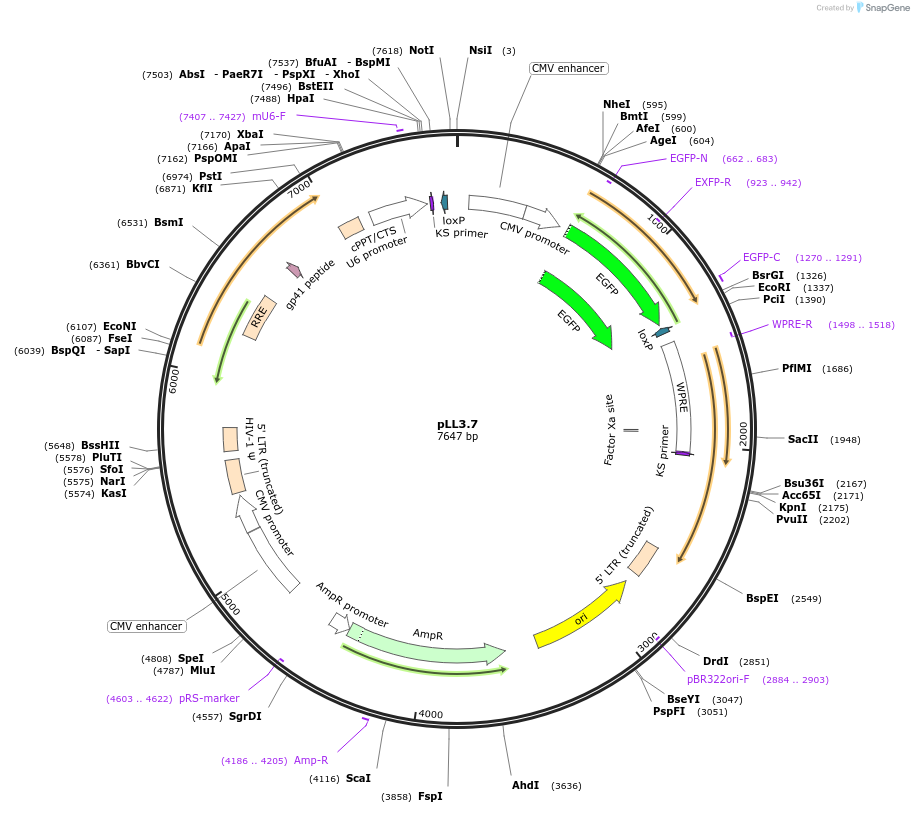
Map uploaded by the depositor.
