



GFP-Myo9b R1695M
(Plasmid
#134911)
-
PurposeExpression of rat Myo 9b (Myr 5) in mammalian cells.GAP minus mutant.
-
Depositing Lab
-
Depositing OrganizationUniversität Münster
Located in Germany -
Citations
-
Sequence Information


Ordering
| Item | Catalog # | Description | Quantity | Price (USD) | |
|---|---|---|---|---|---|
| Plasmid | 134911 | Standard format: Plasmid sent in bacteria as agar stab | 1 | $94 | |
| DNA | 134911-D50 | 50 μg of DNA in Tris buffer | $495 | ||
| DNA | 134911-D100 | 100 μg of DNA in Tris buffer | $585 | ||
Backbone
-
Vector backbonepEGFP-C1
-
Backbone manufacturerClontech
- Backbone size w/o insert (bp) 4686
- Total vector size (bp) 11535
-
Vector typeMammalian Expression
-
Selectable markersNeomycin (select with G418)
Growth in Bacteria
-
Bacterial Resistance(s)Kanamycin, 50 μg/mL
-
Growth Temperature37°C
-
Growth Strain(s)DH5alpha
-
Copy numberHigh Copy
Gene/Insert
-
Gene/Insert nameMyo 9b (rat) with 3' UTR. GAP minus mutant R1695M
-
Alt nameMyr 5 R1695M
-
SpeciesR. norvegicus (rat)
-
Insert Size (bp)6849
-
Mutationchanged arginine 1695 to methionine
-
Entrez GeneMyo9b
- Promoter CMV IE
-
Tag
/ Fusion Protein
- EGFP (N terminal on backbone)
Cloning Information
- Cloning method Restriction Enzyme
- 5′ cloning site Xho I (not destroyed)
- 3′ cloning site Sma I (destroyed during cloning)
- 5′ sequencing primer EGFP-C CATGGTCCTGCTGGAGTTCGTG
- 3′ sequencing primer SV40pA-R GAAATTTGTGATGCTATTGC
- (Common Sequencing Primers)
Terms and Licenses
-
Academic/Nonprofit Terms
-
Industry Terms
- Not Available to Industry
Trademarks:
- Zeocin® is an InvivoGen trademark.
Depositor Comments
See also:
Van den Boom et al.
Molecular Biology of the Cell Vol. 18, No. 4, 1507-1518, April 2007
The Myosin IXb Motor Activity Targets the Myosin IXb RhoGAP Domain as Cargo to Sites of Actin Polymerization.
Published Online:21 Feb 2007https://doi.org/10.1091/mbc.e06-08-0771
Please note: Plasmid contains a T721I mutation in Myo9b. This mutation is not known to affect protein function.
DNA (Catalog # 134911-D50)
Purpose
Ready-to-use, high-purity DNA prep. DNA aliquots are suitable for use in mammalian cell transfections and other molecular biology applications.
Delivery
- Amount 50 μg
- Concentration 1 μg/μL
- Pricing $495 USD
- Storage 4 ℃ (short-term) or -20 ℃ (long-term)
Terms and Licenses
-
Academic/Nonprofit Terms
-
Industry Terms
- Not Available to Industry
Quality Control
Every DNA prep is verified by next-generation sequencing, confirming plasmid identity, sequence integrity, and absence of DNA contaminants. Concentration is confirmed to be within ±2.5% of the stated concentration.
Our production process has been validated to consistently yield endotoxin levels below 1.0 EU/μg. Individual lots are not tested for endotoxin.
DNA (Catalog # 134911-D100)
Purpose
Ready-to-use, high-purity DNA prep. DNA aliquots are suitable for use in mammalian cell transfections and other molecular biology applications.
Delivery
- Amount 100 μg
- Concentration 1 μg/μL
- Pricing $585 USD
- Storage 4 ℃ (short-term) or -20 ℃ (long-term)
Terms and Licenses
-
Academic/Nonprofit Terms
-
Industry Terms
- Not Available to Industry
Quality Control
Every DNA prep is verified by next-generation sequencing, confirming plasmid identity, sequence integrity, and absence of DNA contaminants. Concentration is confirmed to be within ±2.5% of the stated concentration.
Our production process has been validated to consistently yield endotoxin levels below 1.0 EU/μg. Individual lots are not tested for endotoxin.
These plasmids were created by your colleagues. Please acknowledge the Principal Investigator, cite the article in which the plasmids were described, and include Addgene in the Materials and Methods of your future publications.
-
For your Materials & Methods section:
GFP-Myo9b R1695M was a gift from Martin Bähler (Addgene plasmid # 134911 ; http://n2t.net/addgene:134911 ; RRID:Addgene_134911) -
For your References section:
The rat myosin myr 5 is a GTPase-activating protein for Rho in vivo: essential role of arginine 1695. Muller RT, Honnert U, Reinhard J, Bahler M. Mol Biol Cell. 1997 Oct;8(10):2039-53. doi: 10.1091/mbc.8.10.2039. 10.1091/mbc.8.10.2039 PubMed 9348541
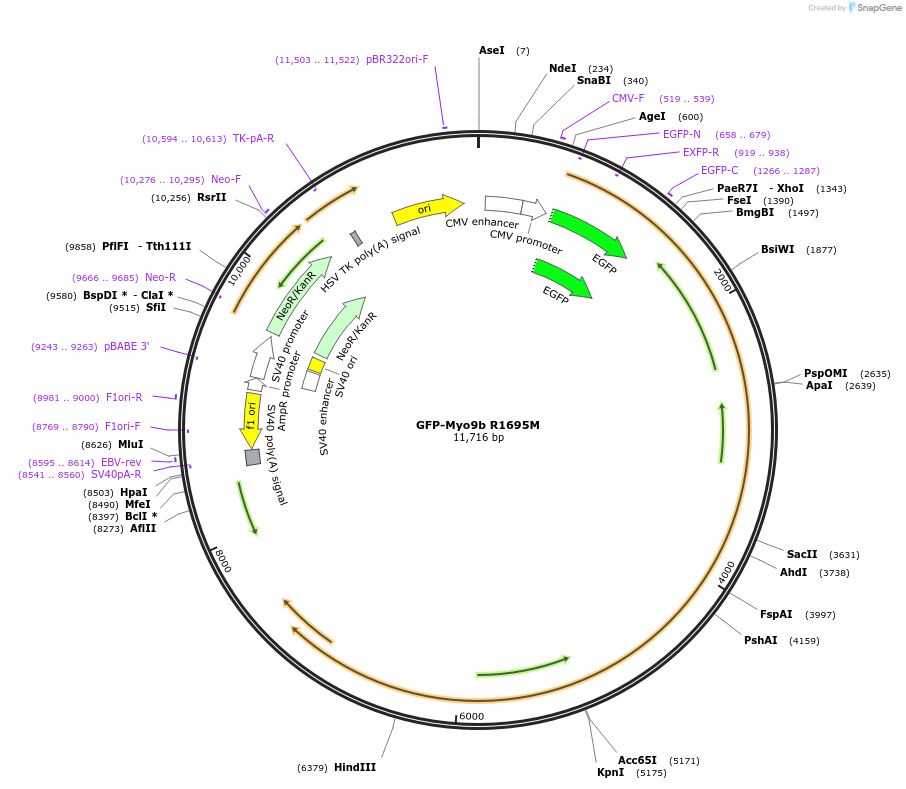
Map uploaded by the depositor.
