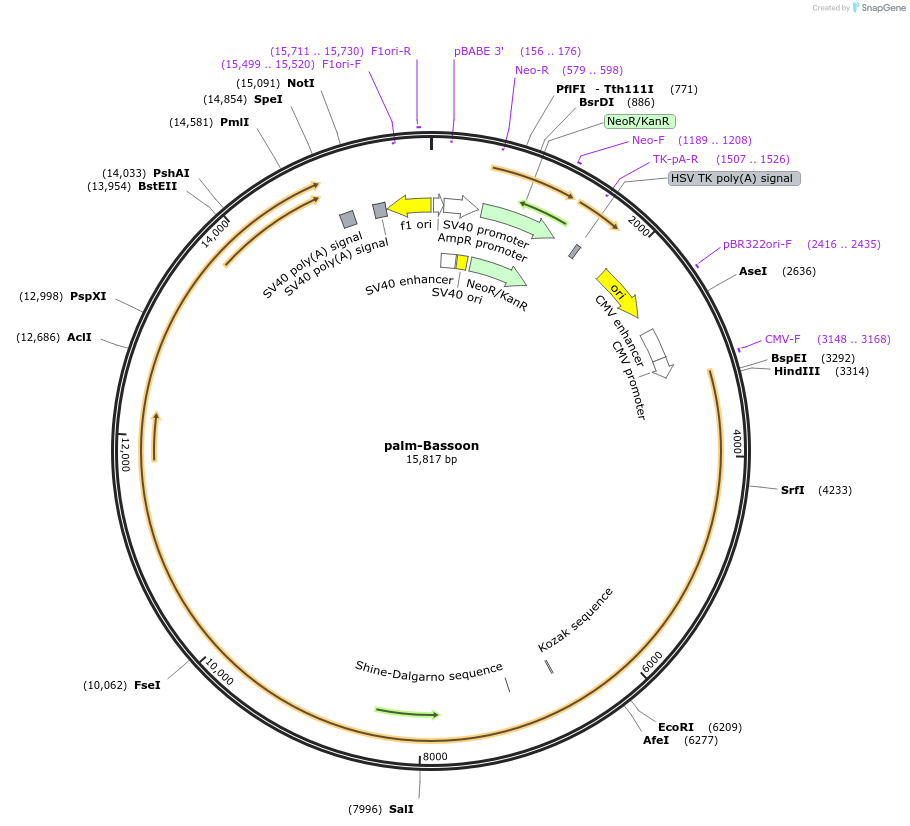
palm-Bassoon
(Plasmid
#250162)
-
PurposeEncodes a version of rat Bassoon with a palmitoylation consensus replacing the N-terminal 94 aa. For mammalian expression.
-
Depositing Lab
-
Sequence Information
Ordering
This material is available to academics and nonprofits only.
| Item | Catalog # | Description | Quantity | Price (USD) | |
|---|---|---|---|---|---|
| Plasmid | 250162 | Standard format: Plasmid sent in bacteria as agar stab | 1 | $89 | |
Backbone
-
Vector backbonepEGFP-C1
- Backbone size w/o insert (bp) 4204
- Total vector size (bp) 15817
-
Vector typeMammalian Expression
Growth in Bacteria
-
Bacterial Resistance(s)Kanamycin, 50 μg/mL
-
Growth Temperature37°C
-
Growth Strain(s)EPI300
-
Copy numberUnknown
Gene/Insert
-
Gene/Insert namepalmitoylated Bassoon construct (N-terminal 94 aa replaced by palmitoylation consensus)
-
SpeciesR. norvegicus (rat)
-
Insert Size (bp)11613
-
Entrez GeneBsn (a.k.a. Znf231)
- Promoter CMV
Cloning Information
- Cloning method Restriction Enzyme
- 5′ cloning site NheI (not destroyed)
- 3′ cloning site SpeI (not destroyed)
- 5′ sequencing primer CAACGGGACTTTCCAAAATG
- (Common Sequencing Primers)
Terms and Licenses
-
Academic/Nonprofit Terms
-
Industry Terms
- Not Available to Industry
Trademarks:
- Zeocin® is an InvivoGen trademark.
Depositor Comments
1) Identification of Bassoon: https://doi.org/10.1083/jcb.142.2.499
2) First description of a full-length recombinant Bassoon construct: https://doi.org/10.1016/S1044-7431(03)00015-0
How to cite this plasmid
( Back to top)
These plasmids were created by your colleagues. Please acknowledge the Principal Investigator, cite the article in which the plasmids were described, and include Addgene in the Materials and Methods of your future publications.
-
For your Materials & Methods section:
palm-Bassoon was a gift from Thomas Dresbach (Addgene plasmid # 250162 ; http://n2t.net/addgene:250162 ; RRID:Addgene_250162) -
For your References section:
Establishing synthetic ribbon-type active zones in a heterologous expression system. Kapoor R, Do TT, Schwenzer N, Petrovic A, Dresbach T, Lehnart SE, Fernandez-Busnadiego R, Moser T. Elife. 2026 Jan 13;13:RP98254. doi: 10.7554/eLife.98254. 10.7554/eLife.98254 PubMed 41528127