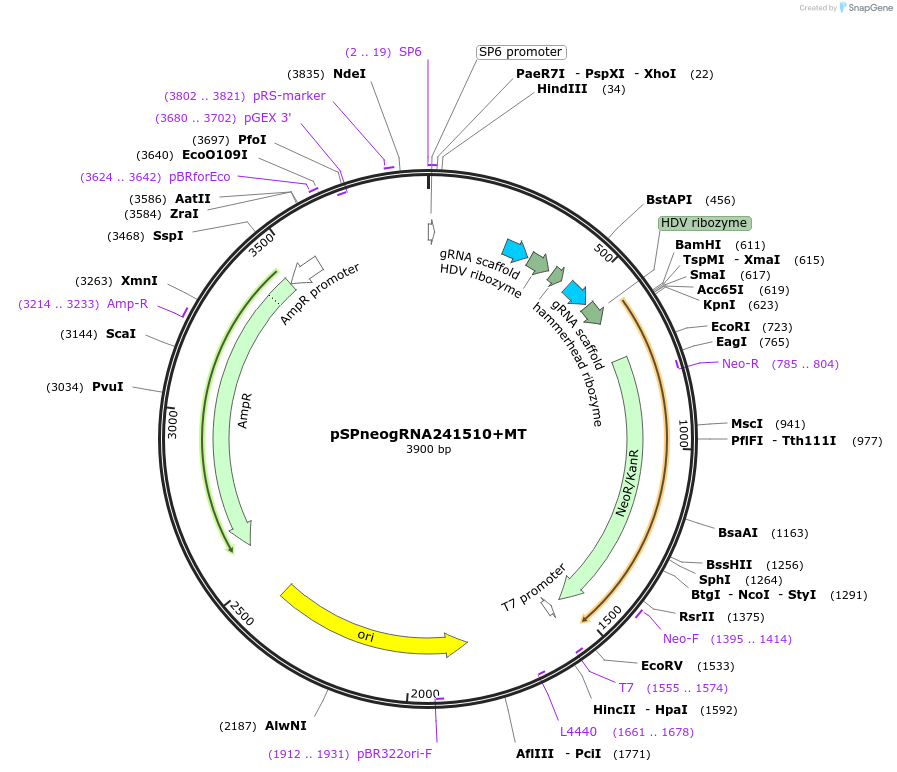
pSPneogRNA241510+MT
(Plasmid
#84292)
-
PurposeExpress LdPBK_241510.1 and LdMT targeting gRNAs simutaneously
-
Depositing Lab
-
Depositing OrganizationMcGill University
Located in Canada -
Citations
-
Sequence Information
Ordering
| Item | Catalog # | Description | Quantity | Price (USD) | |
|---|---|---|---|---|---|
| Plasmid | 84292 | Standard format: Plasmid sent in bacteria as agar stab | 1 | $94 | |
| DNA | 84292-D50 | 50 μg of DNA in Tris buffer | $495 | ||
| DNA | 84292-D100 | 100 μg of DNA in Tris buffer | $585 | ||
Backbone
-
Vector backbonepSP72
- Total vector size (bp) 3900
-
Vector typeCRISPR ; Leishmania donovani
-
Selectable markersNeomycin (select with G418)
Growth in Bacteria
-
Bacterial Resistance(s)Ampicillin, 100 μg/mL
-
Growth Temperature37°C
-
Growth Strain(s)DH5alpha
-
Copy numberHigh Copy
Gene/Insert
-
Gene/Insert nameLdBPK_241510.1 targeting gRNA and LdMT targeting gRNA
-
gRNA/shRNA sequenceGGTGTCGTTCTGCAGCCA and GTCCAGGCGCAGTGGATGC
-
SpeciesLeishmania donovani
-
GenBank IDLdBPK_241510.1 in TritrypDB LdBPK_131590.1 in TritrypDB
- Promoter L. donovani ribosome RNA promoter
Cloning Information
- Cloning method Restriction Enzyme
- 5′ cloning site Bbs I (destroyed during cloning)
- 3′ cloning site Bbs I (destroyed during cloning)
- 5′ sequencing primer SP6 Promoter
- 3′ sequencing primer T7 promoter
- (Common Sequencing Primers)
Terms and Licenses
-
Academic/Nonprofit Terms
-
Industry Terms
- Not Available to Industry
Trademarks:
- Zeocin® is an InvivoGen trademark.
Depositor Comments
This dual gRNA expression plasmid is used to target both LdBPK_241510.1 and LdMT gene. In the article, it was used to generate the targeted chromosome translocations between chromosome 13 and 24 and to enrich the edited LdBPK_241510.1 mutants by selection with miltefosine. For addgene customers, this dual gRNA expression plasmid will mainly be used as the PCR template to generate new double gRNAs expression vector or co-targeting MT vector. See article for more detail.
DNA (Catalog # 84292-D50)
Purpose
Ready-to-use, high-purity DNA prep. DNA aliquots are suitable for use in mammalian cell transfections and other molecular biology applications.
Delivery
- Amount 50 μg
- Concentration 1 μg/μL
- Pricing $495 USD
- Storage 4 ℃ (short-term) or -20 ℃ (long-term)
Terms and Licenses
-
Academic/Nonprofit Terms
-
Industry Terms
- Not Available to Industry
Quality Control
Every DNA prep is verified by next-generation sequencing, confirming plasmid identity, sequence integrity, and absence of DNA contaminants. Concentration is confirmed to be within ±2.5% of the stated concentration.
Our production process has been validated to consistently yield endotoxin levels below 1.0 EU/μg. Individual lots are not tested for endotoxin.
DNA (Catalog # 84292-D100)
Purpose
Ready-to-use, high-purity DNA prep. DNA aliquots are suitable for use in mammalian cell transfections and other molecular biology applications.
Delivery
- Amount 100 μg
- Concentration 1 μg/μL
- Pricing $585 USD
- Storage 4 ℃ (short-term) or -20 ℃ (long-term)
Terms and Licenses
-
Academic/Nonprofit Terms
-
Industry Terms
- Not Available to Industry
Quality Control
Every DNA prep is verified by next-generation sequencing, confirming plasmid identity, sequence integrity, and absence of DNA contaminants. Concentration is confirmed to be within ±2.5% of the stated concentration.
Our production process has been validated to consistently yield endotoxin levels below 1.0 EU/μg. Individual lots are not tested for endotoxin.
These plasmids were created by your colleagues. Please acknowledge the Principal Investigator, cite the article in which the plasmids were described, and include Addgene in the Materials and Methods of your future publications.
-
For your Materials & Methods section:
pSPneogRNA241510+MT was a gift from Greg Matlashewski (Addgene plasmid # 84292 ; http://n2t.net/addgene:84292 ; RRID:Addgene_84292) -
For your References section:
Optimized CRISPR-Cas9 Genome Editing for Leishmania and Its Use To Target a Multigene Family, Induce Chromosomal Translocation, and Study DNA Break Repair Mechanisms. Zhang WW, Lypaczewski P, Matlashewski G. mSphere. 2017 Jan 18;2(1). pii: e00340-16. doi: 10.1128/mSphere.00340-16. eCollection 2017 Jan-Feb. mSphere00340-16 [pii] PubMed 28124028