-
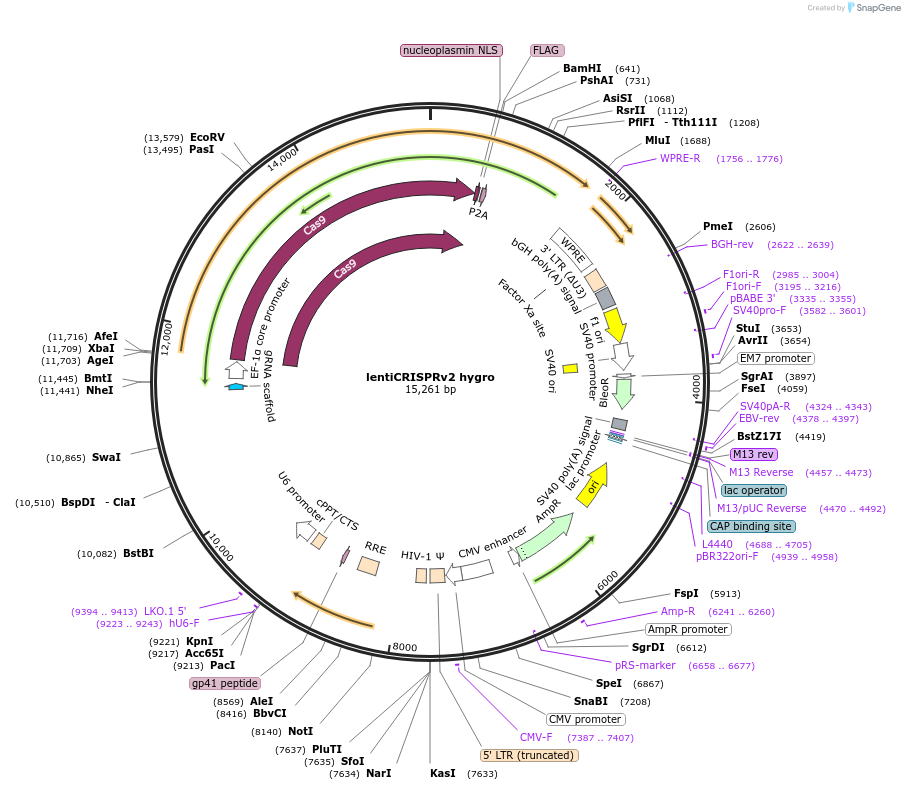
Purpose(Empty Backbone) Variant of lentiCRISPRv2 that confers hygromycin resistance
-
Depositing Lab
-
Depositing OrganizationQIMR Berghofer Medical Research Institute
Located in Australia -
Citations
-
Sequence Information
Ordering
| Item | Catalog # | Description | Quantity | Price (USD) | |
|---|---|---|---|---|---|
| Plasmid | 98291 | Standard format: Plasmid sent in bacteria as agar stab | 1 | $94 | |
Backbone
-
Vector backbonelentiCRISPRv2
-
Backbone manufacturerFeng Zhang (Addgene #52961)
- Backbone size (bp) 15261
-
Vector typeLentiviral, CRISPR
-
Selectable markersHygromycin
Growth in Bacteria
-
Bacterial Resistance(s)Ampicillin, 100 μg/mL
-
Growth Temperature37°C
-
Growth Strain(s)NEB Stable
-
Copy numberHigh Copy
Gene/Insert
-
Gene/Insert nameP2A-hygro
- Promoter EF-1a
Cloning Information
- Cloning method Restriction Enzyme
- 5′ cloning site BamHI (not destroyed)
- 3′ cloning site MluI (not destroyed)
- 5′ sequencing primer CCAAAGAGGTGCTGGACG
- 3′ sequencing primer WPRE-R (CATAGCGTAAAAGGAGCAACA)
- (Common Sequencing Primers)
Resource Information
-
Addgene Notes
Terms and Licenses
-
Academic/Nonprofit Terms
-
Industry Terms
- Not Available to Industry
Trademarks:
- Zeocin® is an InvivoGen trademark.
Depositor Comments
Double stranded oligonucleotides encoding sgRNA sequences can be cloned between the BsmBI restriction sites as for lentiCRISPRv2. The second MluI site in the original lentiCRISPRv2 plasmid was destroyed by Klenow end-filling and religation after MluI digestion. For target guide (sgRNA) sequence cloning instructions, please see https://www.addgene.org/52961 for the Zhang's lab lentiCRISPR v2 guide.
These plasmids were created by your colleagues. Please acknowledge the Principal Investigator, cite the article in which the plasmids were described, and include Addgene in the Materials and Methods of your future publications.
-
For your Materials & Methods section:
lentiCRISPRv2 hygro was a gift from Brett Stringer (Addgene plasmid # 98291 ; http://n2t.net/addgene:98291 ; RRID:Addgene_98291) -
For your References section:
A reference collection of patient-derived cell line and xenograft models of proneural, classical and mesenchymal glioblastoma. Stringer BW, Day BW, D'Souza RCJ, Jamieson PR, Ensbey KS, Bruce ZC, Lim YC, Goasdoue K, Offenhauser C, Akgul S, Allan S, Robertson T, Lucas P, Tollesson G, Campbell S, Winter C, Do H, Dobrovic A, Inglis PL, Jeffree RL, Johns TG, Boyd AW. Sci Rep. 2019 Mar 20;9(1):4902. doi: 10.1038/s41598-019-41277-z. 10.1038/s41598-019-41277-z PubMed 30894629