


GRASP Cloning Kit
(Kit #
1000000282
)
Depositing Lab: Ian Small
GRASP (Golden Gate Repeat Assembly for Synthetic PPR Proteins) is a MoClo-compatible collection of 42 plasmids that enables the high-efficiency assembly of RNA-binding protein subunits. Pentatricopeptide repeat (PPR) proteins are composed of discrete motifs that each recognize an RNA base via two amino acids. With GRASP, the combination of a robust RNA-binding code with stable consensus-based motifs allows the creation of designer PPR proteins specific for a desired target. Being compatible with the MoClo overhang standard, GRASP PPRs can be cloned as the CDS with a wide variety of other kits tailored for different organisms or functions.
This kit will be sent as bacterial glycerol stocks in 96-well plate format.
Original Publication
GRASP: a modular toolkit for building synthetic pentatricopeptide repeat RNA-binding proteins. Dennis M, Low SY, Viljoen A, Pullakhandam A, Colas des Francs-Small C, Campbell-Clause L, Bond CS, Small I, Kwok van der Giezen FM. Nucleic Acids Res. 2025 Oct 28;53(20):gkaf1169. doi: 10.1093/nar/gkaf1169. PubMed (Link opens in a new window) Article (Link opens in a new window)
Description
GRASP plasmids are ‘Level -1’ under the MoClo standard, and are ‘sub-PPR motif’ parts. They are assembled five-at-a-time into a valid Level 0 acceptor, such as pAGM9121, to create a 4.5-motif tract. GRASP allows two to four such tracts to be assembled into a complete protein possessing 9, 14, or 19 RNA-binding motifs. This resulting PPR will be specific to an RNA tract of the same length.
In the original publication (Dennis et al. 2025), PPRs consisting of nine motifs were assembled with additional PPR-associated C-termini to create RNA-editing factors expressible in vitro and in E. coli; the assembly involved a Level 1 acceptor plasmid, a promoter (5’ UTR), two GRASP CDS parts, two PPR C-terminal domain parts, and a terminator (3’ UTR).
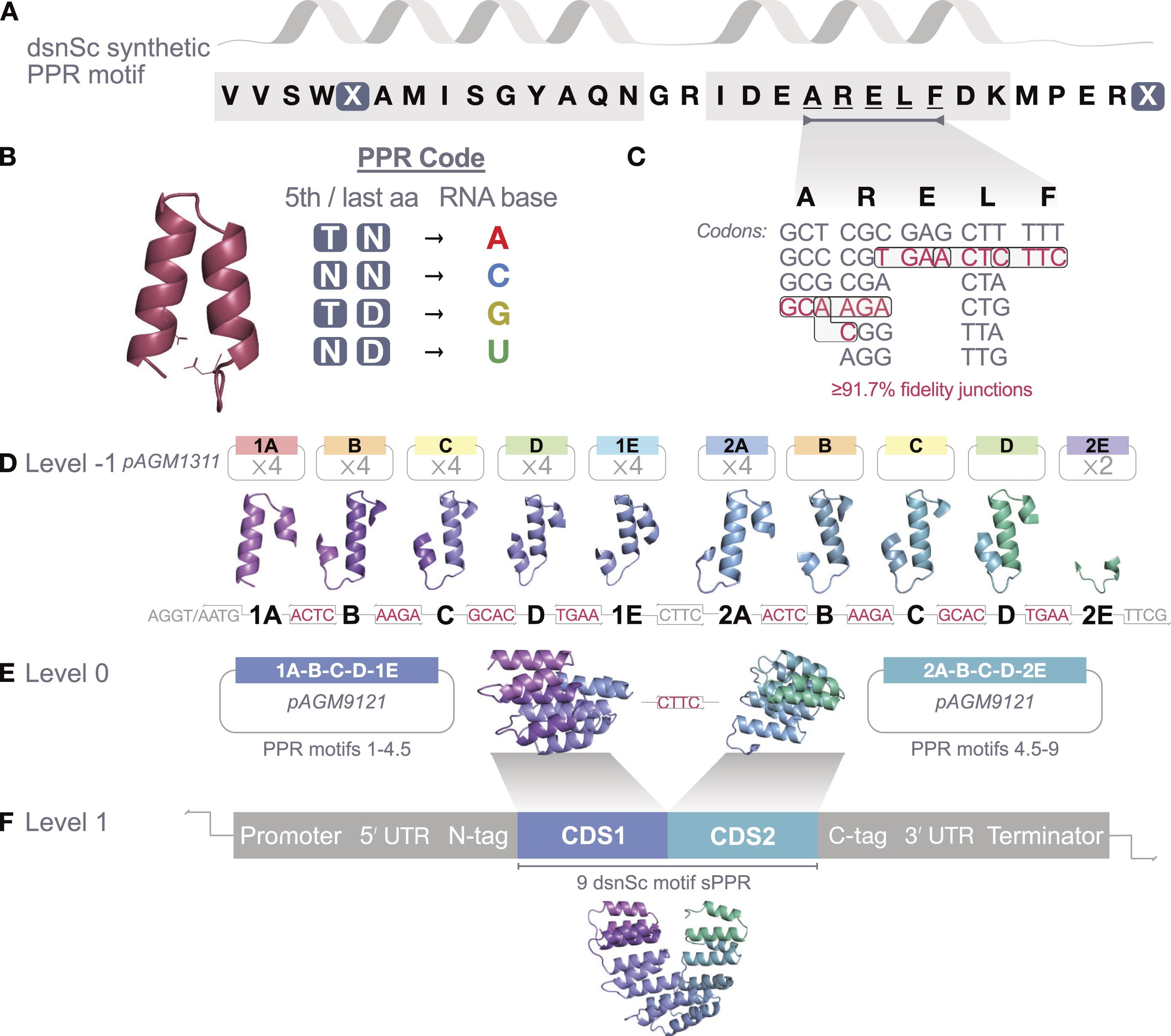
Figure 1: Schematic of the GRASP kit for assembly of a 9-motif synthetic PPR protein. (A) Positions of RNA-binding residues in PPR motif. (B) RNA-binding code and respective bases. (C) Position of high-fidelity Golden Gate overhangs in motifs. (D) Available GRASP parts to assemble a nine-motif PPR, with the overhangs between them in red. Sixteen additional parts are available to create 14- and 19-motif PPRs. (E) Assembly of CDS PPR ‘subunits’ CDS1 and CDS2 from 5 GRASP parts. (F) GRASP CDS1 and CDS2 act as coding sequence modules in the MoClo Golden Gate assembly standard. Image from Dennis et al. 2025, reproduced under CC BY-NC license.
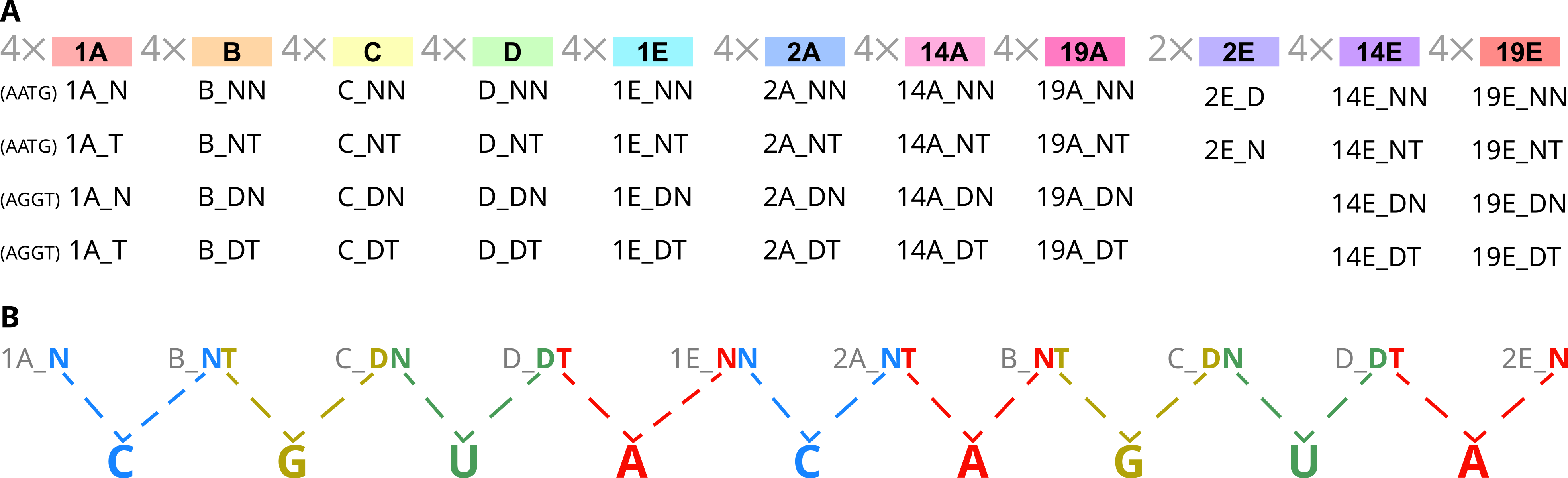
Figure 2: Target sequence specificity. (A) Forty-two plasmids available in GRASP, named according to amino acids in the respective binding code positions. (B) Arrangement of GRASP parts in a 9-motif tract, and how the part names combine to define the base specificity. Image from Dennis et al. 2025, reproduced under CC BY-NC license.
Kit Documentation
How to Cite this Kit
These plasmids were created by your colleagues. Please acknowledge the Principal Investigator, cite the article in which they were created, and include Addgene in the Materials and Methods of your future publications.
For your Materials and Methods section:
"The GRASP Cloning Kit was a gift from Ian Small (Addgene kit #1000000282)."
For your Reference section:
GRASP: a modular toolkit for building synthetic pentatricopeptide repeat RNA-binding proteins. Dennis M, Low SY, Viljoen A, Pullakhandam A, Colas des Francs-Small C, Campbell-Clause L, Bond CS, Small I, Kwok van der Giezen FM. Nucleic Acids Res. 2025 Oct 28;53(20):gkaf1169. doi: 10.1093/nar/gkaf1169. PubMed (Link opens in a new window) Article (Link opens in a new window)
GRASP Cloning Kit - #1000000282
- Resistance Color Key
Each circle corresponds to a specific antibiotic resistance in the kit plate map wells.
- Inventory
Searchable and sortable table of all plasmids in kit. The Well column lists the plasmid well location in its plate. The Plasmid column links to a plasmid's individual web page.
- Kit Plate Map
96-well plate map for plasmid layout. Hovering over a well reveals the plasmid name, while clicking on a well opens the plasmid page.
Resistance Color Key
| Kanamycin |
Inventory
| Well | Plasmid | Resistance |
|---|---|---|
| A / 1 | pPR-1_1A_5N_AATG |
|
| A / 2 | pPR-1_1A_5N_AGGT |
|
| A / 3 | pPR-1_1A_5T_AATG |
|
| A / 4 | pPR-1_1A_5T_AGGT |
|
| A / 5 | pPR-1_1E_LD5N |
|
| A / 6 | pPR-1_1E_LD5T |
|
| A / 7 | pPR-1_1E_LN5N |
|
| A / 8 | pPR-1_1E_LN5T |
|
| A / 9 | pPR-1_2A_LD5N |
|
| A / 10 | pPR-1_2A_LD5T |
|
| A / 11 | pPR-1_2A_LN5N |
|
| A / 12 | pPR-1_2A_LN5T |
|
| B / 1 | pPR-1_2E_LD |
|
| B / 2 | pPR-1_2E_LN |
|
| B / 3 | pPR-1_14A_LD5N |
|
| B / 4 | pPR-1_14A_LD5T |
|
| B / 5 | pPR-1_14A_LN5N |
|
| B / 6 | pPR-1_14A_LN5T |
|
| B / 7 | pPR-1_14E_LD5N |
|
| B / 8 | pPR-1_14E_LD5T |
|
| B / 9 | pPR-1_14E_LN5N |
|
| B / 10 | pPR-1_14E_LN5T |
|
| B / 11 | pPR-1_19A_LD5N |
|
| B / 12 | pPR-1_19A_LD5T |
|
| C / 1 | pPR-1_19A_LN5N |
|
| C / 2 | pPR-1_19A_LN5T |
|
| C / 3 | pPR-1_19E_LD5N |
|
| C / 4 | pPR-1_19E_LD5T |
|
| C / 5 | pPR-1_19E_LN5N |
|
| C / 6 | pPR-1_19E_LN5T |
|
| C / 7 | pPR-1_B_LD5N |
|
| C / 8 | pPR-1_B_LD5T |
|
| C / 9 | pPR-1_B_LN5N |
|
| C / 10 | pPR-1_B_LN5T |
|
| C / 11 | pPR-1_C_LD5N |
|
| C / 12 | pPR-1_C_LD5T |
|
| D / 1 | pPR-1_C_LN5N |
|
| D / 2 | pPR-1_C_LN5T |
|
| D / 3 | pPR-1_D_LD5N |
|
| D / 4 | pPR-1_D_LD5T |
|
| D / 5 | pPR-1_D_LN5N |
|
| D / 6 | pPR-1_D_LN5T |
|