



-
PurposeCre-dependent viral expression of ChR2-tdTomato for neuronal excitation
-
Depositing Lab
-
Publication
-
Sequence Information


Ordering
| Item | Catalog # | Description | Quantity | Price (USD) | |
|---|---|---|---|---|---|
| Plasmid | 18917 | Standard format: Plasmid sent in bacteria as agar stab | 1 | $94 | |

Don’t see the serotype you want?
Make a packaging request and we'll get back to you.
Please log in to submit a packaging request.
-
SerotypeSelect serotype for details See details about
-
PricingSelect serotype and quantity $ USD for preparation of µL virus + $34 USD for plasmid.
-
How this works
- Place a request for a quantity of 2 (0.2 mL), 10 (1 mL), 25 (2.5 mL), or 50 (5 mL). Our all-inclusive pricing includes DNA production and QC.
- Addgene will quickly confirm that we can produce a high-quality prep for you.
- Track your request and place an order from within your account. Payment information must be added before we can begin processing your order.
- Receive your prep in 6–9 weeks after the MTA is approved by your organization.
- Learn more about our Packaged on Request Service.
Backbone
-
Vector backboneAAV2
- Backbone size w/o insert (bp) 5340
-
Vector typeAAV, Cre/Lox ; Adeno-Associated Virus
Growth in Bacteria
-
Bacterial Resistance(s)Ampicillin, 100 μg/mL
-
Growth Temperature30°C
-
Growth Strain(s)Stbl3
-
Growth instructionsStbl2 E coli from Invitrogen Grow at 30 degrees in 2xYT media
-
Copy numberLow Copy
Gene/Insert
-
Gene/Insert nameChannelrhodopsin 2-tdtomato
-
Alt nameChR2
-
SpeciesChlamydomonas reinhardtii
-
Insert Size (bp)2367
- Promoter CAG
-
Tag
/ Fusion Protein
- tdtomato (C terminal on insert)
Cloning Information
- Cloning method Restriction Enzyme
- 5′ cloning site Spe1 (destroyed during cloning)
- 3′ cloning site Spe1 (destroyed during cloning)
- 5′ sequencing primer CTGTGGCTGCGTGAAAGCCTTG
- (Common Sequencing Primers)
Resource Information
-
Addgene Notes
-
A portion of this plasmid was derived from a plasmid made byKarel Svoboda, Janelia Farm Research Campus
-
Articles Citing this Plasmid
Terms and Licenses
-
Academic/Nonprofit Terms
-
Industry Terms
- Not Available to Industry
Trademarks:
- Zeocin® is an InvivoGen trademark.
Depositor Comments
These vectors are prone to recombination. This is a well known issue with these AAV vectors and is due to the inverted terminal repeats (ITRs) required for AAV production. To minimize recombination, we propagate these plasmids in Stbl2 cells from Invitrogen. Also, to minimize recombination, cells should be cultured at 30 C.
Note that these cultures will grow slowly (20 h for minipreps). Better yields and culture times are obtained with 2xYT as the media. This is strongly recommended.
Because recombination may still happen occasionally, we do a panel of restriction digestions to assess whether the ITRs are in tact. Separate digestions with PvuII, Sma1, and SnaB1 should be performed. The expected patterns can be calculated from the attached sequence. Please see Reviews in the right column for an image of Addgene's digest with these enzymes.
These plasmids were created by your colleagues. Please acknowledge the Principal Investigator, cite the article in which the plasmids were described, and include Addgene in the Materials and Methods of your future publications.
-
For your Materials & Methods section:
AAV-FLEX-rev-ChR2-tdtomato was a gift from Scott Sternson (Addgene plasmid # 18917 ; http://n2t.net/addgene:18917 ; RRID:Addgene_18917) -
For your References section:
A FLEX switch targets Channelrhodopsin-2 to multiple cell types for imaging and long-range circuit mapping. Atasoy D, Aponte Y, Su HH, Sternson SM. J Neurosci. 2008 Jul 9. 28(28):7025-30. 10.1523/JNEUROSCI.1954-08.2008 PubMed 18614669
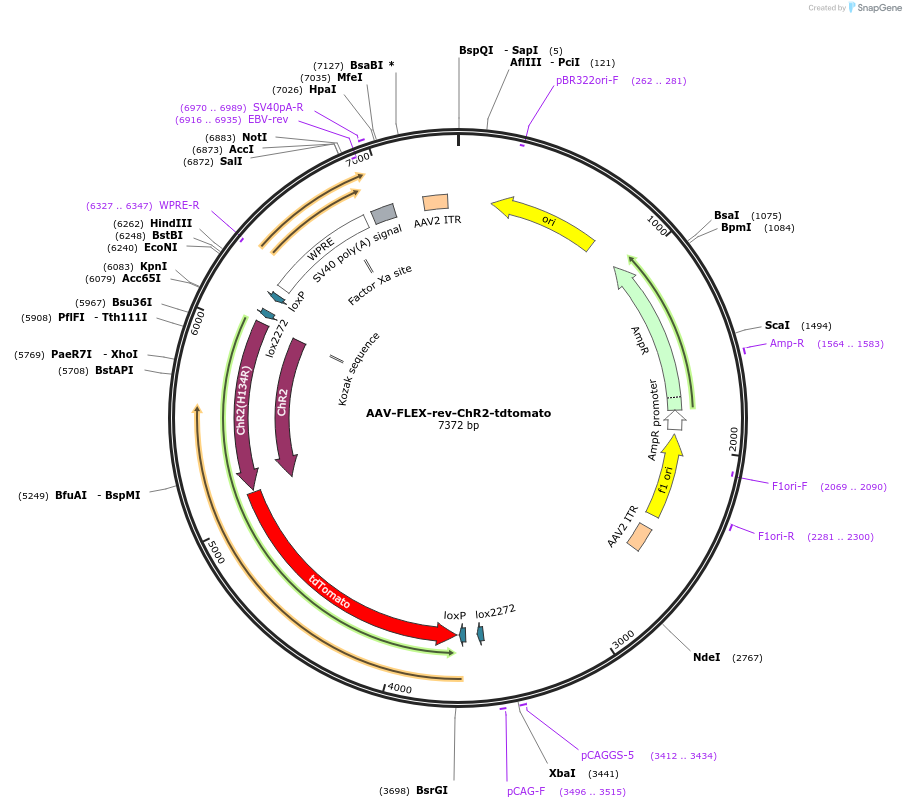
Map uploaded by the depositor.
