



Desmoplakin I affinity mutant (F40-based tension sensor)
(Plasmid
#119190)
-
PurposeThe affinity mutant for the F40-based human desmoplakin I tension sensor incorporates a point mutation that exhibits enhanced keratin association.
-
Depositing Lab
-
Depositing OrganizationStanford University
Located in the United States of America -
Sequence Information


Ordering
| Item | Catalog # | Description | Quantity | Price (USD) | |
|---|---|---|---|---|---|
| Plasmid | 119190 | Standard format: Plasmid sent in bacteria as agar stab | 1 | $94 | |
| DNA | 119190-D50 | 50 μg of DNA in Tris buffer | $495 | ||
| DNA | 119190-D100 | 100 μg of DNA in Tris buffer | $585 | ||
Backbone
-
Vector backbonepSBtet-Pur
-
Backbone manufacturerEric Kowarz
- Backbone size w/o insert (bp) 5569
- Total vector size (bp) 16228
-
Vector typeMammalian Expression ; Transposon
-
Selectable markersPuromycin
Growth in Bacteria
-
Bacterial Resistance(s)Ampicillin, 100 μg/mL
-
Growth Temperature37°C
-
Growth Strain(s)NEB Stable
-
Copy numberHigh Copy
Gene/Insert
-
Gene/Insert namehuman Desmoplakin I(S2849G)-[mTFP1-F40-mEYFP] (internal-1945)
-
Alt nameDesmoplakin I affinity mutant (F40-based tension sensor)
-
Alt nameDPI-TS-S2849G
-
SpeciesH. sapiens (human)
-
Insert Size (bp)10659
-
Mutationinserted F40-based tension sensor module after aa1945; S2849G in DPI which exhibits increased keratin association
-
GenBank IDNM_004415.3
-
Entrez GeneDSP (a.k.a. DCWHKTA, DP)
- Promoter TCE
-
Tag
/ Fusion Protein
- mTFP1-F40-mEYFP
Cloning Information
- Cloning method Restriction Enzyme
- 5′ cloning site SfiI (not destroyed)
- 3′ cloning site SfiI (not destroyed)
- 5′ sequencing primer CCTGGAGCCAATTCCAACTCT
- 3′ sequencing primer CACTGCATTCTTGTTGTGGTT
- (Common Sequencing Primers)
Resource Information
-
A portion of this plasmid was derived from a plasmid made byDesmoplakin I-GFP (Addgene, #32227) from Kathleen Green used as a template for Desmoplakin I and pSBtet-Pur (Addgene plasmid #60507) from Eric Kowarz used as a backbone.
Terms and Licenses
-
Academic/Nonprofit Terms
-
Industry Terms
- Not Available to Industry
Trademarks:
- Zeocin® is an InvivoGen trademark.
DNA (Catalog # 119190-D50)
Purpose
Ready-to-use, high-purity DNA prep. DNA aliquots are suitable for use in mammalian cell transfections and other molecular biology applications.
Delivery
- Amount 50 μg
- Concentration 1 μg/μL
- Pricing $495 USD
- Storage 4 ℃ (short-term) or -20 ℃ (long-term)
Terms and Licenses
-
Academic/Nonprofit Terms
-
Industry Terms
- Not Available to Industry
Quality Control
Every DNA prep is verified by next-generation sequencing, confirming plasmid identity, sequence integrity, and absence of DNA contaminants. Concentration is confirmed to be within ±2.5% of the stated concentration.
Our production process has been validated to consistently yield endotoxin levels below 1.0 EU/μg. Individual lots are not tested for endotoxin.
DNA (Catalog # 119190-D100)
Purpose
Ready-to-use, high-purity DNA prep. DNA aliquots are suitable for use in mammalian cell transfections and other molecular biology applications.
Delivery
- Amount 100 μg
- Concentration 1 μg/μL
- Pricing $585 USD
- Storage 4 ℃ (short-term) or -20 ℃ (long-term)
Terms and Licenses
-
Academic/Nonprofit Terms
-
Industry Terms
- Not Available to Industry
Quality Control
Every DNA prep is verified by next-generation sequencing, confirming plasmid identity, sequence integrity, and absence of DNA contaminants. Concentration is confirmed to be within ±2.5% of the stated concentration.
Our production process has been validated to consistently yield endotoxin levels below 1.0 EU/μg. Individual lots are not tested for endotoxin.
These plasmids were created by your colleagues. Please acknowledge the Principal Investigator, cite the article in which the plasmids were described, and include Addgene in the Materials and Methods of your future publications.
-
For your Materials & Methods section:
Desmoplakin I affinity mutant (F40-based tension sensor) was a gift from Alex Dunn (Addgene plasmid # 119190 ; http://n2t.net/addgene:119190 ; RRID:Addgene_119190) -
For your References section:
Mechanical loading of desmosomes depends on the magnitude and orientation of external stress. Price AJ, Cost AL, Ungewiss H, Waschke J, Dunn AR, Grashoff C. Nat Commun. 2018 Dec 11;9(1):5284. doi: 10.1038/s41467-018-07523-0. 10.1038/s41467-018-07523-0 PubMed 30538252
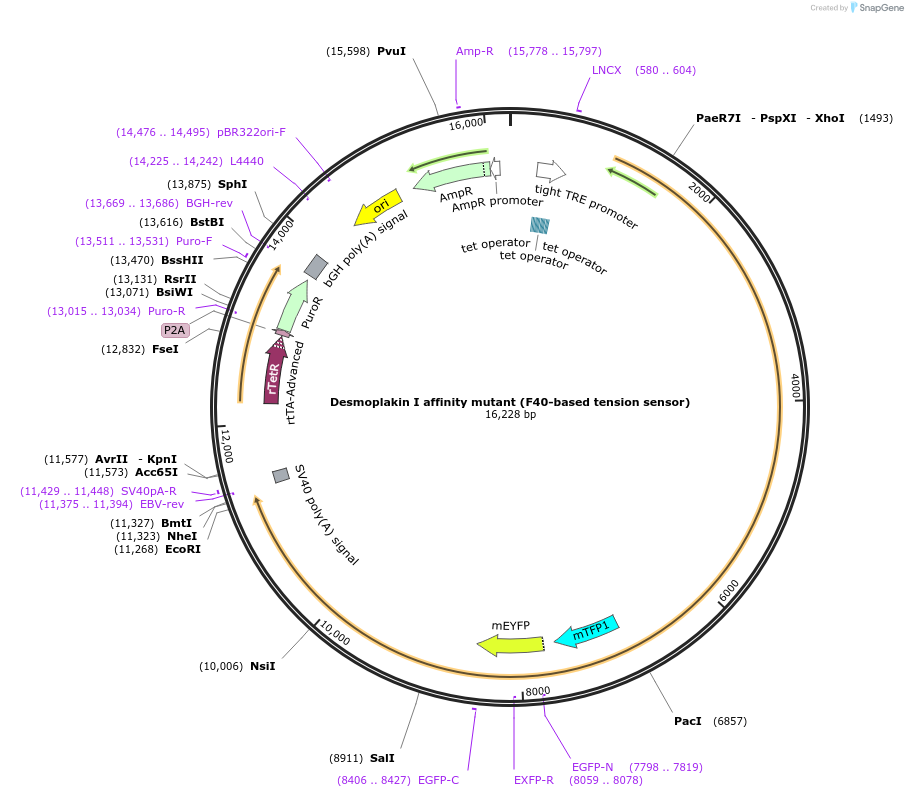
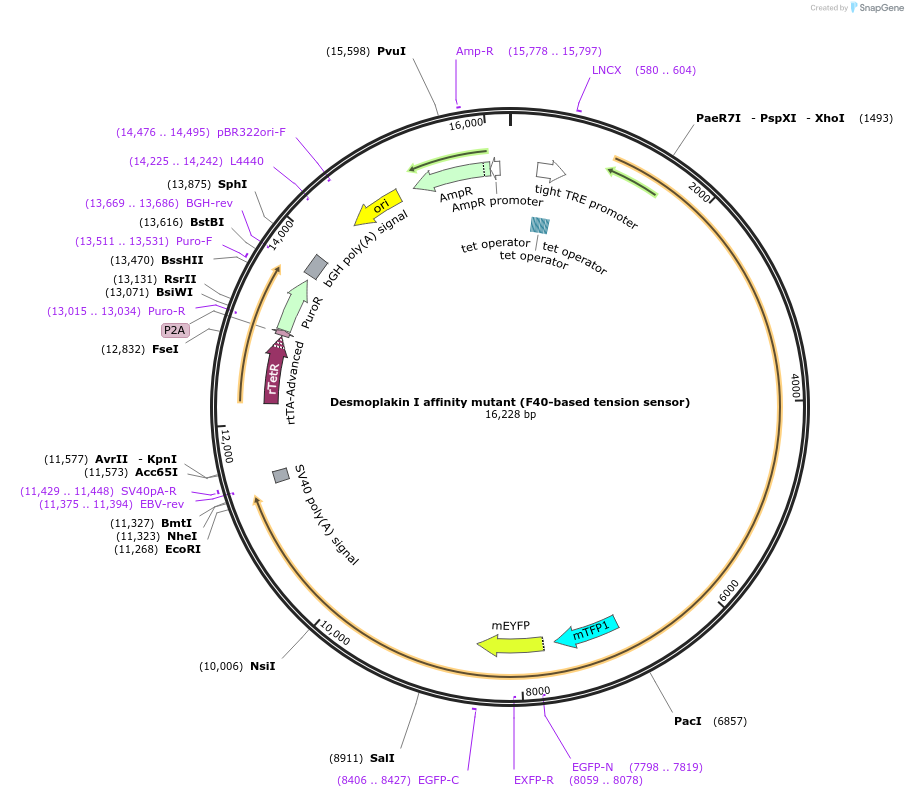
Map uploaded by the depositor.
