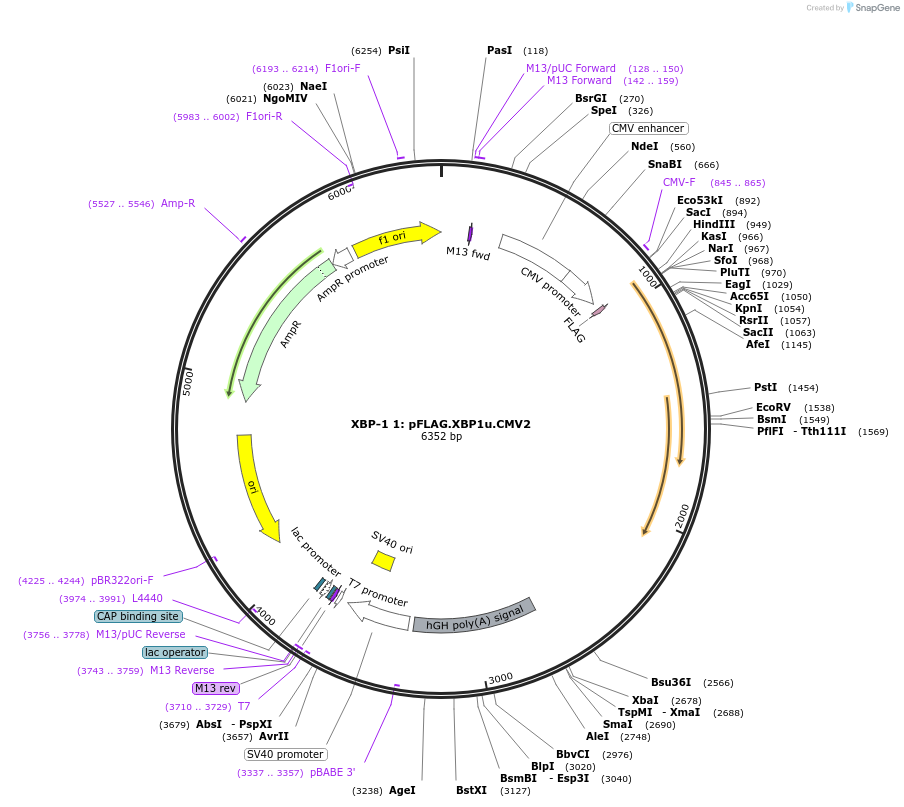
-
Depositing Lab
-
Depositing OrganizationNYU Grossman School of Medicine
Located in the United States of America -
Publication
-
Citations
-
Sequence Information
Ordering
| Item | Catalog # | Description | Quantity | Price (USD) | |
|---|---|---|---|---|---|
| Plasmid | 21832 | Standard format: Plasmid sent in bacteria as agar stab | 1 | $94 | |
| DNA | 21832-D50 | 50 μg of DNA in Tris buffer | $495 | ||
| DNA | 21832-D100 | 100 μg of DNA in Tris buffer | $585 | ||
Backbone
-
Vector backbonepFLAG-CMV2
-
Backbone manufacturerSigma
- Backbone size w/o insert (bp) 4700
-
Vector typeMammalian Expression
Growth in Bacteria
-
Bacterial Resistance(s)Ampicillin, 100 μg/mL
-
Growth Temperature37°C
-
Growth Strain(s)DH5alpha
-
Copy numberUnknown
Gene/Insert
-
Gene/Insert nameXBP-1 unprocessed
-
Alt nameXBP-1
-
Alt nameX-box binding protein 1
-
SpeciesM. musculus (mouse)
-
Entrez GeneXbp1 (a.k.a. D11Ertd39e, TREB-5, TREB5, XBP-1)
-
Tag
/ Fusion Protein
- Flag (N terminal on insert)
Cloning Information
- Cloning method Restriction Enzyme
- 5′ sequencing primer CMV-F
- (Common Sequencing Primers)
Terms and Licenses
-
Academic/Nonprofit Terms
-
Industry Terms
- Not Available to Industry
Trademarks:
- Zeocin® is an InvivoGen trademark.
Depositor Comments
Addgene sequencing results show two mismatches with author's sequence causing two amino acid mutations - G27V and A76V.
FLAG-epitope tagged unspliced XBP-1 in the mammalian expression plasmid pFLAG-CMV-2. Flag-tagged version of XBP-1 was constructed by inserting the Flag epitope tag sequence immediately 3' of the ATG start codon.
Note: Cheah Kathryn Song Eng reported on November 4, 2004 that the sequence of this plasmid deviates from the predicted by G1028T. This impacts on the CDS changing Gly27Val. We do not know if this is a mutation that crept into our construction, a mutation that was present in the cDNA we purchased or if it is a point in which the mouse genome has some variability. Nor do we know the functional significance of this, but we note that the corresponding residue in the human is Ala. Furthermore, this variation/mutation is in a region of relatively poor sequence conservation across species, suggesting that it might not be all that important.
DNA (Catalog # 21832-D50)
Purpose
Ready-to-use, high-purity DNA prep. DNA aliquots are suitable for use in mammalian cell transfections and other molecular biology applications.
Delivery
- Amount 50 μg
- Concentration 1 μg/μL
- Pricing $495 USD
- Storage 4 ℃ (short-term) or -20 ℃ (long-term)
Terms and Licenses
-
Academic/Nonprofit Terms
-
Industry Terms
- Not Available to Industry
Quality Control
Every DNA prep is verified by next-generation sequencing, confirming plasmid identity, sequence integrity, and absence of DNA contaminants. Concentration is confirmed to be within ±2.5% of the stated concentration.
Our production process has been validated to consistently yield endotoxin levels below 1.0 EU/μg. Individual lots are not tested for endotoxin.
DNA (Catalog # 21832-D100)
Purpose
Ready-to-use, high-purity DNA prep. DNA aliquots are suitable for use in mammalian cell transfections and other molecular biology applications.
Delivery
- Amount 100 μg
- Concentration 1 μg/μL
- Pricing $585 USD
- Storage 4 ℃ (short-term) or -20 ℃ (long-term)
Terms and Licenses
-
Academic/Nonprofit Terms
-
Industry Terms
- Not Available to Industry
Quality Control
Every DNA prep is verified by next-generation sequencing, confirming plasmid identity, sequence integrity, and absence of DNA contaminants. Concentration is confirmed to be within ±2.5% of the stated concentration.
Our production process has been validated to consistently yield endotoxin levels below 1.0 EU/μg. Individual lots are not tested for endotoxin.
These plasmids were created by your colleagues. Please acknowledge the Principal Investigator, cite the article in which the plasmids were described, and include Addgene in the Materials and Methods of your future publications.
-
For your Materials & Methods section:
XBP-1 1: pFLAG.XBP1u.CMV2 was a gift from David Ron (Addgene plasmid # 21832 ; http://n2t.net/addgene:21832 ; RRID:Addgene_21832) -
For your References section:
IRE1 couples endoplasmic reticulum load to secretory capacity by processing the XBP-1 mRNA. Calfon M, Zeng H, Urano F, Till JH, Hubbard SR, Harding HP, Clark SG, Ron D. Nature. 2002 Jan 3. 415(6867):92-6. 10.1038/415092a PubMed 11780124