



pAAV-THP-Synaptophysin-pHluorin
(Plasmid
#242903)
-
PurposeFluorescent reporter for imaging of synaptic vesicle recycling in Dopaminergic Neurons
-
Depositing Lab
-
Sequence Information


Ordering
This material is available to academics and nonprofits only.
| Item | Catalog # | Description | Quantity | Price (USD) | |
|---|---|---|---|---|---|
| Plasmid | 242903 | Standard format: Plasmid sent in bacteria as agar stab | 1 | $89 | |
Backbone
-
Vector backbonepAAV2.5-THP
-
Backbone manufacturerKwang-Soo Kim Lab
- Backbone size w/o insert (bp) 6324
- Total vector size (bp) 7989
-
Vector typeMammalian Expression, AAV
Growth in Bacteria
-
Bacterial Resistance(s)Ampicillin, 100 μg/mL
-
Growth Temperature37°C
-
Growth Strain(s)NEB Stable
-
Copy numberUnknown
Gene/Insert
-
Gene/Insert namesynaptophysin plus pHluorin
-
SpeciesM. musculus (mouse), Synthetic
-
Insert Size (bp)1665
- Promoter rat Tyrosine hydroxylase
-
Tag
/ Fusion Protein
- mouse synaptophysin (N terminal on insert)
Cloning Information
- Cloning method Restriction Enzyme
- 5′ cloning site HindIII (unknown if destroyed)
- 3′ cloning site SalI (unknown if destroyed)
- 5′ sequencing primer ATGGACGTGGTGAATCAGCT
- (Common Sequencing Primers)
Resource Information
-
A portion of this plasmid was derived from a plasmid made byKwang-Soo Kim Lab (Addgene #80335, THP)
Terms and Licenses
-
Academic/Nonprofit Terms
-
Industry Terms
- Not Available to Industry
Trademarks:
- Zeocin® is an InvivoGen trademark.
How to cite this plasmid
( Back to top)
These plasmids were created by your colleagues. Please acknowledge the Principal Investigator, cite the article in which the plasmids were described, and include Addgene in the Materials and Methods of your future publications.
-
For your Materials & Methods section:
pAAV-THP-Synaptophysin-pHluorin was a gift from Timothy Ryan (Addgene plasmid # 242903 ; http://n2t.net/addgene:242903 ; RRID:Addgene_242903) -
For your References section:
Neuromodulatory control of energy reserves in dopaminergic neurons. Pulido C, Gentry MS, Ryan TA. Proc Natl Acad Sci U S A. 2025 Dec 16;122(50):e2523019122. doi: 10.1073/pnas.2523019122. Epub 2025 Dec 5. 10.1073/pnas.2523019122 PubMed 41348744
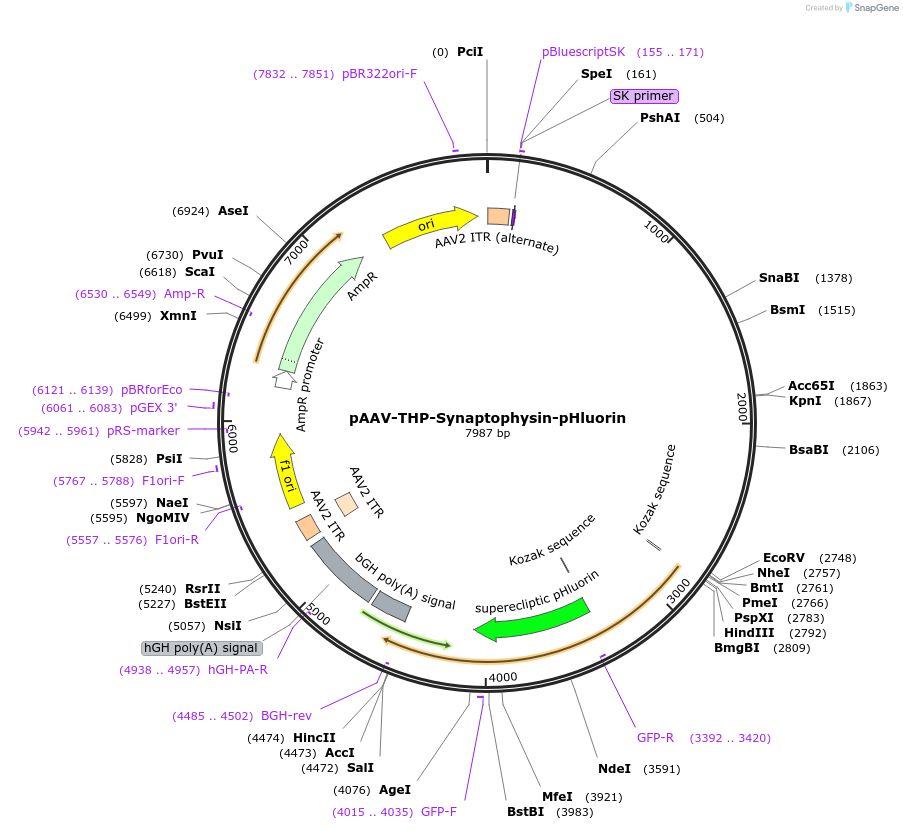
Map uploaded by the depositor.
