


Gαs Inhibitory Probes Kits
(Kit #
1000000287, 1000000288, 1000000289
)
Depositing Lab: Mikel Garcia-Marcos
Kit 1000000287: The Gαs inhibitory probes (pcDNA3.1) kit contains plasmids in a pcDNA3.1 backbone for the expression of constructs containing the Gαs binding peptide 2 (GαsBP2) sequence.
Kit 1000000288: The Gαs inhibitory probes (chemogenetically inducible inhibition) kit contains plasmids for the expression of constructs to achieve chemically-induced inhibition of Gαs by two different approaches: one based on rapamycin and another one based on the plant pheromone abscisic acid (ABA).
Kit 1000000289: The Gαs inhibitory probes (lentiviral constructs) kit contains plasmids in a pLVX backbone compatible with lentiviral packaging for the expression of constructs containing the Gαs binding peptide 2 (GαsBP2) sequence.
These kits will be sent as individual bacterial stabs at room temperature.
Ordering
| Item | Catalog # | Description | Quantity | Price (USD) | ||
|---|---|---|---|---|---|---|
| Kit | 1000000287 | Gαs Inhibitory Probes (pcDNA3.1) Kit | 1 | $423 | Add to Cart | |
| Kit | 1000000288 | Gαs Inhibitory Probes (chemogenetically inducible inhibition) Kit | 1 | $423 | Add to Cart | |
| Kit | 1000000289 | Gαs Inhibitory Probes (lentiviral constructs) Kit | 1 | $423 | Add to Cart | |
Original Publication
Inhibitory probes for spatiotemporal analysis of Gαs protein signaling. Zhao J, Luebbers A, Savransky S, Lin TY, Cheng N, Wilcox A, Janicot R, Green E, Sharma A, Maziarz M, Varelas X, Irannejad R, Vilardaga JP, Garcia-Marcos M. Nat Chem Biol. 2026 Feb 3. doi: 10.1038/s41589-025-02138-1. PubMed (Link opens in a new window) Article (Link opens in a new window)
Description
Kit 1000000287: The Gαs inhibitory probes (pcDNA3.1) kit contains plasmids in a pcDNA3.1 backbone for the expression of constructs containing the Gαs binding peptide 2 (GαsBP2) sequence. These constructs serve as genetically encoded probes that specifically bind the active conformation of Gαs and block its ability to interact with effectors like adenylyl cyclase, thereby preventing G protein signal propagation (Figure 1). The different variants included in this kit include probes that can be targeted to specific subcellular compartments (plasma membrane, endosomes, cytosol) and negative controls consisting of a mutant (W11A) that does not bind to Gαs. All constructs are fusions to the red fluorescent protein mKate2. Together, these constructs provide a versatile platform for studying the spatiotemporal organization of endogenous Gαs signaling.
Kit 1000000288: The Gαs inhibitory probes (chemogenetically inducible inhibition) kit contains plasmids for the expression of constructs to achieve chemically-induced inhibition of Gαs by two different approaches: one based on rapamycin and another one based on the plant hormone abscisic acid (ABA) (Figure 2). Each approach consists of a chemically induced dimerization system of two components expressed in separate plasmids. One component contains the Gαs binding peptide 2 (GαsBP2) sequence, which serves as a genetically encoded probe that specifically binds the active conformation of Gαs and blocks its ability to interact with effectors like adenylyl cyclase. This component is fused to one of two dimerization domains. Upon rapamycin or ABA stimulation, this domain dimerizes with a second domain that is targeted to the plasma membrane and expressed from a separate plasmid. As a consequence, the GαsBP2-containing construct is translocated from the cytosol to the plasma membrane. GαsBP2 is inactive in the cytosol. Once translocated to the plasma membrane, it becomes competent to inhibit Gαs signaling efficiently.
The rapamycin-inducible system is based on the FKBP-FRB pair of domains, whereas the ABA-inducible system is based on the ABIcs–PYLcs pair of domains.
Kit 1000000289: The Gαs inhibitory probes (lentiviral constructs) kit contains plasmids in a pLVX backbone compatible with lentiviral packaging for the expression of constructs containing the Gαs binding peptide 2 (GαsBP2) sequence. These constructs serve as genetically encoded probes that specifically bind the active conformation of Gαs and block its ability to interact with effectors like adenylyl cyclase, thereby preventing G protein signal propagation (Figure 1). The different construct variants included in this kit include probes that can be targeted to specific subcellular compartments (plasma membrane, endosomes, cytosol) and negative controls consisting of a mutant (W11A) that does not bind to Gαs. All constructs are fusions to the red fluorescent protein mKate2. Together, these constructs provide a versatile platform for studying the spatiotemporal organization of endogenous Gαs signaling.
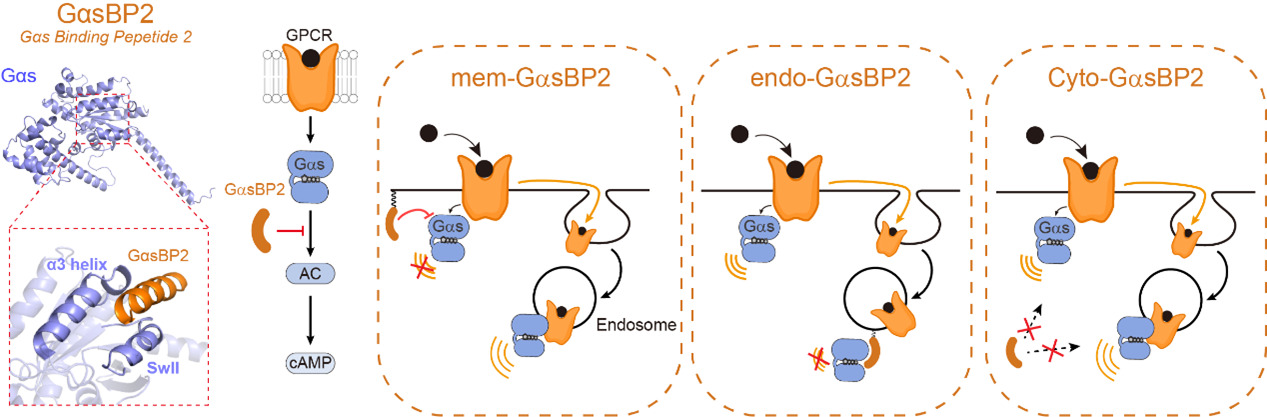
Figure 1: Gαs binding peptide 2 (GαsBP2) is a genetically encoded peptide that specifically binds active Gαs and blocks its interaction with adenylyl cyclase (AC). GαsBP2 specifically targeted to subcellular loci enable the precise modulation of endogenous Gαs signaling within defined cellular compartments.
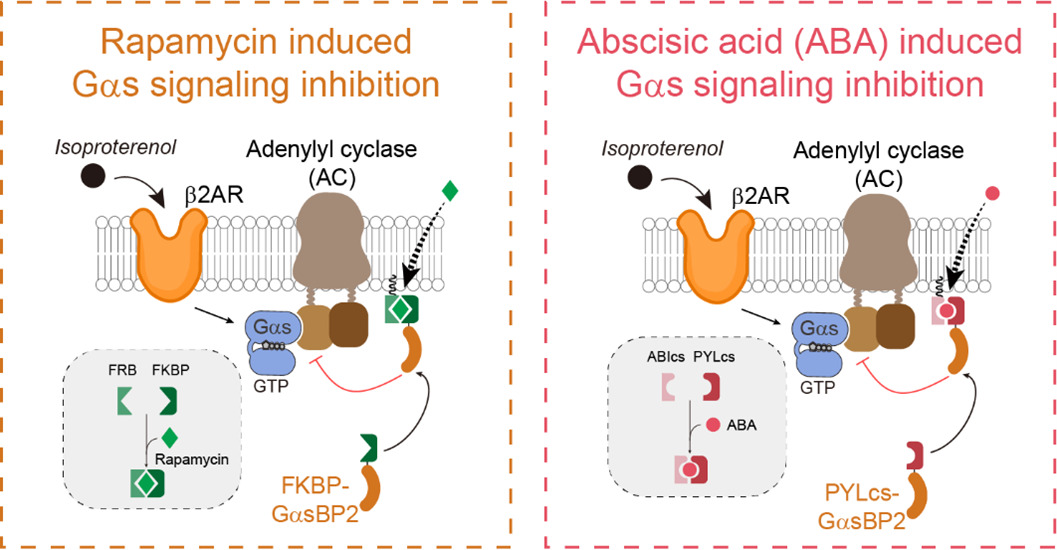
Figure 2: Under resting conditions, GαsBP2 constructs in the cytosol do not affect Gαs signaling. Rapamycin- or ABA-induced recruitment of GαsBP2 from the cytosol to membranes leads to efficient and specific inhibition of Gαs signaling.
How to Cite this Kit
These plasmids were created by your colleagues. Please acknowledge the Principal Investigator, cite the article in which they were created, and include Addgene in the Materials and Methods of your future publications.
For your Materials and Methods section:
"The Gαs Inhibitory Probes (pcDNA3.1) Kit was a gift from Mikel Garcia-Marcos (Addgene kit #1000000287)."
"The Gαs Inhibitory Probes (Chemogenetically Inducible Inhibition) Kit was a gift from Mikel Garcia-Marcos (Addgene kit #1000000288)."
"The Gαs Inhibitory Probes (lentiviral constructs) Kit was a gift from Mikel Garcia-Marcos (Addgene kit #1000000289)."
For your Reference section:
Inhibitory probes for spatiotemporal analysis of Gαs protein signaling. Zhao J, Luebbers A, Savransky S, Lin TY, Cheng N, Wilcox A, Janicot R, Green E, Sharma A, Maziarz M, Varelas X, Irannejad R, Vilardaga JP, Garcia-Marcos M. Nat Chem Biol. 2026 Feb 3. doi: 10.1038/s41589-025-02138-1. PubMed (Link opens in a new window) Article (Link opens in a new window)
The Gαs inhibitory probes (pcDNA3.1) kit contains six plasmids. Please refer to the individual plasmid pages below for more details on each plasmid in this kit:
The Gαs inhibitory probes (chemogenetically inducible inhibition) kit contains four plasmids. Please refer to the individual plasmid pages below for more details on each plasmid in this kit:
The Gαs inhibitory probes (lentiviral constructs) kit contains eight plasmids. Please refer to the individual plasmid pages below for more details on each plasmid in this kit:
- pLVX-CMV-GαsBP2 WT-mKate2-mem-IRES-Hygro
- pLVX-CMV-GαsBP2 WA-mKate2-mem-IRES-Hygro
- pLVX-CMV-mem-GαsBP2 WT-mKate2-IRES-Hygro
- pLVX-CMV-mem-GαsBP2 WA-mKate2-IRES-Hygro
- pLVX-CMV-endo-GαsBP2 WT-mKate2-IRES-Hygro
- pLVX-CMV-endo-GαsBP2 WA-mKate2-IRES-Hygro
- pLVX-CMV-cyto-GαsBP2 WT-mKate2-IRES-Hygro
- pLVX-CMV-cyto-GαsBP2 WA-mKate2-IRES-Hygro